The Atomic Human: AI, Institutions and Corporate Strategy
A Guest Lecture for Global Management and Politics
LUISS Guido Carli, Viale Romania Campus, Rome
Part 1: What AI Is and Isn’t


Information and Embodiment

Embodiment Factors
| bits/min | billions | 2,000 |
|
billion calculations/s |
~100 | a billion |
| embodiment | 20 minutes | 5 billion years |
Communication Bandwidth
- Human communication: walking pace (2000 bits/minute)
- Machine communication: light speed (billions of bits/second)
- Our sharing walks, machine sharing …
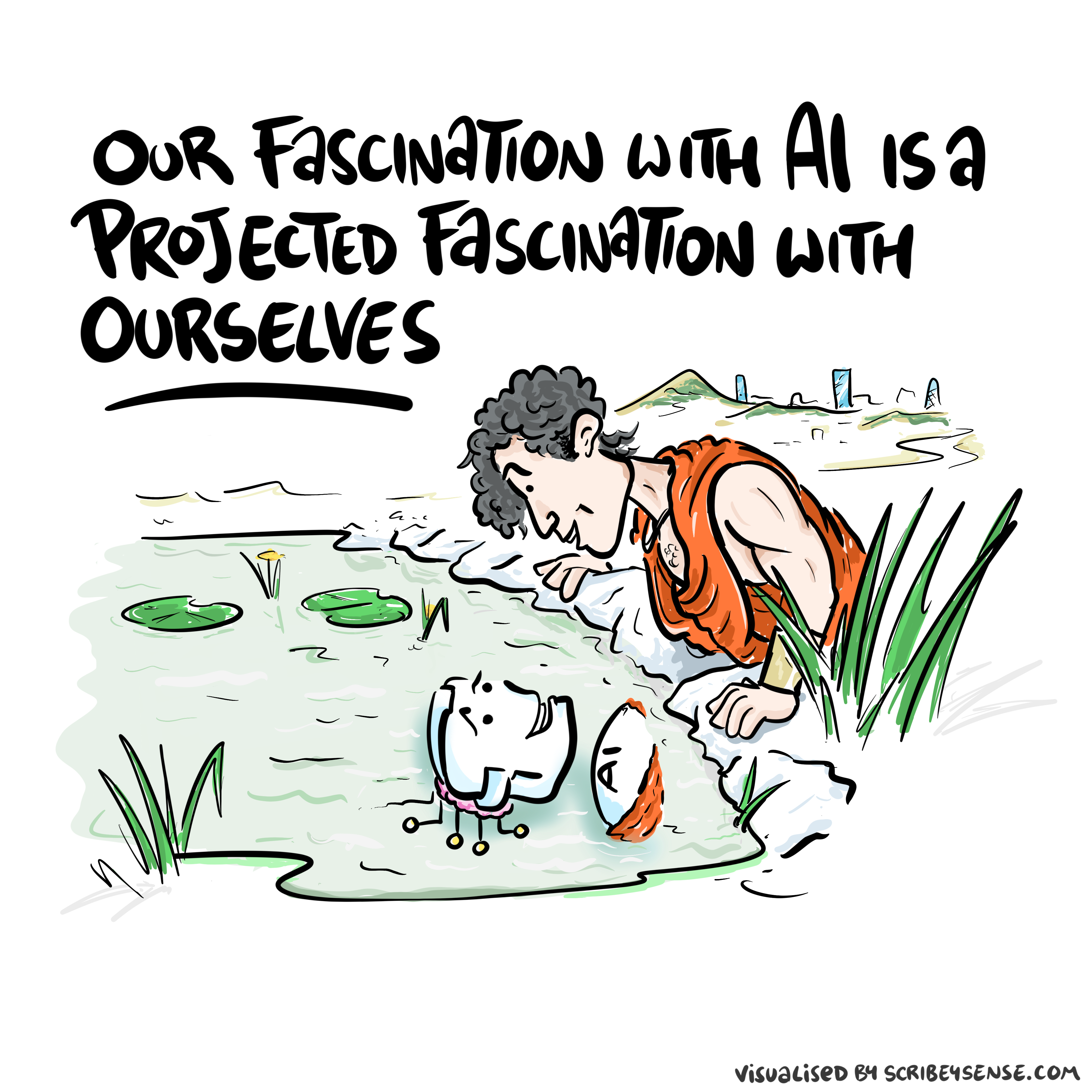

Homo Atomicus
- Where we have homo economicus the machine can step in.
- Quantitative vs Qualitative gap
- Homo atomicus is …
- Not in A-level results
- Not in hospital waiting lists
- In the quality of human interaction
Discussion
Part 2: Information, Institutions and Change

The Attention Economy
- Human intelligence is locked-in
- This makes it a bottleneck
Herbert Simon on Information
What information consumes is rather obvious: it consumes the attention of its recipients. Hence a wealth of information creates a poverty of attention …
Simon (1971)
Institutional Character
Bezos memo to Amazon in 2002
The API Mandate
- All teams will henceforth expose their data and functionality through service interfaces.
- Teams must communicate with each other through these interfaces.
- There will be no other form of inter-process communication allowed: no direct linking, no direct reads of another team’s data store, no shared-memory model, no back-doors whatsoever. The only communication allowed is via service interface calls over the network.
- It doesn’t matter what technology they use.
- All service interfaces, without exception, must be designed from the ground up to be externalizable. That is to say, the team must plan and design to be able to expose the interface to developers in the outside world. No exceptions.
Duality of Corporation and Information
- What is less written about is corporate structure.
- This information infrastructure is reflected in the corporation.
- Two pizza teams with devolved autonomy.
- Bound together through corporate culture.
Conway’s Law
Any organization that designs a system (defined broadly) will produce a design whose structure is a copy of the organization’s communication structure.
Conway (n.d.)
Amazon and Agility
- Company prides itself on agility.
- Operates through a system of devolved autonomy
- Teams have defined inputs and outputs.
- Corporate culture bonds them togethether.
- Customer obsession
- Ownership
Cambridge
- Over 800 years old.
- Less commonly thought of as agile.
- Reliable institutional character.
- Amazon in comparison is more mecurial.
Organisational Data Science
- Claim:
- For data driven decision making to work there must be an interplay between institutional character and the information infrastructure.
Cultural Transplant
- Claim:
- Transplanting another organisation’s decision making infrastructure directly leads cultural rejection from the new host.
How Information Flows in Organisations
Hub-and-Spoke
Peer-to-Peer
Culture and Communication









More Information Topography
Information and Money Flow Together
Training and Culture as Hub
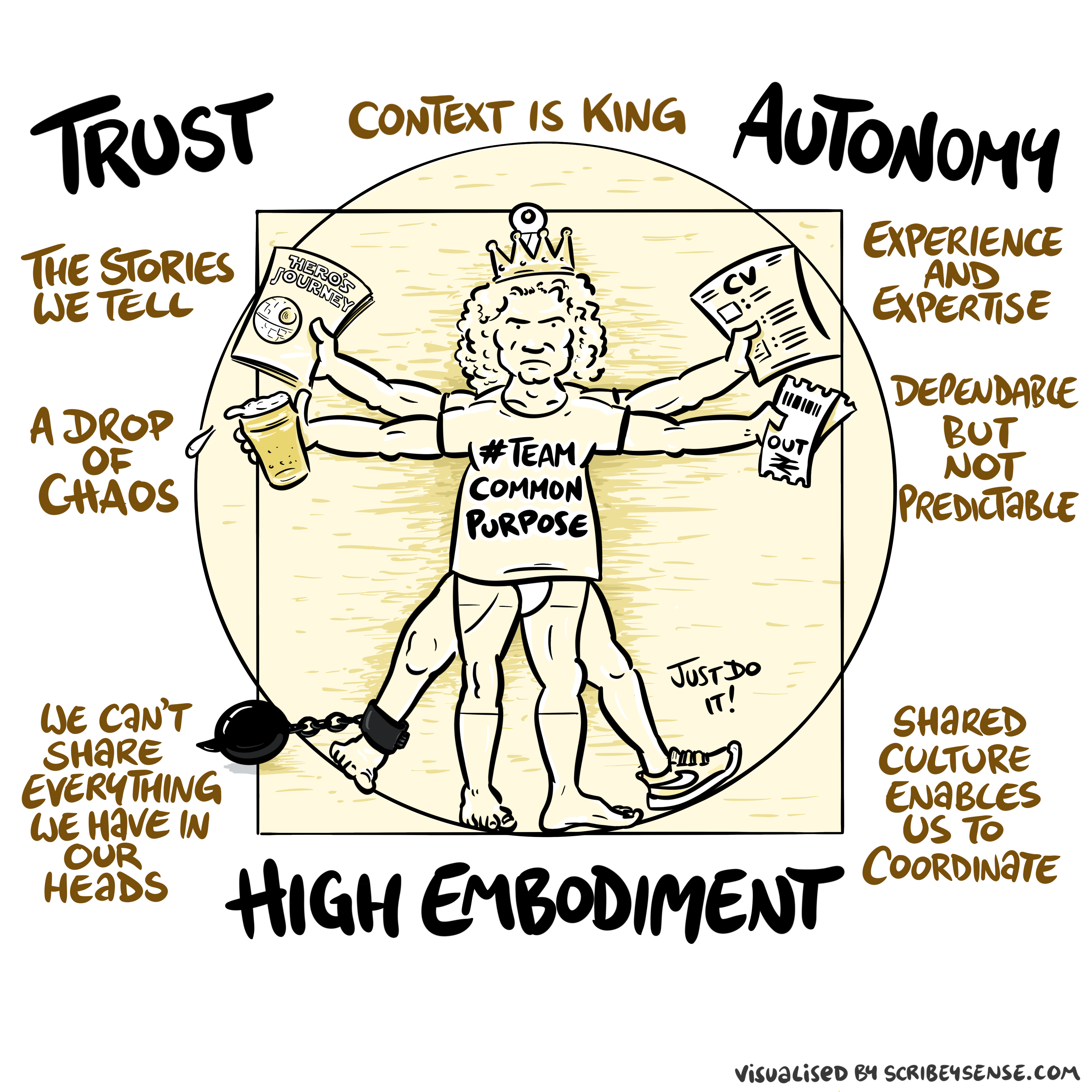
Trust, Autonomy and Embodiment
- Trust is not a slogan
- Trust is an infrastructure
- Autonomy depends on Trust
- Trust depends on shared culture
A Warning: The Horizon Scandal
The Horizon Scandal

Part 3: Strategic Implications
The Productivity Flywheel
Productivity Flywheel
Attention Reinvestment Cycle
Supply Chain of Ideas
- Ideas flow from creation to application like physical supply chains
- Parallels with traditional economic supply chain management
- Particularly relevant for IT and AI solutions
Supply Chain of Ideas
- Current imbalance between supply and demand sides
- Mismatch between macroeconomic interventions and microeconomic need
- Over-Focus on solutionism
- technologies/companies
- Under-focus on real-world needs … disconnect between government and citizens … disconnect between companies and customers
Supply Chain of Ideas
- Need to map idea problems demand to idea supply
- Need to understand … problems (demand) … current “stock” of solutions (supply)
- Requires active management of idea resources
- Shape supply to meet demand

Where Should AI Be Directed?
Wicked Problems
Thanks!
company: Trent AI
book: The Atomic Human
twitter: @lawrennd
The Atomic Human pages atomic human, the 13 , baby shoes 368, topography, information 34-9, 43-8, 57, 62, 104, 115-16, 127, 140, 192, 196, 199, 291, 334, 354-5, anthropomorphization (‘anthrox’) 30-31, 90-91, 93-4, 100, 132, 148, 153, 163, 216-17, 239, 276, 326, 342, Blake, William Newton 121–123, Blake, William Newton 121–123, 258, 260, 283, 284, 301, 306, Michelangelo, The Creation of Adam 7-9, 31, 91, 105–106, 121, 153, 206, 216, 350, Blake, William Elohim Creating Adam 121, 217–18, trust 43, 79, 100, embodiment factor 13, 29, 35, 79, 87, 105, 197, 216-217, 249, 269, 327, 353, 363, 369, topography, information 34-9, 43-8, 57, 62, 104, 115-16, 127, 140, 192, 196, 199, 291, 334, 354-5, Horizon scandal 371.
newspaper: Guardian Profile Page
blog posts:
Dan Andrews image of our reflective obsession with AI
Dan Andrews image from Chapter 3