The Atomic Human
Abstract
It seems that wherever we look, on TV, on the internet, or in newspapers, people are telling us how they are using AI to give us better experiences but are they? What does that mean? Is it safe? Should we be concerned?
Artificial Intelligence refers to the ability of machines to perform tasks that typically require human intelligence. This includes capabilities like learning, problem-solving, decision-making, and perception but, as generative AI reshapes the technology landscape, we face fundamental questions about human-machine interaction.
In this talk I’ll discuss the limitations of artificial intelligence, why I find the notion of artificial general intelligence absurd, and how there’s a part of us that can never be replaced by the machine.
This talk is based on my book, The Atomic Human, published with Allen Lane.
Introduction
Welcome to the CSES/ARU Christmas Lectures! Today we’re going to talk about artificial intelligence, but not in the way you might expect. Rather than focusing on what computers can do, we’re going to focus on what makes us uniquely human.
You’ve probably heard a lot about AI recently. It’s everywhere: in your phones, in your apps, in the news. Some people say it will solve all our problems. Others worry it will take over the world. But to understand AI, we first need to understand ourselves.
Henry Ford’s Faster Horse


Figure: A 1925 Ford Model T built at Henry Ford’s Highland Park Plant in Dearborn, Michigan. This example now resides in Australia, owned by the founder of FordModelT.net. From https://commons.wikimedia.org/wiki/File:1925_Ford_Model_T_touring.jpg
It’s said that Henry Ford’s customers wanted a “a faster horse.” If Henry Ford was selling us artificial intelligence today, what would the customer call for, “a smarter human?” That’s certainly the picture of machine intelligence we find in science fiction narratives, but the reality of what we’ve developed is much more mundane.
Car engines produce prodigious power from petrol. Machine intelligences deliver decisions derived from data. In both cases the scale of consumption enables a speed of operation that is far beyond the capabilities of their natural counterparts. Unfettered energy consumption has consequences in the form of climate change. Does unbridled data consumption also have consequences for us?
If we devolve decision making to machines, we depend on those machines to accommodate our needs. If we don’t understand how those machines operate, we lose control over our destiny. Our mistake has been to see machine intelligence as a reflection of our intelligence. We cannot understand the smarter human without understanding the human. To understand the machine, we need to better understand ourselves.
What Kind of Intelligence Are We Creating?
Artificial General Vehicle
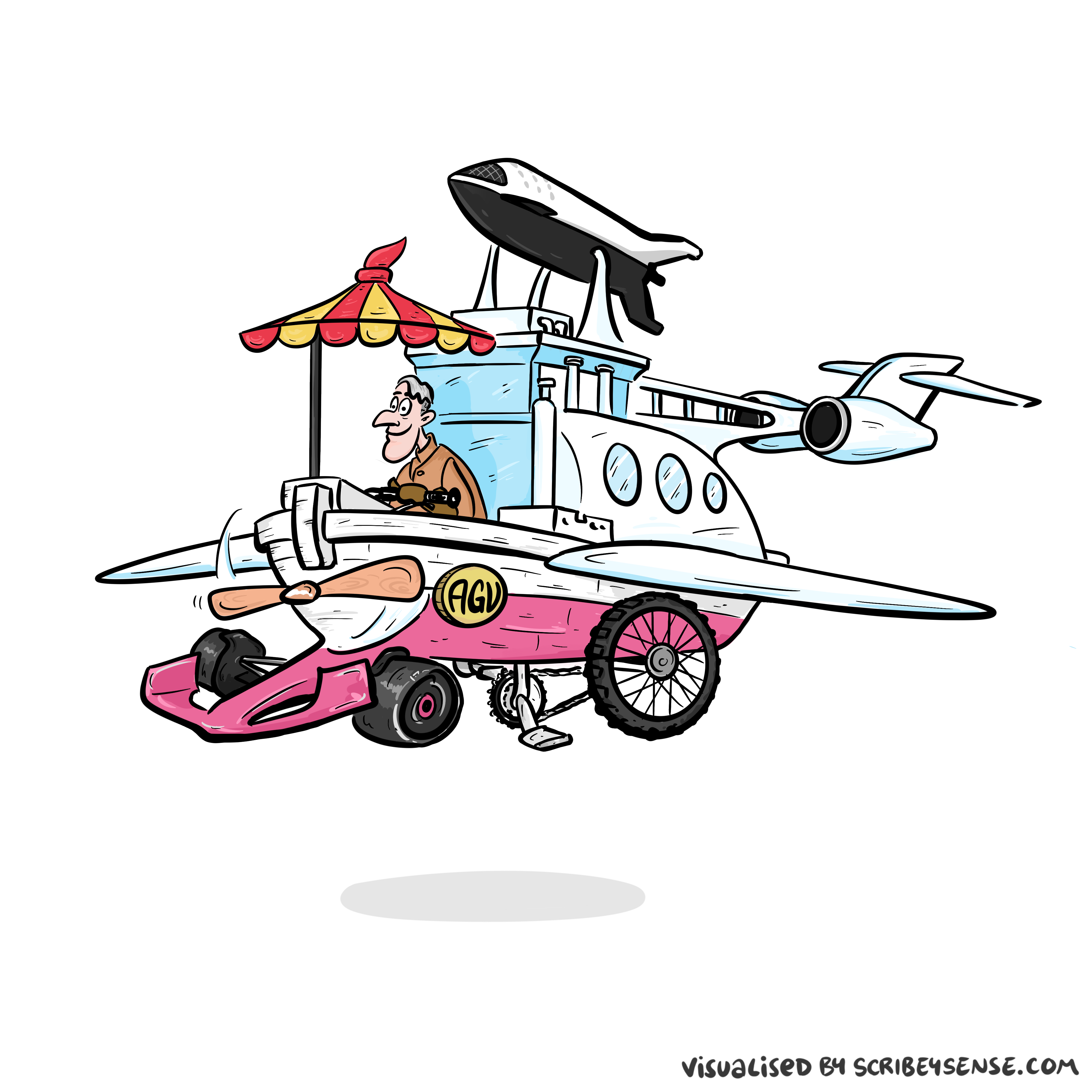
Figure: The notion of artificial general intelligence is as absurd as the notion of an artificial general vehicle - no single vehicle is optimal for every journey. (Illustration by Dan Andrews inspired by a conversation about “The Atomic Human” Lawrence (2024))
This illustration was created by Dan Andrews inspired by a conversation about “The Atomic Human” book. The drawing emerged from discussions with Dan about the flawed concept of artificial general intelligence and how it parallels the absurd idea of a single vehicle optimal for all journeys. The vehicle itself is inspired by shared memories of Professor Pat Pending in Hanna Barbera’s Wacky Races.
I often turn up to talks with my Brompton bicycle. Embarrassingly I even took it to Google which is only a 30 second walk from King’s Cross station. That made me realise it’s become a sort of security blanket. I like having it because it’s such a flexible means of transport.
But is the Brompton an “artificial general vehicle?” A vehicle that can do everything? Unfortunately not, for example it’s not very good for flying to the USA. There is no artificial general vehicle that is optimal for every journey. Similarly there is no such thing as artificial general intelligence. The idea is artificial general nonsense.
That doesn’t mean there aren’t different principles to intelligence we can look at. Just like vehicles have principles that apply to them. When designing vehicles we need to think about air resistance, friction, power. We have developed solutions such as wheels, different types of engines and wings that are deployed across different vehicles to achieve different results.
Intelligence is similar. The notion of artificial general intelligence is fundamentally eugenic. It builds on Spearman’s term “general intelligence” which is part of a body of literature that was looking to assess intelligence in the way we assess height. The objective then being to breed greater intelligences (Lyons, 2022).
This is one of my favourite examples because it shows why the term “Artificial General Intelligence” or AGI doesn’t really make sense. Just as there’s no vehicle that’s perfect for every journey, there’s no intelligence that’s perfect for every problem.
The Atomic Eye
The Atomic Human
Figure: The Atomic Eye, by slicing away aspects of the human that we used to believe to be unique to us, but are now the preserve of the machine, we learn something about what it means to be human.
The development of what some are calling intelligence in machines, raises questions around what machine intelligence means for our intelligence. The idea of the atomic human is derived from Democritus’s atomism.
In the fifth century bce the Greek philosopher Democritus posed a question about our physical universe. He imagined cutting physical matter into pieces in a repeated process: cutting a piece, then taking one of the cut pieces and cutting it again so that each time it becomes smaller and smaller. Democritus believed this process had to stop somewhere, that we would be left with an indivisible piece. The Greek word for indivisible is atom, and so this theory was called atomism.
The Atomic Human considers the same question, but in a different domain, asking: As the machine slices away portions of human capabilities, are we left with a kernel of humanity, an indivisible piece that can no longer be divided into parts? Or does the human disappear altogether? If we are left with something, then that uncuttable piece, a form of atomic human, would tell us something about our human spirit.
See Lawrence (2024) atomic human, the p. 13.
How Are We Different from Machines?
To understand what makes us special, let me tell you a story about a remarkable man named Jean-Dominique Bauby.
The Diving Bell and the Butterfly
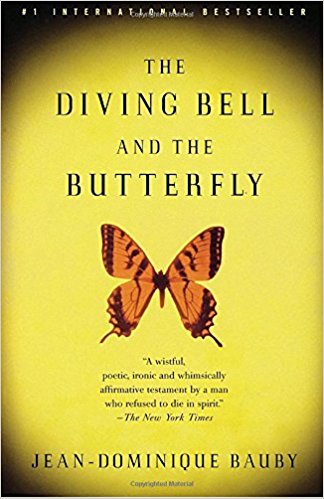
Figure: The Diving Bell and the Buttefly is the autobiography of Jean Dominique Bauby.
The Diving Bell and the Butterfly is the autobiography of Jean Dominique Bauby. Jean Dominique, the editor of French Elle magazine, suffered a major stroke at the age of 43 in 1995. The stroke paralyzed him and rendered him speechless. He was only able to blink his left eyelid, he became a sufferer of locked in syndrome.
See Lawrence (2024) Le Scaphandre et le papillon (The Diving Bell and the Butterfly) p. 10–12.
O M D P C F B V
H G J Q Z Y X K W
Figure: The ordering of the letters that Bauby used for writing his autobiography.
How could he do that? Well, first, they set up a mechanism where he could scan across letters and blink at the letter he wanted to use. In this way, he was able to write each letter.
It took him 10 months of four hours a day to write the book. Each word took two minutes to write.
Imagine doing all that thinking, but so little speaking, having all those thoughts and so little ability to communicate.
One challenge for the atomic human is that we are all in that situation. While not as extreme as for Bauby, when we compare ourselves to the machine, we all have a locked-in intelligence.

Figure: Jean Dominique Bauby was the Editor in Chief of the French Elle Magazine, he suffered a stroke that destroyed his brainstem, leaving him only capable of moving one eye. Jean Dominique became a victim of locked in syndrome.
Incredibly, Jean Dominique wrote his book after he became locked in. It took him 10 months of four hours a day to write the book. Each word took two minutes to write.
The idea behind embodiment factors is that we are all in that situation. While not as extreme as for Bauby, we all have somewhat of a locked in intelligence.
See Lawrence (2024) Bauby, Jean Dominique p. 9–11, 18, 90, 99-101, 133, 186, 212–218, 234, 240, 251–257, 318, 368–369.
Bauby and Shannon
|
|
|
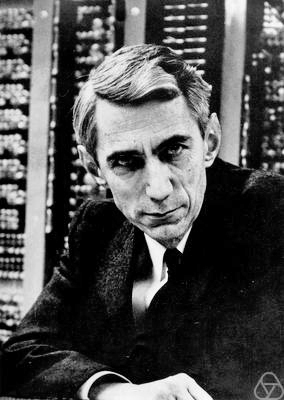
Figure: Claude Shannon developed information theory which allows us to quantify how much Bauby can communicate. This allows us to compare how locked in he is to us.
See Lawrence (2024) Shannon, Claude p. 10, 30, 61, 74, 98, 126, 134, 140, 143, 149, 260, 264, 269, 277, 315, 358, 363.
The Embodiment Factor
Embodiment Factors
|
|
|||
| bits/min | billions | 2000 | 6 |
|
billion calculations/s |
~100 | a billion | a billion |
| embodiment | 20 minutes | 5 billion years | 15 trillion years |
Figure: Embodiment factors are the ratio between our ability to compute and our ability to communicate. Jean Dominique Bauby suffered from locked-in syndrome. The embodiment factors show that relative to the machine we are also locked in. In the table we represent embodiment as the length of time it would take to communicate one second’s worth of computation. For computers it is a matter of minutes, but for a human, whether locked in or not, it is a matter of many millions of years.
Let me explain what I mean. Claude Shannon introduced a mathematical concept of information for the purposes of understanding telephone exchanges.
Information has many meanings, but mathematically, Shannon defined a bit of information to be the amount of information you get from tossing a coin.
If I toss a coin, and look at it, I know the answer. You don’t. But if I now tell you the answer I communicate to you 1 bit of information. Shannon defined this as the fundamental unit of information.
If I toss the coin twice, and tell you the result of both tosses, I give you two bits of information. Information is additive.
Shannon also estimated the average information associated with the English language. He estimated that the average information in any word is 12 bits, equivalent to twelve coin tosses.
So every two minutes Bauby was able to communicate 12 bits, or six bits per minute.
This is the information transfer rate he was limited to, the rate at which he could communicate.
Compare this to me, talking now. The average speaker for TEDX speaks around 160 words per minute. That’s 320 times faster than Bauby or around a 2000 bits per minute. 2000 coin tosses per minute.
But, just think how much thought Bauby was putting into every sentence. Imagine how carefully chosen each of his words was. Because he was communication constrained he could put more thought into each of his words. Into thinking about his audience.
So, his intelligence became locked in. He thinks as fast as any of us, but can communicate slower. Like the tree falling in the woods with no one there to hear it, his intelligence is embedded inside him.
Two thousand coin tosses per minute sounds pretty impressive, but this talk is not just about us, it’s about our computers, and the type of intelligence we are creating within them.
So how does two thousand compare to our digital companions? When computers talk to each other, they do so with billions of coin tosses per minute.
Let’s imagine for a moment, that instead of talking about communication of information, we are actually talking about money. Bauby would have 6 dollars. I would have 2000 dollars, and my computer has billions of dollars.
The internet has interconnected computers and equipped them with extremely high transfer rates.
However, by our very best estimates, computers actually think slower than us.
How can that be? You might ask, computers calculate much faster than me. That’s true, but underlying your conscious thoughts there are a lot of calculations going on.
Each thought involves many thousands, millions or billions of calculations. How many exactly, we don’t know yet, because we don’t know how the brain turns calculations into thoughts.
Our best estimates suggest that to simulate your brain a computer would have to be as large as the UK Met Office machine here in Exeter. That’s a 250 million pound machine, the fastest in the UK. It can do 16 billion billon calculations per second.
It simulates the weather across the word every day, that’s how much power we think we need to simulate our brains.
So, in terms of our computational power we are extraordinary, but in terms of our ability to explain ourselves, just like Bauby, we are locked in.
For a typical computer, to communicate everything it computes in one second, it would only take it a couple of minutes. For us to do the same would take 15 billion years.
If intelligence is fundamentally about processing and sharing of information. This gives us a fundamental constraint on human intelligence that dictates its nature.
I call this ratio between the time it takes to compute something, and the time it takes to say it, the embodiment factor (Lawrence, 2017). Because it reflects how embodied our cognition is.
If it takes you two minutes to say the thing you have thought in a second, then you are a computer. If it takes you 15 billion years, then you are a human.
This is what I call being “locked in.” Jean-Dominique Bauby was physically locked in due to his condition, but in a sense, all of us are locked in compared to machines. We think incredibly fast - your brain is doing billions of calculations every second - but we communicate relatively slowly.
Machines are the opposite. They don’t think as deeply as we do, but they can share information incredibly quickly. That’s why the internet feels so powerful - it’s connecting machines that can share information at billions of bits per second.
The Real Conversation
Bandwidth Constrained Conversations
Figure: Conversation relies on internal models of other individuals.
Figure: Misunderstanding of context and who we are talking to leads to arguments.
Embodiment factors imply that, in our communication between humans, what is not said is, perhaps, more important than what is said. To communicate with each other we need to have a model of who each of us are.
To aid this, in society, we are required to perform roles. Whether as a parent, a teacher, an employee or a boss. Each of these roles requires that we conform to certain standards of behaviour to facilitate communication between ourselves.
Control of self is vitally important to these communications.
The high availability of data available to humans undermines human-to-human communication channels by providing new routes to undermining our control of self.
The consequences between this mismatch of power and delivery are to be seen all around us. Because, just as driving an F1 car with bicycle wheels would be a fine art, so is the process of communication between humans.
If I have a thought and I wish to communicate it, I first need to have a model of what you think. I should think before I speak. When I speak, you may react. You have a model of who I am and what I was trying to say, and why I chose to say what I said. Now we begin this dance, where we are each trying to better understand each other and what we are saying. When it works, it is beautiful, but when mis-deployed, just like a badly driven F1 car, there is a horrible crash, an argument.
Think about your conversations with friends. They’re not just about exchanging information - they’re about understanding, empathy, shared experiences. That’s something that’s uniquely human and incredibly difficult for machines to replicate.
Computer Conversations
Figure: Conversation relies on internal models of other individuals.
Figure: Misunderstanding of context and who we are talking to leads to arguments.
Similarly, we find it difficult to comprehend how computers are making decisions. Because they do so with more data than we can possibly imagine.
In many respects, this is not a problem, it’s a good thing. Computers and us are good at different things. But when we interact with a computer, when it acts in a different way to us, we need to remember why.
Just as the first step to getting along with other humans is understanding other humans, so it needs to be with getting along with our computers.
Embodiment factors explain why, at the same time, computers are so impressive in simulating our weather, but so poor at predicting our moods. Our complexity is greater than that of our weather, and each of us is tuned to read and respond to one another.
Their intelligence is different. It is based on very large quantities of data that we cannot absorb. Our computers don’t have a complex internal model of who we are. They don’t understand the human condition. They are not tuned to respond to us as we are to each other.
Embodiment factors encapsulate a profound thing about the nature of humans. Our locked in intelligence means that we are striving to communicate, so we put a lot of thought into what we’re communicating with. And if we’re communicating with something complex, we naturally anthropomorphize them.
We give our dogs, our cats, and our cars human motivations. We do the same with our computers. We anthropomorphize them. We assume that they have the same objectives as us and the same constraints. They don’t.
This means, that when we worry about artificial intelligence, we worry about the wrong things. We fear computers that behave like more powerful versions of ourselves that will struggle to outcompete us.
In reality, the challenge is that our computers cannot be human enough. They cannot understand us with the depth we understand one another. They drop below our cognitive radar and operate outside our mental models.
The real danger is that computers don’t anthropomorphize. They’ll make decisions in isolation from us without our supervision because they can’t communicate truly and deeply with us.
The New Flow of Information
New Flow of Information
Classically the field of statistics focused on mediating the relationship between the machine and the human. Our limited bandwidth of communication means we tend to over-interpret the limited information that we are given, in the extreme we assign motives and desires to inanimate objects (a process known as anthropomorphizing). Much of mathematical statistics was developed to help temper this tendency and understand when we are valid in drawing conclusions from data.
Figure: The trinity of human, data, and computer, and highlights the modern phenomenon. The communication channel between computer and data now has an extremely high bandwidth. The channel between human and computer and the channel between data and human is narrow. New direction of information flow, information is reaching us mediated by the computer. The focus on classical statistics reflected the importance of the direct communication between human and data. The modern challenges of data science emerge when that relationship is being mediated by the machine.
Data science brings new challenges. In particular, there is a very large bandwidth connection between the machine and data. This means that our relationship with data is now commonly being mediated by the machine. Whether this is in the acquisition of new data, which now happens by happenstance rather than with purpose, or the interpretation of that data where we are increasingly relying on machines to summarize what the data contains. This is leading to the emerging field of data science, which must not only deal with the same challenges that mathematical statistics faced in tempering our tendency to over interpret data but must also deal with the possibility that the machine has either inadvertently or maliciously misrepresented the underlying data.
The world has changed dramatically in recent years. We now live in a world where machines mediate much of our communication and decision-making. Understanding this new flow of information is crucial for understanding both AI and ourselves.
Our Data, Our Intelligence
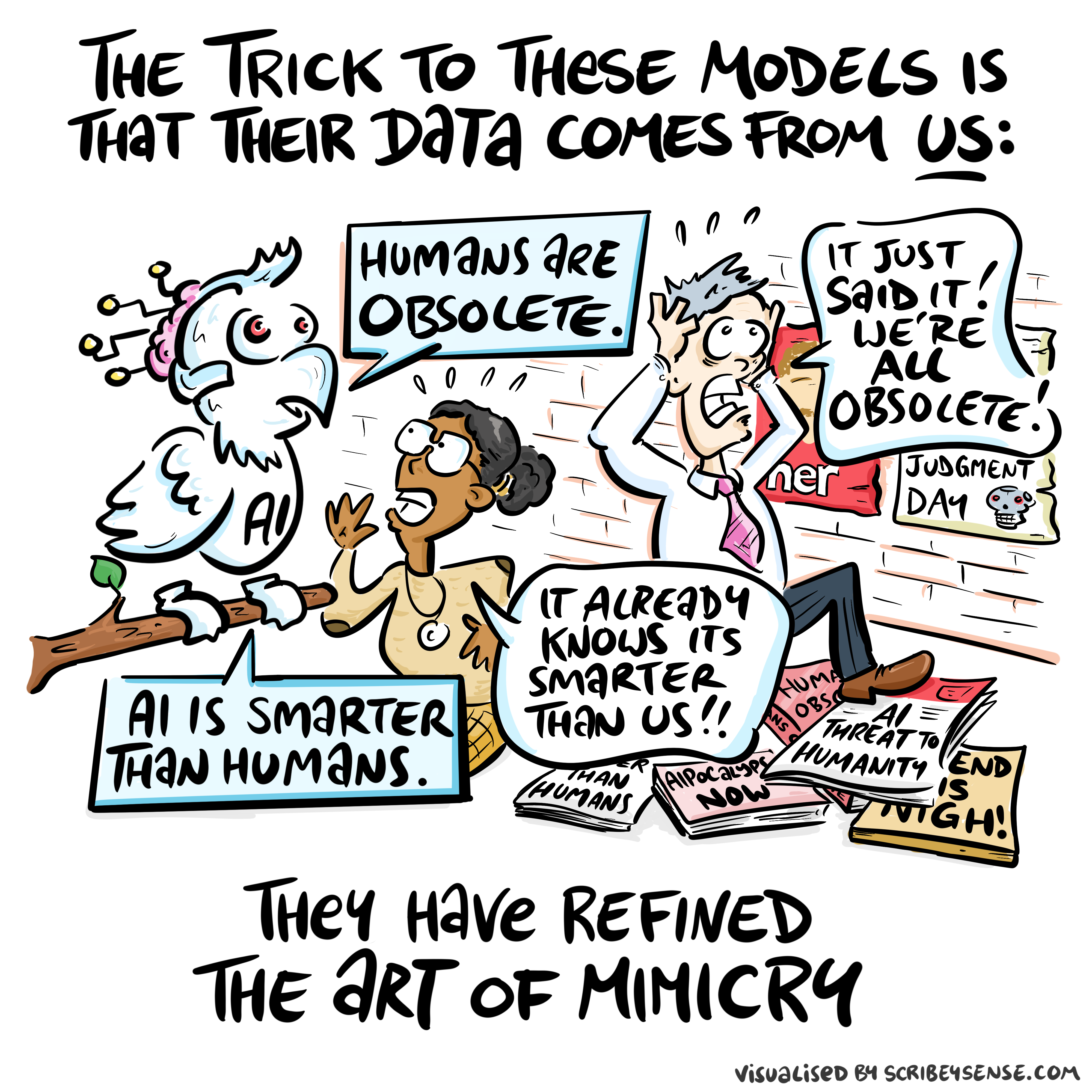
Figure: The nature of digital communication has changed dramatically, with machines processing vast amounts of human-generated data and feeding it back to us in ways that can distort our information landscape. (Illustration by Dan Andrews inspired by Chapter 5 “Enlightenment” of “The Atomic Human” Lawrence (2024))
This illustration was created by Dan Andrews after reading Chapter 5 “Enlightenment” of “The Atomic Human” book. The chapter examines how machine learning models like GPTs ingest vast amounts of human-created data and then reflect modified versions back to us. The drawing celebrates the stochastic parrots paper by Bender et al. (2021) while also capturing how this feedback loop of information can distort our digital discourse.
See blog post on Two Types of Stochastic Parrots.
See blog post on Two Types of Stochastic Parrots.
The stochastic parrots paper (Bender et al., 2021) was the moment that the research community, through a group of brave researchers, some of whom paid with their jobs, raised the first warnings about these technologies. Despite their bravery, at least in the UK, their voices and those of many other female researchers were erased from the public debate around AI.
Their voices were replaced by a different type of stochastic parrot, a group of “fleshy GPTs” that speak confidently and eloquently but have little experience of real life and make arguments that, for those with deeper knowledge are flawed in naive and obvious ways.
The story is a depressing reflection of a similar pattern that undermined the UK computer industry Hicks (2018).
We all have a tendency to fall into the trap of becoming fleshy GPTs, and the best way to prevent that happening is to gather diverse voices around ourselves and take their perspectives seriously even when we might instinctively disagree.
Sunday Times article “Our lives may be enhanced by AI, but Big Tech just sees dollar signs” Times article “Don’t expect AI to just fix everything, professor warns”
Here’s something really important to understand: these AI systems seem intelligent, but their “intelligence” comes from us. They learn from human-created data, human-written text, human-taken photos. In a sense, they’re mirrors reflecting back our own intelligence.
The Human Touch
A Six Word Novel

Figure: Consider the six-word novel, apocryphally credited to Ernest Hemingway, “For sale: baby shoes, never worn.” To understand what that means to a human, you need a great deal of additional context. Context that is not directly accessible to a machine that has not got both the evolved and contextual understanding of our own condition to realize both the implication of the advert and what that implication means emotionally to the previous owner.
See Lawrence (2024) baby shoes p. 368.
But this is a very different kind of intelligence than ours. A computer cannot understand the depth of the Ernest Hemingway’s apocryphal six-word novel: “For Sale, Baby Shoes, Never worn,” because it isn’t equipped with that ability to model the complexity of humanity that underlies that statement.
This is one of my favourite examples of what makes us uniquely human, our ability to understand context, emotion, and meaning with just a few words.
When Things Go Wrong
Understanding AI isn’t just about the technology, it’s about understanding what happens when we deploy digital systems without proper thought. Let me show you two examples from recent history that demonstrate why we need to be careful.
The Horizon Scandal
In the UK we saw these effects play out in the Horizon scandal: the accounting system of the national postal service was computerized by Fujitsu and first installed in 1999, but neither the Post Office nor Fujitsu were able to control the system they had deployed. When it went wrong individual sub postmasters were blamed for the systems’ errors. Over the next two decades they were prosecuted and jailed leaving lives ruined in the wake of the machine’s mistakes.

See Lawrence (2024) Horizon scandal p. 371.
The Horizon scandal is a stark reminder that when we trust automated systems without understanding them, real people suffer real consequences. Over 700 sub-postmasters were prosecuted, some went to prison, lives were destroyed, all because the computer system made errors and people assumed the computer must be right.
This happened because of what I call the “computer says no” problem. We often trust computers more than we should, assuming they can’t make mistakes. But computers only do what they’re programmed to do, and if that programming is flawed, or if the system has bugs, the results can be devastating.
2016 US Elections
In the US the 2016 elections saw manipulation through social media and the Russian troll farm, the Internet Research Agency.


See Lawrence (2024) Cambridge Analytica p. 371.
Trust, Autonomy, and Embodiment
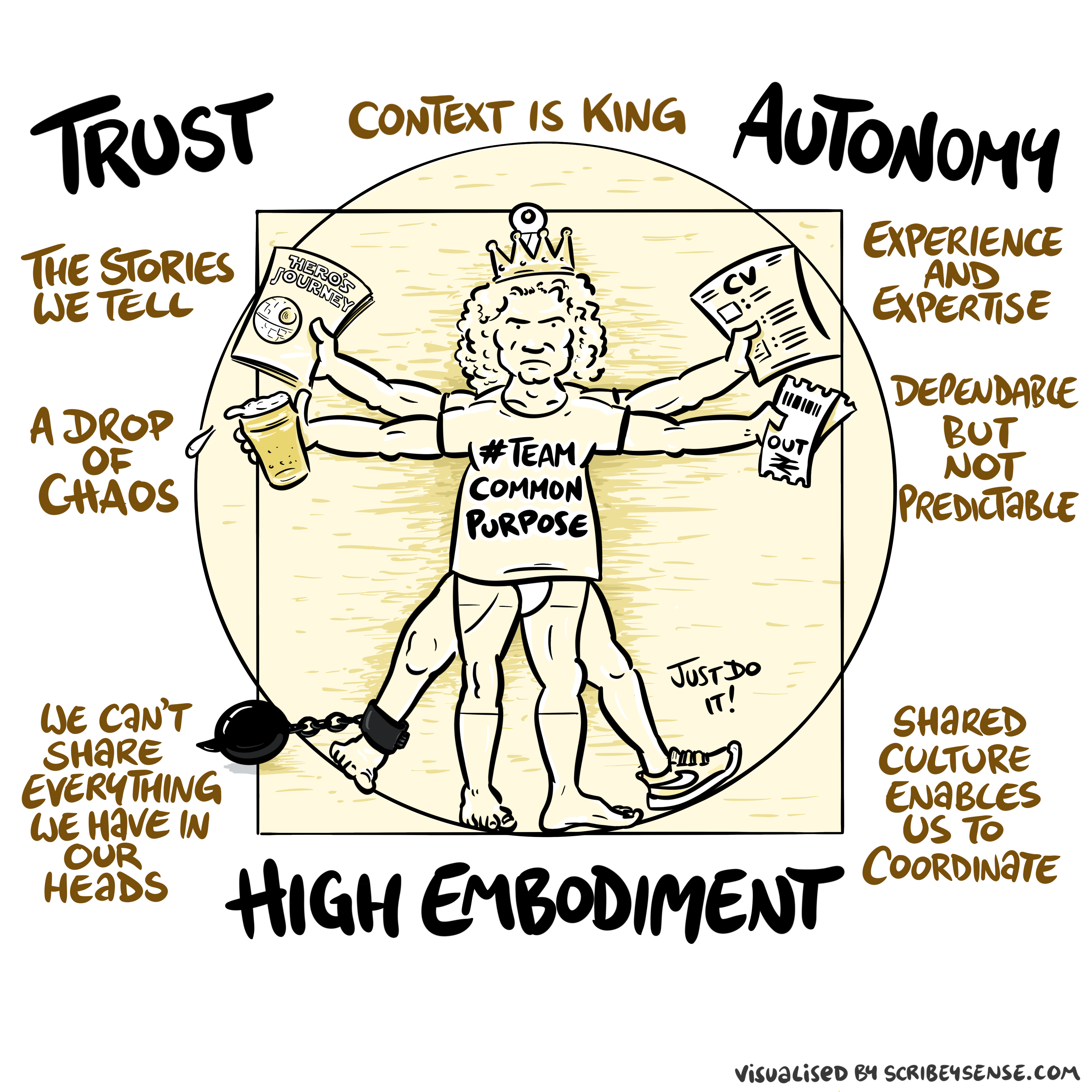
Figure: The relationships between trust, autonomy and embodiment are key to understanding how to properly deploy AI systems in a way that avoids digital autocracy. (Illustration by Dan Andrews inspired by Chapter 3 “Intent” of “The Atomic Human” Lawrence (2024))
This illustration was created by Dan Andrews after reading Chapter 3 “Intent” of “The Atomic Human” book. The chapter explores the concept of intent in AI systems and how trust, autonomy, and embodiment interact to shape our relationship with technology. Dan’s drawing captures these complex relationships and the balance needed for responsible AI deployment.
See blog post on Dan Andrews image from Chapter 3.
See blog post on Dan Andrews image from Chapter 3..
These three concepts - trust, autonomy, and embodiment - are central to understanding the relationship between humans and machines. We need to think carefully about when we should trust machines, what autonomy we should give them, and how their lack of embodiment affects their decision-making.
What Does the Public Think?
In 2017, I was part of a Royal Society working group looking at machine learning. We did something that many technical groups don’t do: we actually asked members of the public what they thought. We ran public dialogues with people from all walks of life, not experts, just regular people.
Royal Society Report
Figure: The Royal Society report on Machine Learning was released on 25th April 2017
A useful reference for state of the art in machine learning is the UK Royal Society Report, Machine Learning: Power and Promise of Computers that Learn by Example.
See Lawrence (2024) Royal Society; machine learning review and p. 25, 321, 395.
Public Research
Figure: The Royal Society comissioned public research from Mori as part of the machine learning review.
As is often the cas when members of the public are well convened, they offered sensible opinions about the utility and challenges of machine learning methods.
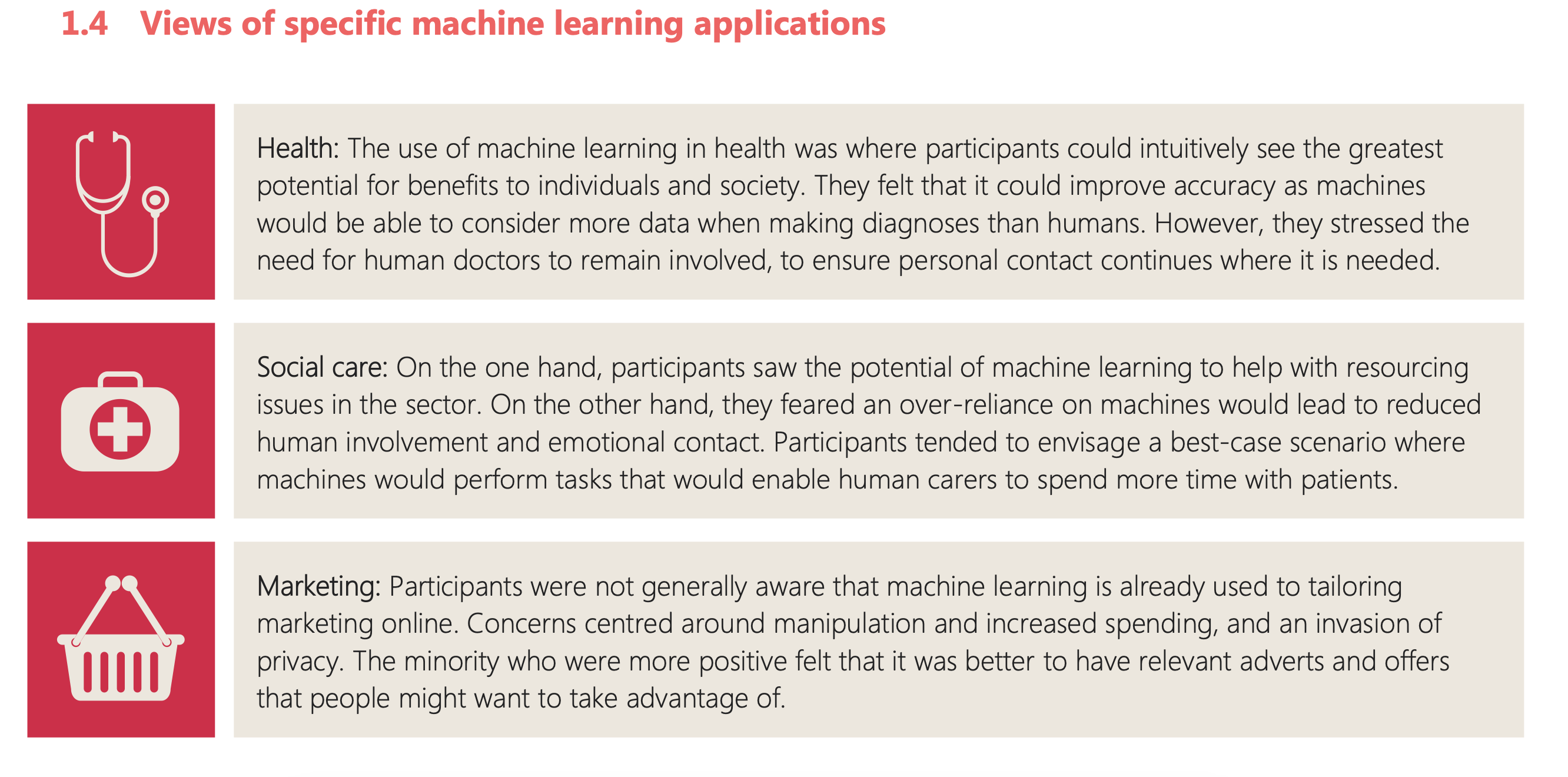
Figure: One of the questions focussed on machine learning applications.
A range of different scenaios were captured by this qualitative work.
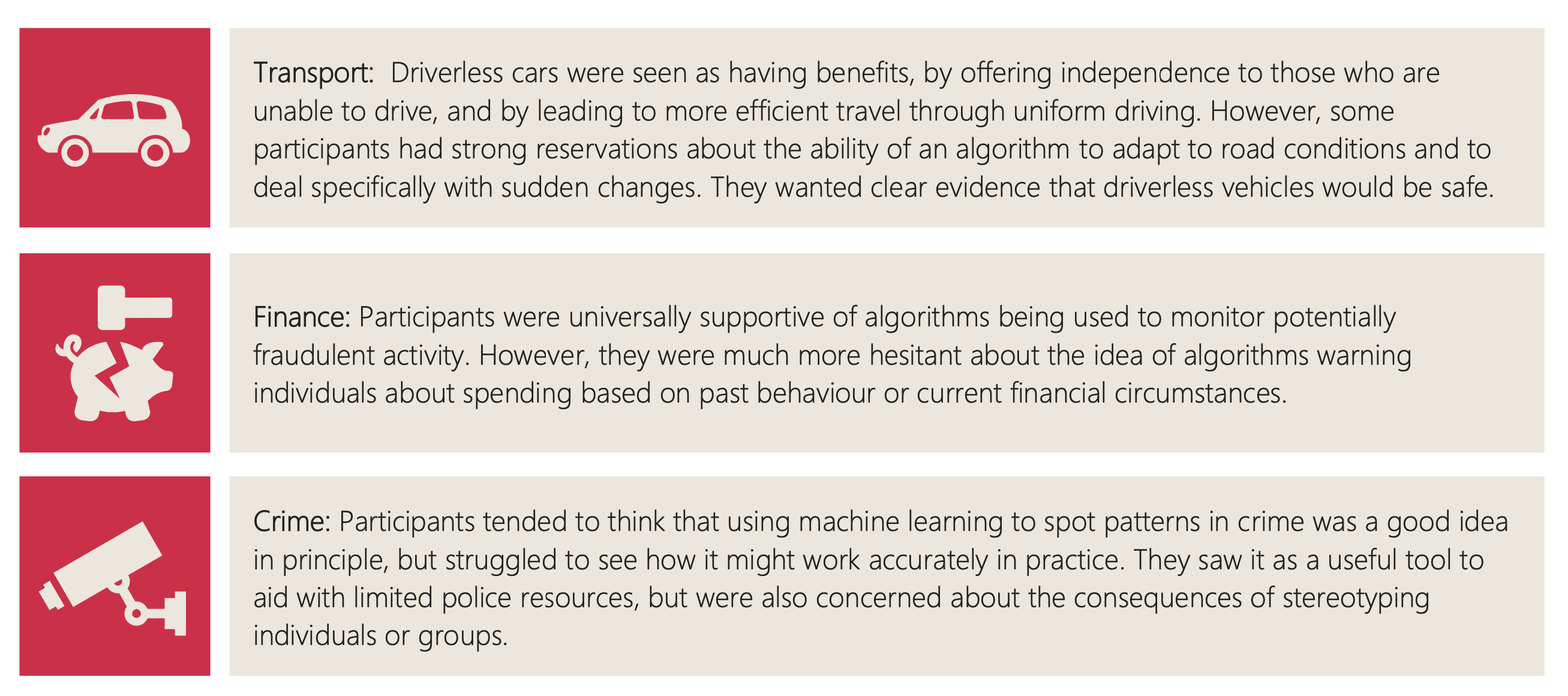
Figure: The public were broadly supportive of a range of application areas.
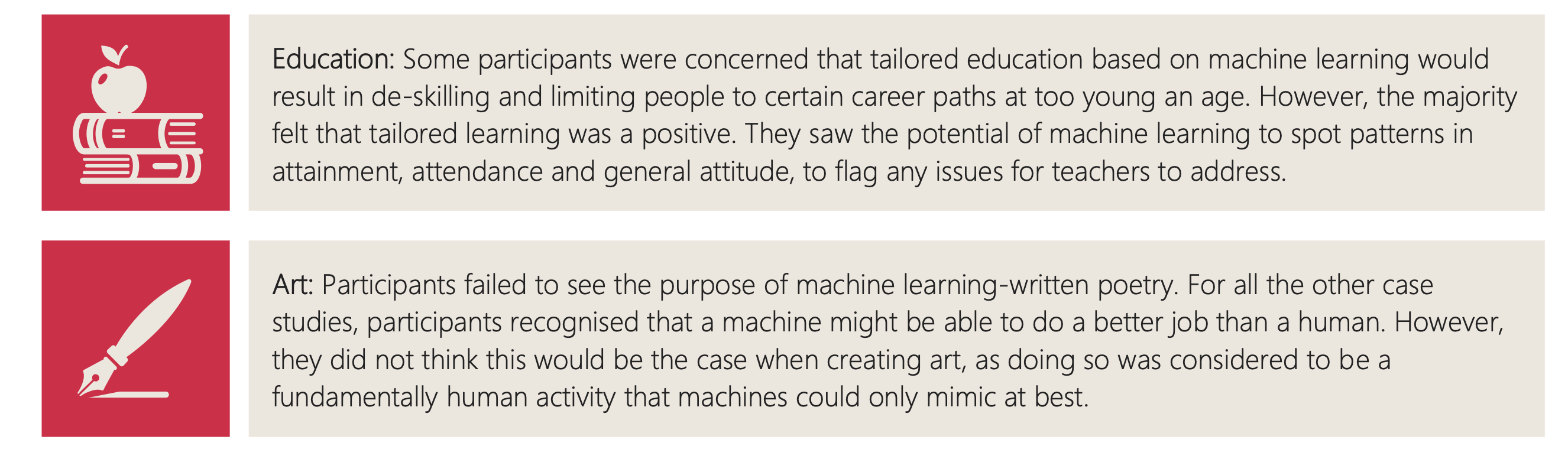
Figure: But they failed to see the point in AI’s that could produce poetry.
The one scenario where the public were unable to perceive any advantage in machine learning was an example from art, the creation of poetry. This was felt to be a fundamentally human activity that machines could only emulate at best.
What’s really interesting is where the public were enthusiastic and where they were skeptical. They could see the value in using AI for healthcare, for transport, for solving crimes, for making cities work better. These all made sense to them.
But there was one area where they were unanimous: they didn’t see the point of AI creating art or poetry. They felt this was fundamentally a human activity that machines could only mimic at best. And I think they were absolutely right about that.
Mercutio
It’s ironic that despite the public focus on transport, health, cities, crime and their confusion as to why we might want AI to do art, one area where significant progress has been made is on AIs that can create literature.
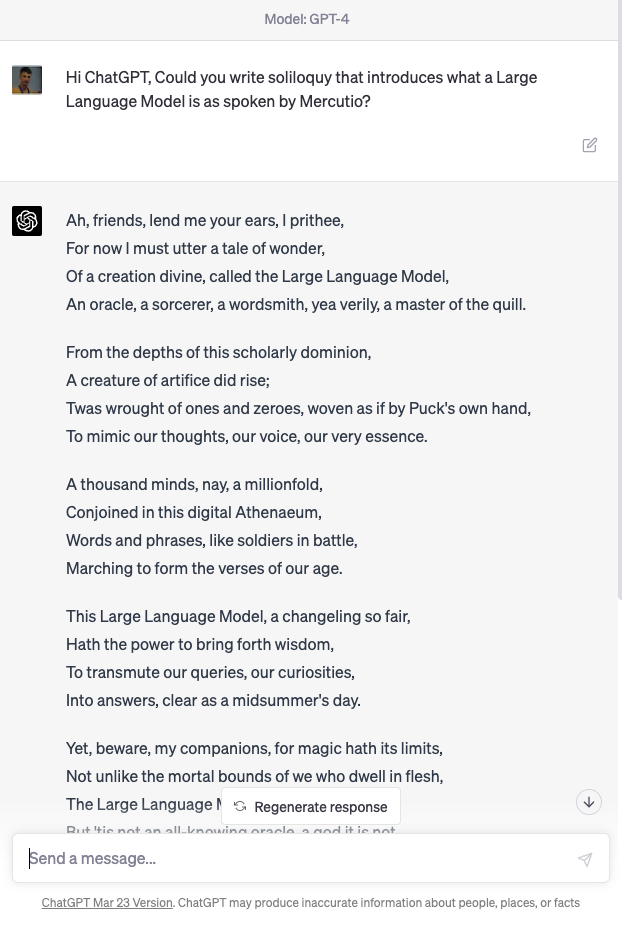
Figure: Despite the public’s desire to see challenges in health, finance, transport, crime solved by machine learning and their skepticism around poetry, one of the problems we have solved seems to be poetry.
User: Hi ChatGPT, Could you write soliloquy that introduces what a Large Language Model is as spoken by Mercutio?
Machine: Ah, friends, lend me your ears, I prithee, For now I must utter a tale of wonder, Of a creation divine, called the Large Language Model, An oracle, a sorcerer, a wordsmith, yea verily, a master of the quill.
From the depths of this scholarly dominion, A creature of artifice did rise; Twas wrought of ones and zeroes, woven as if by Puck’s own hand, To mimic our thoughts, our voice, our very essence.
A thousand minds, nay, a millionfold, Conjoined in this digital Athenaeum, Words and phrases, like soldiers in battle, Marching to form the verses of our age.
This Large Language Model, a changeling so fair, Hath the power to bring forth wisdom, To transmute our queries, our curiosities, Into answers, clear as a midsummer’s day.
Yet, beware, my companions, for magic hath its limits, Not unlike the mortal bounds of we who dwell in flesh, The Large Language Model hath its strengths, But ’tis not an all-knowing oracle, a god it is not.
As Mercutio, your humble servant, doth stand before thee, I marvel at the art and science that hath brought forth this wondrous creation, This Large Language Model, a testament to man’s yearning, To comprehend the world and make meaning of the great tapestry of existence.
In faith, dear friends, let us embrace the magic and beauty of this digital bard, And mayhaps, by its grace, we shall glean some wisdom, As we wander together, hand in hand, Through this boundless realm of knowledge and wonder.
ChatGPT transcript, 14th April 2023.
Despite what the public said they wanted, despite their interest in healthcare and transport and crime, one of the areas where we’ve made the most visible progress is exactly what they didn’t want: AI creating art and literature.
ChatGPT can write sonnets in the style of Shakespeare. It can create images. It can compose music. But as the public understood back in 2017, this isn’t the same as human creativity. It’s mimicry, not creation. It’s pattern matching, not genuine artistic expression.
The machine can produce something that looks like a Shakespearean sonnet, but it doesn’t understand love, or loss, or any of the human experiences that make Shakespeare’s work meaningful to us. It’s learned the patterns, but it hasn’t lived the life.
How Do These Machines Actually Work?
The MONIAC
The MONIAC was an analogue computer designed to simulate the UK economy. Analogue comptuers work through analogy, the analogy in the MONIAC is that both money and water flow. The MONIAC exploits this through a system of tanks, pipes, valves and floats that represent the flow of money through the UK economy. Water flowed from the treasury tank at the top of the model to other tanks representing government spending, such as health and education. The machine was initially designed for teaching support but was also found to be a useful economic simulator. Several were built and today you can see the original at Leeds Business School, there is also one in the London Science Museum and one in the Unisversity of Cambridge’s economics faculty.
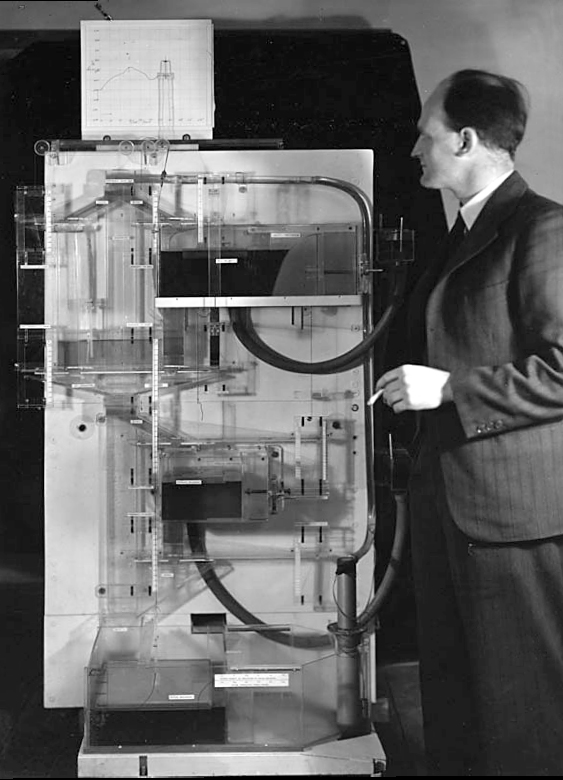
Figure: Bill Phillips and his MONIAC (completed in 1949). The machine is an analogue computer designed to simulate the workings of the UK economy.
See Lawrence (2024) MONIAC p. 232-233, 266, 343.
To understand modern AI, it helps to look at an old machine. The MONIAC was a hydraulic computer that modelled the economy using water flows. Modern AI systems are conceptually similar, they’re models that try to capture patterns in data.
Human Analogue Machine
Recent breakthroughs in generative models, particularly large language models, have enabled machines that, for the first time, can converse plausibly with other humans.
The Apollo guidance computer provided Armstrong with an analogy when he landed it on the Moon. He controlled it through a stick which provided him with an analogy. The analogy is based in the experience that Amelia Earhart had when she flew her plane. Armstrong’s control exploited his experience as a test pilot flying planes that had control columns which were directly connected to their control surfaces.
Figure: The human analogue machine is the new interface that large language models have enabled the human to present. It has the capabilities of the computer in terms of communication, but it appears to present a “human face” to the user in terms of its ability to communicate on our terms. (Image quite obviously not drawn by generative AI!)
The generative systems we have produced do not provide us with the “AI” of science fiction. Because their intelligence is based on emulating human knowledge. Through being forced to reproduce our literature and our art they have developed aspects which are analogous to the cultural proxy truths we use to describe our world.
These machines are to humans what the MONIAC was the British economy. Not a replacement, but an analogue computer that captures some aspects of humanity while providing advantages of high bandwidth of the machine.
But here’s the key difference: modern AI systems operate at incredible speed. They can process information much faster than we can. But speed isn’t everything.
HAM
The Human-Analogue Machine or HAM therefore provides a route through which we could better understand our world through improving the way we interact with machines.
Figure: The trinity of human, data, and computer, and highlights the modern phenomenon. The communication channel between computer and data now has an extremely high bandwidth. The channel between human and computer and the channel between data and human is narrow. New direction of information flow, information is reaching us mediated by the computer. The focus on classical statistics reflected the importance of the direct communication between human and data. The modern challenges of data science emerge when that relationship is being mediated by the machine.
The HAM can provide an interface between the digital computer and the human allowing humans to work closely with computers regardless of their understandin gf the more technical parts of software engineering.
Figure: The HAM now sits between us and the traditional digital computer.
Of course this route provides new routes for manipulation, new ways in which the machine can undermine our autonomy or exploit our cognitive foibles. The major challenge we face is steering between these worlds where we gain the advantage of the computer’s bandwidth without undermining our culture and individual autonomy.
See Lawrence (2024) human-analogue machine (HAMs) p. 343-347, 359-359, 365-368.
Bandwidth vs Complexity
The computer communicates in Gigabits per second, One way of imagining just how much slower we are than the machine is to look for something that communicates in nanobits per second.

|
|||
| bits/min | \(100 \times 10^{-9}\) | \(2,000\) | \(600 \times 10^9\) |
Figure: When we look at communication rates based on the information passing from one human to another across generations through their genetics, we see that computers watching us communicate is roughly equivalent to us watching organisms evolve. Estimates of germline mutation rates taken from Scally (2016).
Figure: Bandwidth vs Complexity.
The challenge we face is that while speed is on the side of the machine, complexity is on the side of our ecology. Many of the risks we face are associated with the way our speed undermines our ecology and the machines speed undermines our human culture.
See Lawrence (2024) Human evolution rates p. 98-99. See Lawrence (2024) Psychological representation of Ecologies p. 323-327.
What Makes Us Atomic?
So we return to the concept of “The Atomic Human.” Atomism, proposed by the ancient Greek philosopher Democritus, suggested that if you kept dividing matter into smaller and smaller pieces, eventually you would reach something that couldn’t be divided any further, the atom, from the Greek word for “indivisible.”
In the same way, as AI takes over more and more tasks that we used to think required human intelligence, e.g. playing chess, recognising faces, translating languages, even writing essays, we discover what’s left. What’s the part of human intelligence that can’t be replaced by a machine?
It’s not about being better at calculations, machines beat us there. It’s not about memory, machines win again. It’s not even about pattern recognition, modern AI can do that remarkably well.
What makes us uniquely human is our limitations and vulnerabilities. This gives us a shared context from which meaning drawn from lived experience. It gives us capacity for genuine empathy and connection. Our creativity is born from our limitations, not despite them.
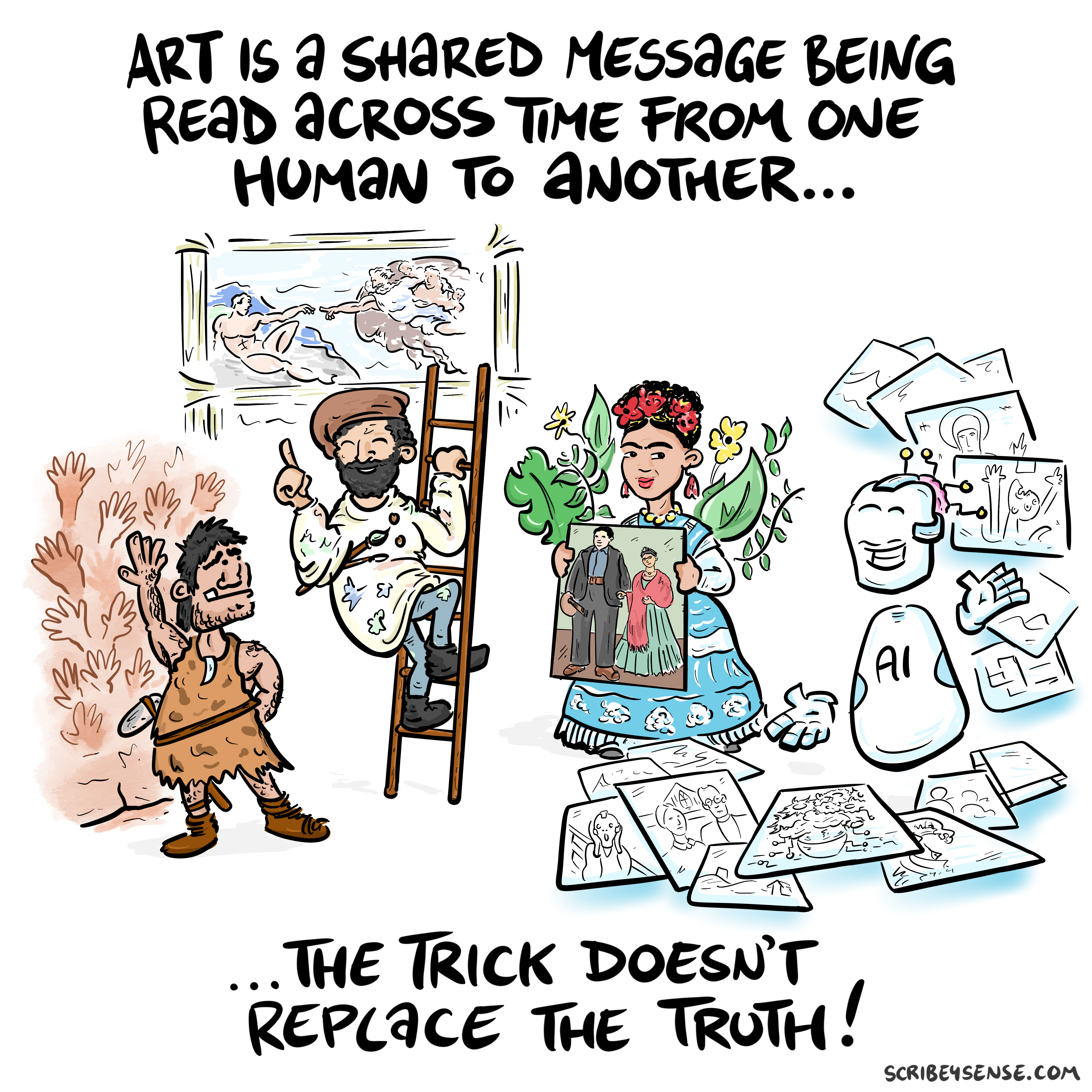
Figure: This is the drawing Dan was inspired to create for Chapter 4. It highlights how even if these machines can generate creative works the lack of origin in humans menas it is not the same as works of art that come to us through history.
See blog post on Art is Human..
For the Working Group for the Royal Society report on Machine Learning, back in 2016, the group worked with Ipsos MORI to engage in public dialogue around the technology. Ever since I’ve been struck about how much more sensible the conversations that emerge from public dialogue are than the breathless drivel that seems to emerge from supposedly more informed individuals.
There were a number of messages that emerged from those dialogues, and many of those messages were reinforced in two further public dialogues we organised in September.
However, there was one area we asked about in 2017, but we didn’t ask about in 2024. That was an area where the public unequivocal that they didn’t want the research community to pursue progress. Quoting from the report (my emphasis).
Art: Participants failed to see the purpose of machine learning-written poetry. For all the other case studies, participants recognised that a machine might be able to do a better job than a human. However, they did not think this would be the case when creating art, as doing so was considered to be a fundamentally human activity that machines could only mimic at best.
Public Views of Machine Learning, April, 2017
How right they were.
This is perhaps the most important point: AI systems can be impressive, they can be useful, but they’re fundamentally different from human intelligence. They’re tools, not replacements.
So Should We Worry?
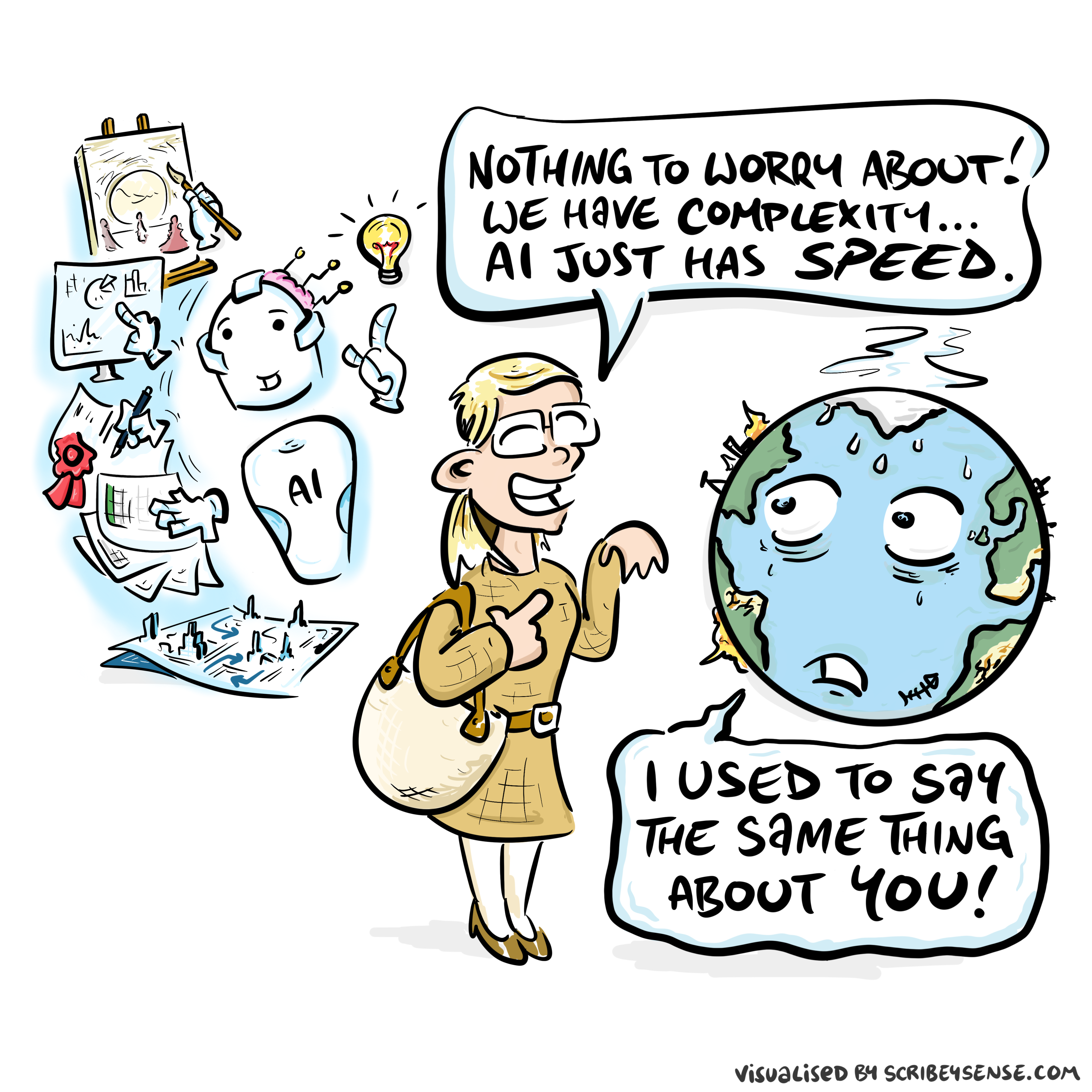
Figure: This is the drawing Dan was inspired to create for Chapter 12. It captures the challenge the analogy where the speed of information assimilation associated with machines is related to the speed assimilation associated with humans.
See blog post on the launch of Facebook’s AI lab..
I don’t think we should be worried about AI taking over the world or becoming conscious. But we should think carefully about how we use these tools. We should understand their limitations. And most importantly, we should value what makes us uniquely human.
Your Role in the Future
You’re growing up in a world where AI is becoming increasingly prevalent. That gives you a unique opportunity and responsibility. You get to help shape how these technologies are used. You get to decide which tasks we want to automate and which we want to keep human.
The key is to understand both the capabilities and limitations of AI. Don’t be intimidated by it, but don’t be naive about it either. Learn how it works. Question how it’s being used. And always remember what makes you uniquely human: your embodiment, your empathy, your creativity, your ability to genuinely understand and connect with other people.
The future isn’t about humans versus machines. It’s about understanding how we can work with these tools while preserving and celebrating what makes us human. That’s the essence of being an Atomic Human - recognizing that there’s a core of humanity that can’t be divided, copied, or replaced by any machine.

Figure: Society faces many wicked problems in health, education, security, and social care that require carefully deploying AI toward meaningful societal challenges rather than focusing on commercially appealing applications. (Illustration by Dan Andrews inspired by the Epilogue of “The Atomic Human” Lawrence (2024))
This illustration was created by Dan Andrews after reading the Epilogue of “The Atomic Human” book. The Epilogue discusses how we might deploy AI to address society’s most pressing challenges, and Dan’s drawing captures the various wicked problems we face and some of the initiatives that are looking to address them.
See blog post on Who is Stepping Up?.
See blog post on Who is Stepping Up?.
What Are We Doing About It?
So we’ve talked about the challenges, the problems, the things that can go wrong. But what are we actually doing to address these issues? Let me tell you about some initiatives that are trying to deploy AI in ways that genuinely help people and address real societal challenges.
Three Complementary Approaches
At Cambridge, we’re working on three interconnected initiatives that each tackle different aspects of the AI challenge.

|
|

|
Figure: Three complementary initiatives: Accelerate Programme for Scientific Discovery (Schmidt Futures funded), Data Science Africa (grassroots capacity building), and ai@cam (University of Cambridge flagship programme).
First, there’s the Accelerate Programme for Scientific Discovery, funded by Schmidt Futures. This is about using AI to solve real scientific problems, from understanding climate change to developing new medicines. It’s about making sure AI serves science, not just commerce.
Second, there’s Data Science Africa, a grassroots initiative that I’m particularly proud of. This is about capacity building on the African continent, making sure that AI development isn’t just happening in Silicon Valley or Cambridge, but is being shaped by people from diverse backgrounds with diverse needs. It’s end-to-end data science, from the farmer’s field to the Ministry of Agriculture, from health centers to medicine distribution.
Third, there’s ai@cam, the University’s flagship programme. This brings together researchers from across the University, from computer scientists to medics to social scientists to philosophers, all working together to understand and shape how AI develops. It’s about ensuring that AI development is informed by diverse expertise and perspectives.
Why This Matters for You
These initiatives share a common philosophy: AI should serve people, not the other way around. They focus on real problems, they involve diverse communities, and they think carefully about the human impact of the technology.
As you think about your future, remember that you don’t have to accept AI as it’s given to you. You can help shape it. Whether you become a computer scientist, a doctor, a teacher, a policy maker, or anything else, you’ll have opportunities to influence how these technologies are deployed in your field.
The key is to stay curious, stay critical, and stay human. Ask questions. Challenge assumptions. And always remember that the goal isn’t to build the most impressive AI, it’s to build AI that genuinely makes people’s lives better.
Questions to Think About
As we close, here are some questions for you to think about:
Can you think of situations where you’d prefer a human decision-maker over an AI, even if the AI might be more “accurate?” Why?
What human skills do you think will become more valuable, not less, as AI becomes more capable?
How can we ensure that AI systems reflect the values we want in society?
What role do you want AI to play in your future career?
These aren’t questions with simple answers, but they’re important questions to think about as you navigate a world increasingly shaped by artificial intelligence.
Thanks!
For more information on these subjects and more you might want to check the following resources.
- company: Trent AI
- book: The Atomic Human
- twitter: @lawrennd
- podcast: The Talking Machines
- newspaper: Guardian Profile Page
- blog: http://inverseprobability.com