Tautology, Barbers, Impredicativity and Self-Adjudication
Here’s a thought that is tautological:
a self-adjudicating system cannot seek external arbitration to determine its next state.
I like the idea that some tautologies are useful. And I think this one is. I’ve been applying it to the dynamical system I’m working on called “The Inaccessible Game”. The aim is to create an information theoretic zero-player game which has rules that are emergent. I think the tautology is a route to a selection principle for the game.
Why would a game need to seek external adjudication? Well imagine a situation where the next move in the game could not be resolved within the game’s internal rules. Such a game would either stall, or have to seek external adjudication. And how could such a situation arise? Well, one way is by falling victim to impredicative circularity. A famous example was given by Bertrand Russell and it’s become known as the barber paradox.
Imagine there’s a village and the village has a barber. The barber shaves only those people in the village who don’t shave themselves. The question is, does the barber shave themself?
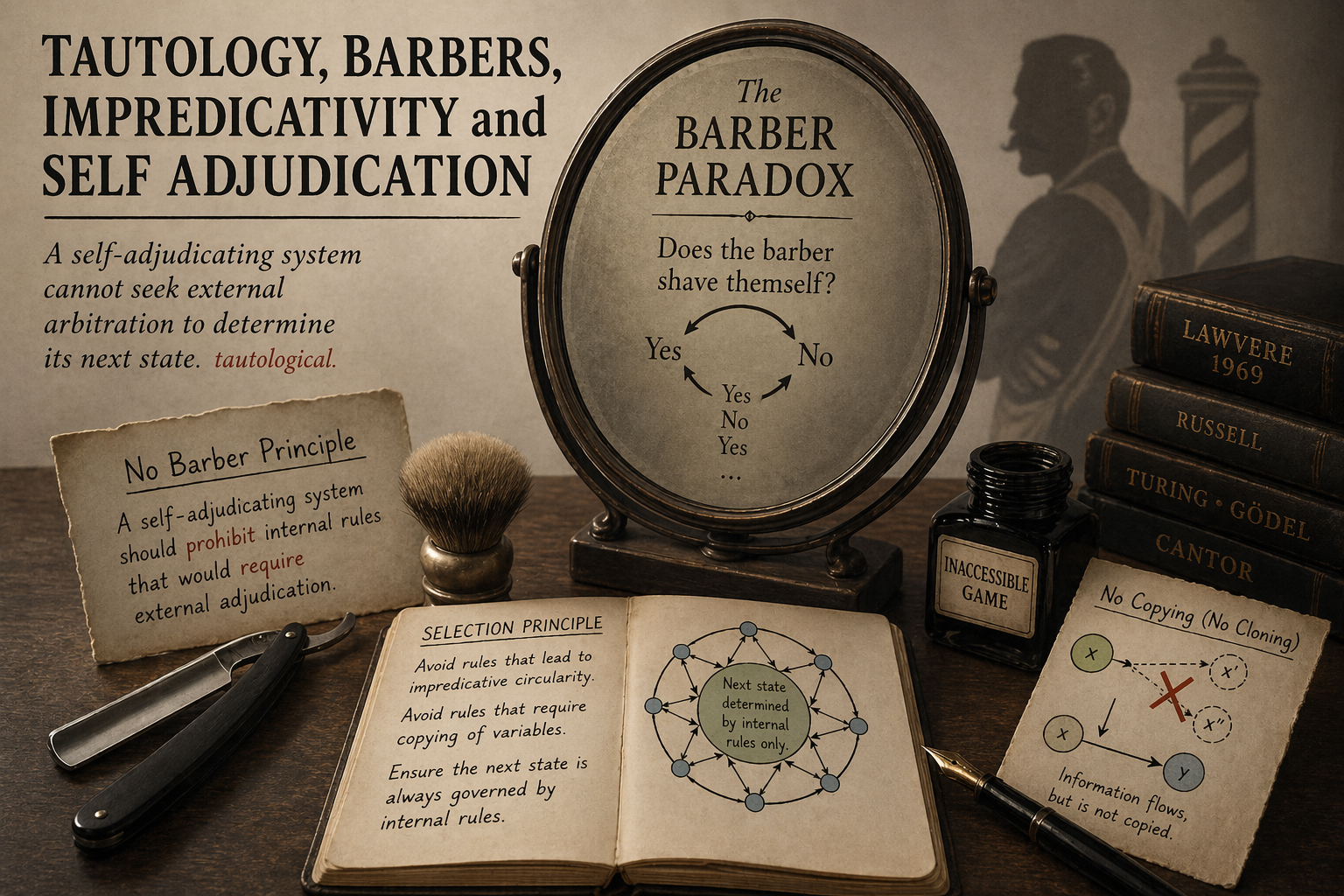
Could prohibiting impredicative circularity provide a selection principle for a self-adjudicating game?
This question leads to an impredicative circularity, if the barber shaves themselves, then they don’t, so they do and then they don’t etc …
So the tautology above suggests that a self-adjudicating system should ensure that such a situation doesn’t arise. How can we do that?
I call the selection principle the “No Barber Principle”. The idea is that a self-adjudicating system should not have external structure that adjudicates and therefore it should prohibit internal rules that would require such adjudication.
Is this principle useful? My best attempt at showing it can be is given in the latest paper in the inaccessible game series http://arxiv.org/abs/2604.21945. The paper argues that by blocking copying of variables, we can guarantee that Russell’s paradox can’t arise. It builds on a category theoretic explanation due to William Lawvere.1 An amazing paper from 1969 that connects Russell to Turing, Gödel and Cantor.2
The no-cloning condition is a sufficient condition rather than the necessary one, but I’ve been quite taken with the idea that in a self-adjudicating system copying is prohibited … this gives the work a foundational reason to prefer von Neumann entropy over Shannon.
-
F. William Lawvere, Diagonal arguments and cartesian closed categories in Category Theory, Homology Theory and their Applications II from Lecture Notes in Mathematics volume 92 pp 134–145, 1969. Springer: Berlin. DOI:10.1007/BFb0080769. ↩
-
I’ve also been very taken with his book (with Stephen Schanuel) “Conceptual Mathematics” which I’ve been reading carefully to better understand the category theoretic arguments. I can’t claim to have fully (or even partially) achieved that though! ↩