Artificial Intelligence and Commercial Applications
Links
Abstract
Artificial intelligence is reshaping commercial opportunity at a pace that outstrips most strategic frameworks. For senior executives and entrepreneurs, the practical question is not whether AI matters, but how to deploy it without confusing machine capability with human judgment.
Drawing on The Atomic Human, this session explores what AI actually is — and what it is not — through the lens of information bandwidth, attention, and organisational decision-making. We examine commercial applications of recent generative systems, why superficial automation often fails, and how leaders can redesign information flows so that human attention remains the scarce resource that creates durable advantage.
The session closes with future directions: human-analogue machines as interfaces, the risks of agentic debt, and a people-first approach to AI strategy that Chinese and global firms can apply as they navigate a rapidly changing commercial landscape.
Opening: Commercial Advantage in the Age of Intelligent Machines
Welcome. Over the next ninety minutes we will look at artificial intelligence from a commercial perspective: what recent systems can and cannot do, how they change the firm, and what leaders should do next. Simultaneous interpretation is running, so I will keep the beats short and leave time for discussion.
Three parts. First, a clear model of machine intelligence versus human intelligence — without that, commercial strategy drifts into hype. Second, how AI reshapes information flows, attention, and decision rights inside the firm. Third, recent developments — generative systems as human-analogue machines — and the strategic choices that follow.
Part 1: What AI Is (and Isn’t) for Commercial Leaders
Henry Ford’s Faster Horse

Figure: A 1925 Ford Model T built at Henry Ford’s Highland Park Plant in Dearborn, Michigan. This example now resides in Australia, owned by the founder of FordModelT.net. From https://commons.wikimedia.org/wiki/File:1925_Ford_Model_T_touring.jpg

It’s said that Henry Ford’s customers wanted a “a faster horse.” If Henry Ford was selling us artificial intelligence today, what would the customer call for, “a smarter human?” That’s certainly the picture of machine intelligence we find in science fiction narratives, but the reality of what we’ve developed is much more mundane.
Car engines produce prodigious power from petrol. Machine intelligences deliver decisions derived from data. In both cases the scale of consumption enables a speed of operation that is far beyond the capabilities of their natural counterparts. Unfettered energy consumption has consequences in the form of climate change. Does unbridled data consumption also have consequences for us?
If we devolve decision making to machines, we depend on those machines to accommodate our needs. If we don’t understand how those machines operate, we lose control over our destiny. Our mistake has been to see machine intelligence as a reflection of our intelligence. We cannot understand the smarter human without understanding the human. To understand the machine, we need to better understand ourselves.

Figure: The notion of artificial general intelligence is as absurd as the notion of an artificial general vehicle - no single vehicle is optimal for every journey. (Illustration by Dan Andrews inspired by a conversation about “The Atomic Human” Lawrence (2024))
This illustration was created by Dan Andrews inspired by a conversation about “The Atomic Human” book. The drawing emerged from discussions with Dan about the flawed concept of artificial general intelligence and how it parallels the absurd idea of a single vehicle optimal for all journeys. The vehicle itself is inspired by shared memories of Professor Pat Pending in Hanna Barbera’s Wacky Races.
The Atomic Human
Figure: The Atomic Eye, by slicing away aspects of the human that we used to believe to be unique to us, but are now the preserve of the machine, we learn something about what it means to be human.
The development of what some are calling intelligence in machines, raises questions around what machine intelligence means for our intelligence. The idea of the atomic human is derived from Democritus’s atomism.
In the fifth century bce the Greek philosopher Democritus posed a question about our physical universe. He imagined cutting physical matter into pieces in a repeated process: cutting a piece, then taking one of the cut pieces and cutting it again so that each time it becomes smaller and smaller. Democritus believed this process had to stop somewhere, that we would be left with an indivisible piece. The Greek word for indivisible is atom, and so this theory was called atomism.
The Atomic Human considers the same question, but in a different domain, asking: As the machine slices away portions of human capabilities, are we left with a kernel of humanity, an indivisible piece that can no longer be divided into parts? Or does the human disappear altogether? If we are left with something, then that uncuttable piece, a form of atomic human, would tell us something about our human spirit.
See Lawrence (2024) atomic human, the p. 13.
Information and Embodiment
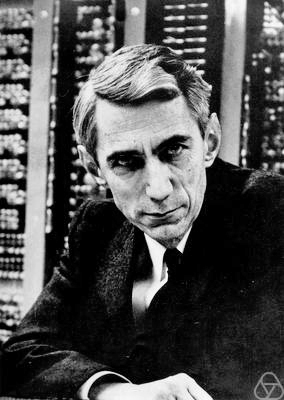
Figure: Claude Shannon (1916-2001)
| bits/min | billions | 2,000 |
| billion calculations/s | ~100 | a billion |
| embodiment | 20 minutes | 5 billion years |
Figure: Embodiment factors are the ratio between our ability to compute and our ability to communicate. Relative to the machine we are also locked in. In the table we represent embodiment as the length of time it would take to communicate one second’s worth of computation. For computers it is a matter of minutes, but for a human, it is a matter of thousands of millions of years.
Embodiment Factors: Walking vs Light Speed
Imagine human communication as moving at walking pace. The average person speaks about 160 words per minute, which is roughly 2000 bits per minute. If we compare this to walking speed, roughly 1 m/s we can think of this as the speed at which our thoughts can be shared with others.
Compare this to machines. When computers communicate, their bandwidth is 600 billion bits per minute. Three hundred million times faster than humans or the equiavalent of \(3 \times 10 ^{8}\). In twenty minutes we could be a kilometer down the road, where as the computer can go to the Sun and back again..
This difference is not just only about speed of communication, but about embodiment. Our intelligence is locked in by our biology: our brains may process information rapidly, but our ability to share those thoughts is limited to the slow pace of speech or writing. Machines, in comparison, seem able to communicate their computations almost instantaneously, anywhere.
So, the embodiment factor is the ratio between the time it takes to think a thought and the time it takes to communicate it. For us, it’s like walking; for machines, it’s like moving at light speed. This difference means that most direct comparisons between human and machine need to be carefully made. Because for humans not the size of our communication bandwidth that counts, but it’s how we overcome that limitation..
Figure: Conversation relies on internal models of other individuals.
Figure: Misunderstanding of context and who we are talking to leads to arguments.
Embodiment factors imply that, in our communication between humans, what is not said is, perhaps, more important than what is said. To communicate with each other we need to have a model of who each of us are.
To aid this, in society, we are required to perform roles. Whether as a parent, a teacher, an employee or a boss. Each of these roles requires that we conform to certain standards of behaviour to facilitate communication between ourselves.
Control of self is vitally important to these communications.
The consequences between this mismatch of power and delivery are to be seen all around us. Because, just as driving an F1 car with bicycle wheels would be a fine art, so is the process of communication between humans.
If I have a thought and I wish to communicate it, I first need to have a model of what you think. I should think before I speak. When I speak, you may react. You have a model of who I am and what I was trying to say, and why I chose to say what I said. Now we begin this dance, where we are each trying to better understand each other and what we are saying. When it works, it is beautiful, but when mis-deployed, just like a badly driven F1 car, there is a horrible crash, an argument.
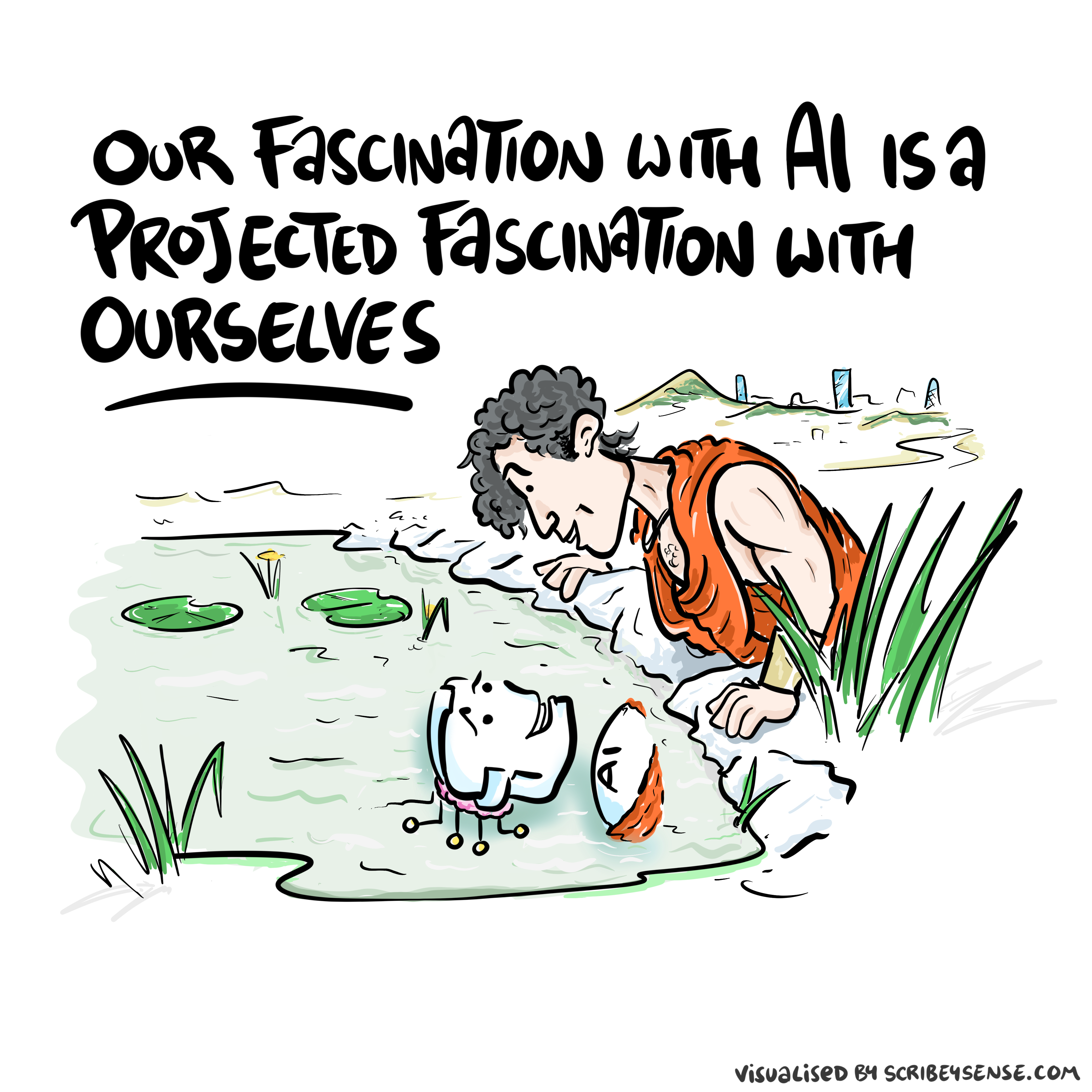
Figure: This is the drawing Dan was inspired to create for Chapter 1. It captures the fundamentally narcissistic nature of our (societal) obsession with our intelligence.
See blog post on Dan Andrews image of our reflective obsession with AI.. See also (Vallor, 2024).
A Six Word Novel

Figure: Consider the six-word novel, apocryphally credited to Ernest Hemingway, “For sale: baby shoes, never worn.” To understand what that means to a human, you need a great deal of additional context. Context that is not directly accessible to a machine that has not got both the evolved and contextual understanding of our own condition to realize both the implication of the advert and what that implication means emotionally to the previous owner.
See Lawrence (2024) baby shoes p. 368.
But this is a very different kind of intelligence than ours. A computer cannot understand the depth of the Ernest Hemingway’s apocryphal six-word novel: “For Sale, Baby Shoes, Never worn,” because it isn’t equipped with that ability to model the complexity of humanity that underlies that statement.
Homo Atomicus
We won’t find the atomic human in the percentage of A grades that our children are achieving at schools or the length of waiting lists we have in our hospitals. It sits behind all this. We see the atomic human in the way a nurse spends an extra few minutes ensuring a patient is comfortable or a bus driver pauses to allow a pensioner to cross the road or a teacher praises a struggling student to build their confidence.
We need to move away from homo economicus towards homo atomicus.
For commercial leaders, the Atomic Human is not a philosophical aside. It is a strategy filter. If a capability is easily automated, it will not remain a durable source of differentiation. Advantage concentrates in the parts of the business that remain irreducibly human: trust, judgment under uncertainty, culture, and the relationships that bind customers and partners.
Discussion 1
Take five to eight minutes at tables. Ask each group to name one capability they would not automate — and why. Capture answers that point to trust, customer relationships, ethical judgment, or cultural cohesion.
Part 2: Commercial Applications and Organisational Change
Commercial application of AI is less about buying a model and more about redesigning how information moves through the firm. Recent systems amplify throughput; they do not automatically improve decision quality.
Philosopher’s Stone

Figure: The Alchemist by Joseph Wright of Derby (1771). The picture depicts Hennig Brand discovering the element phosphorus when searching for the Philosopher’s Stone.
The philosopher’s stone is a mythical substance that can convert base metals to gold.
The Attention Economy
Human intelligence is locked-in. It’s bandwidth restricted. This makes it a bottleneck in the attention economy.
Herbert Simon on Information
What information consumes is rather obvious: it consumes the attention of its recipients. Hence a wealth of information creates a poverty of attention …
Simon (1971)
The attention economy was a phenomenon described in 1971 by the American computer scientist Herbert Simon. He saw the coming information revolution and wrote that a wealth of information would create a poverty of attention. Too much information means that human attention becomes the scarce resource, the bottleneck. It becomes the gold in the attention economy.
The power associated with control of information dates back to the invention of writing. By pressing reeds into clay tablets Sumerian scribes stored information and controlled the flow of information.
New Flow of Information
Classically the field of statistics focused on mediating the relationship between the machine and the human. Our limited bandwidth of communication means we tend to over-interpret the limited information that we are given, in the extreme we assign motives and desires to inanimate objects (a process known as anthropomorphizing). Much of mathematical statistics was developed to help temper this tendency and understand when we are valid in drawing conclusions from data.
Figure: The trinity of human, data, and computer, and highlights the modern phenomenon. The communication channel between computer and data now has an extremely high bandwidth. The channel between human and computer and the channel between data and human is narrow. New direction of information flow, information is reaching us mediated by the computer. The focus on classical statistics reflected the importance of the direct communication between human and data. The modern challenges of data science emerge when that relationship is being mediated by the machine.
Data science brings new challenges. In particular, there is a very large bandwidth connection between the machine and data. This means that our relationship with data is now commonly being mediated by the machine. Whether this is in the acquisition of new data, which now happens by happenstance rather than with purpose, or the interpretation of that data where we are increasingly relying on machines to summarize what the data contains. This is leading to the emerging field of data science, which must not only deal with the same challenges that mathematical statistics faced in tempering our tendency to over interpret data but must also deal with the possibility that the machine has either inadvertently or maliciously misrepresented the underlying data.
See Lawrence (2024) topography, information p. 34-9, 43-8, 57, 62, 104, 115-16, 127, 140, 192, 196, 199, 291, 334, 354-5. See Lawrence (2024) anthropomorphization (‘anthrox’) p. 30-31, 90-91, 93-4, 100, 132, 148, 153, 163, 216-17, 239, 276, 326, 342.
Institutional Character
Before we start, I’d like to highlight one idea that will be key for contextualisation of everything else. There is a strong interaction between the structure of an organisation and the structure of its software.
This is known as Conway’s law:
Organizations, who design systems, are constrained to produce designs which are copies of the communication structures of these organizations.
Melvin Conway Conway (n.d.)
The API Mandate
The API Mandate was a memo issued by Jeff Bezos in 2002. Internet folklore has the memo making five statements:
- All teams will henceforth expose their data and functionality through service interfaces.
- Teams must communicate with each other through these interfaces.
- There will be no other form of inter-process communication allowed: no direct linking, no direct reads of another team’s data store, no shared-memory model, no back-doors whatsoever. The only communication allowed is via service interface calls over the network.
- It doesn’t matter what technology they use.
- All service interfaces, without exception, must be designed from the ground up to be externalizable. That is to say, the team must plan and design to be able to expose the interface to developers in the outside world. No exceptions.
The mandate marked a shift in the way Amazon viewed software, moving to a model that dominates the way software is built today, so-called “Software-as-a-Service.”
Any organization that designs a system (defined broadly) will produce a design whose structure is a copy of the organization’s communication structure.
Conway (n.d.)
The law is cited in the classic software engineering text, The Mythical Man Month (Brooks, n.d.).
As a result, and in awareness of Conway’s law, the implementation of this mandate also had a dramatic effect on Amazon’s organizational structure.
Because the design that occurs first is almost never the best possible, the prevailing system concept may need to change. Therefore, flexibility of organization is important to effective design.
Conway (n.d.)
Amazon is set up around the notion of the “two pizza team.” Teams of 6-10 people that can be theoretically fed by two (American) pizzas. This structure is tightly interconnected with the software. Each of these teams owns one of these “services.” Amazon is strict about the team that develops the service owning the service in production. This approach is the secret to their scale as a company, and the approach has been adopted by many other large tech companies. The software-as-a-service approach changed the information infrastructure of the company. The routes through which information is shared. This had a knock-on effect on the corporate culture.
Amazon works through an approach I think of as “devolved autonomy.” The culture of the company is widely taught (e.g. Customer Obsession, Ownership, Frugality), a team’s inputs and outputs are strictly defined, but within those parameters, teams have a great of autonomy in how they operate. The information infrastructure was devolved, so the autonomy was devolved. The different parts of Amazon are then bound together through shared corporate culture.
Amazon prides itself on agility, I spent three years there and I can confirm things move very quickly. I used to joke that just as a dog year is seven normal years, an Amazon year is four normal years in any other company.
Not all institutions move quickly. My current role is at the University of Cambridge. There are similarities between the way a University operates and the way Amazon operates. In particular Universities exploit devolved autonomy to empower their research leads.
Naturally there are differences too, for example, Universities do less work on developing culture. Corporate culture is a critical element in ensuring that despite the devolved autonomy of Amazon, there is a common vision.
Cambridge University is over 800 years old. Agility is not a word that is commonly used to describe its institutional framework. I don’t want to make a claim for whether an agile institution is better or worse, it’s circumstantial. Institutions have characters, like people. The institutional character of the University is the one of a steady and reliable friend. The institutional character of Amazon is more mecurial.
Why do I emphasise this? Because when it comes to organisational data science, when it comes to a data driven culture around our decision making, that culture inter-plays with the institutional character. If decision making is truly data-driven, then we should expect co-evolution between the information infrastructure and the institutional structures.
A common mistake I’ve seen is to transplant a data culture from one (ostensibly) successful institution to another. Such transplants commonly lead to organisational rejection. The institutional character of the new host will have cultural antibodies that operate against the transplant even if, at some (typically executive) level the institution is aware of the vital need for integrating the data driven culture.
A major part of my job at Amazon was dealing with these tensions. As a scientist, initially working across the company, working with my team introduced dependencies and practices that impinged on the devolved autonomy. I face a similar challenge at Cambridge. Our aim is to integrate data driven methodologies with the classical sciences, humanities and across the academic spectrum. The devolved autonomy inherent in University research provides a similar set of challenges to those I faced at Amazon.
My role before Amazon was at the University of Sheffield. Those were quieter times in terms of societal interest in machine learning and data science, but the Royal Society was already convening a working group on Machine Learning. This was my first interaction with policy advice, I’ve continued that interaction today by working with the AI Council, convening the DELVE group to give pandemic advice, serving on the Advisory Council for the Centre for Science and Policy, and the Advisory Board for the Centre for Data Ethics and Innovation. I’m not an expert on the civil service and government, but I believe many of the themes I’ve outlined above also apply within government. The ideas I’ll talk about today build on the experiences I’ve had at Sheffield, Amazon, and Cambridge alongside the policy work I’ve been involved in to make suggestions of what the barriers are for enabling a culture of data driven policy making.
How Information Flows in Organisations
The information topography of an organisation is how information flows through the organisaiton. At one level this will involve a hierarchy of information propagation: the chart of reporting lines. But alongside this there are other mechanisms to share information.
This dictates the organisations "absorbtive capacity which in turn dictates how it will make decisions. The nature of decisio of decisions depend on how well the information that feeds them can travel.
The three components of the information topography: storage, channel and coupling come together to form the information topography.
Classically information propagates through two principle patterns. Hub-and-spoke networks, and peer-to-peer meshes. The hub-and-spoke becomes a hierarchy as it scales. The different mechanisms have different implications for bandwidth, latency, and resilience.
Figure: In a classical corporate hierarchy, information travels vertically. Strategic decisions flow downward from the CEO through the C-suite (CFO, CIO, COO) to functional departments. Data and reports flow upward. External signals from customers and markets enter at the top. Each layer introduces delay and compression.
The hub-and-spoke model centralises information processing. All communication between departments routes through a central function. This works well for “command and control” but the central node tends to become overloaded. In practive that’s why we obtain a hierarchy so each spoke is itself a hub for the next level.
Figure: In a hub-and-spoke model, all information routes through a central node. This can result in low latency (good command and control) but the central hub can become overloaded.
Peer-to-peer structures allow direct communication between teams without a central intermediary. This maximises bandwidth and reduces latency, but requires more communication interfaces than are managed with hub-and-spoke. Amazon’s API mandate — requiring all teams to expose their capabilities through programmatic interfaces — is an example of deliberately engineering a peer-to-peer information structure within a large organisation. The challenge is coordination: without a hub, norms and protocols must emerge from the network itself. This is where culture becomes important
Figure: In a peer-to-peer network, teams communicate directly with each other through adjacent and cross-cutting channels, without routing through a central authority. This structure is resilient and high-bandwidth, but requires shared protocols and trust. It mirrors how open-source software communities and federated data ecosystems operate.
More Information Topography
In a market economy, monetary flows are information flows. Information about a product, service, or capability travels peer-to-peer across the network, money follows.
Figure: Information flows peer-to-peer across the network (grey, bidirectional). Money flows directionally from customers through the firm network to markets (gold). The two flows are complementary: information establishes the channel, money follows it.
One natural answer to the coordination problem of peer-to-peer networks is to place training and culture at the centre of the hub-and-spoke. Rather than routing decisions through a headquarters, the hub disseminates shared values, capabilities, and ways of working. The spokes retain autonomy in how they operate, but the centre ensures they speak a common language. This is how high-performing organisations like the SAS, McKinsey, or the Catholic Church have historically scaled without losing coherence.
Figure: When training and culture sit at the hub, the central function does not command — it calibrates. Departments retain operational autonomy while sharing a common language, values, and capability base. Information flows to and from the centre, but the centre’s role is alignment rather than control.
Trust, Autonomy and Embodiment
Trust, Autonomy and Embodiment
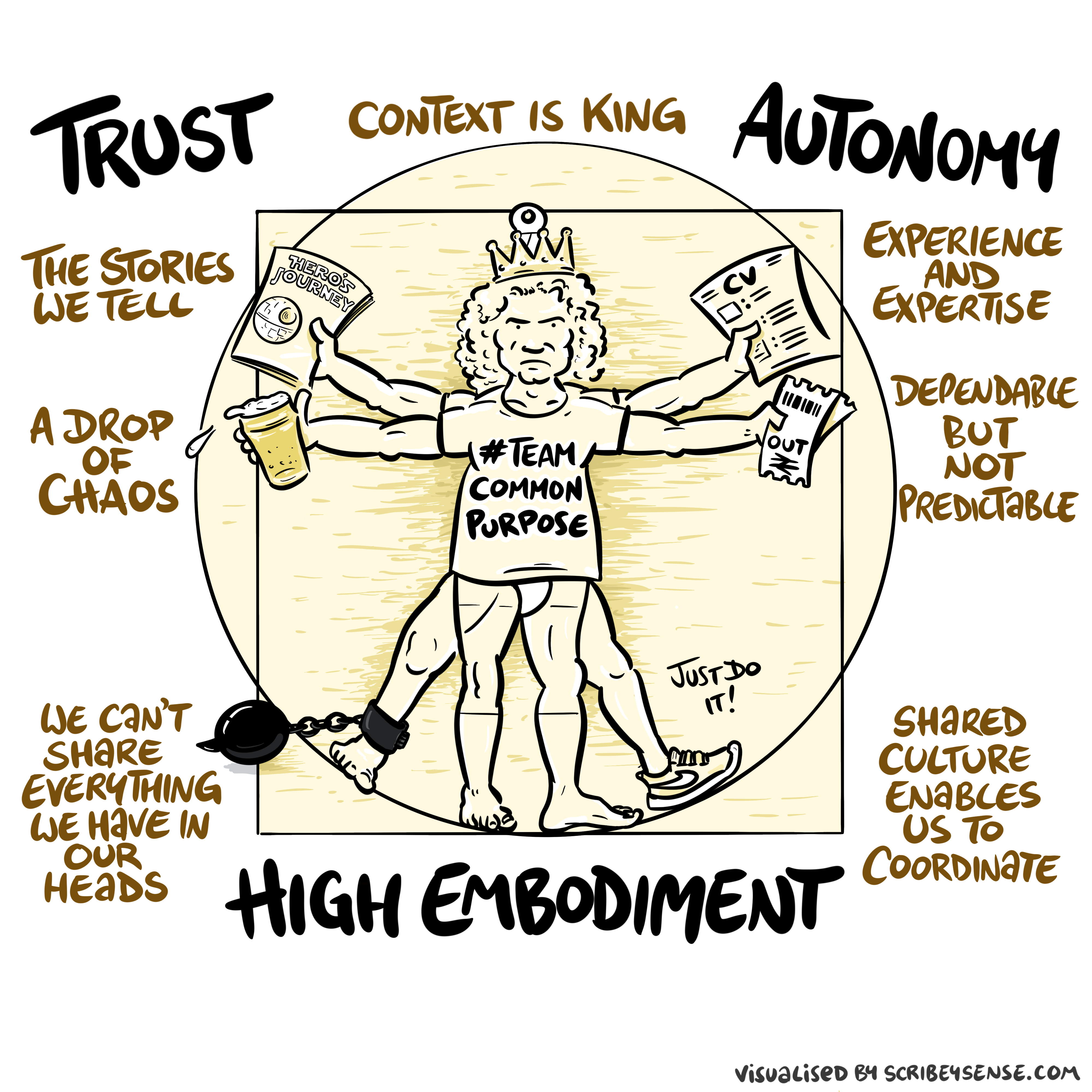
Figure: The relationships between trust, autonomy and embodiment are key to understanding how to properly deploy AI systems in a way that avoids digital autocracy. (Illustration by Dan Andrews inspired by Chapter 3 “Intent” of “The Atomic Human” Lawrence (2024))
This illustration was created by Dan Andrews after reading Chapter 3 “Intent” of “The Atomic Human” book. The chapter explores the concept of intent in AI systems and how trust, autonomy, and embodiment interact to shape our relationship with technology. Dan’s drawing captures these complex relationships and the balance needed for responsible AI deployment.
See blog post on Dan Andrews image from Chapter 3.
Trust is not a slogan; it is the infrastructure that allows autonomy to be devolved without losing control. Autonomy is always conditional: it depends on what information is available, what incentives shape behaviour, and whether escalation and accountability are real. In executive settings, the practical question is: where do we allow delegation (to people or machines), and where do we insist on human judgement and responsibility?
See Lawrence (2024) trust p. 43, 79, 100. See Lawrence (2024) embodiment factor p. 13, 29, 35, 79, 87, 105, 197, 216-217, 249, 269, 327, 353, 363, 369. See Lawrence (2024) topography, information p. 34-9, 43-8, 57, 62, 104, 115-16, 127, 140, 192, 196, 199, 291, 334, 354-5.
See blog post on Dan Andrews image from Chapter 3..
When you deploy AI commercially, you are choosing where to place trust: in the algorithm, in the human, or in a designed combination. Those choices rewrite autonomy and accountability. Get them wrong and you get either paralysis or reckless automation.
A Warning from Commercial Automation
The Horizon scandal
In the UK we saw these effects play out in the Horizon scandal: the accounting system of the national postal service was computerized by Fujitsu and first installed in 1999, but neither the Post Office nor Fujitsu were able to control the system they had deployed. When it went wrong individual sub postmasters were blamed for the systems’ errors. Over the next two decades they were prosecuted and jailed leaving lives ruined in the wake of the machine’s mistakes.

Figure: The still is from the 2015 select committee.
See Lawrence (2024) Horizon scandal p. 371.
Horizon is a public-sector scandal, but the commercial lesson is direct: when organisations subordinate human judgment to algorithmic outputs, the damage compounds. Customers, regulators, and employees all lose trust. For global firms, especially those operating across jurisdictions, intelligent accountability is part of the product.
Where Superficial Automation Fails
Superficial Automation
The rise of AI has enabled automation of many surface-level tasks - what we might call “superficial automation.” These are tasks that appear complex but primarily involve reformatting or restructuring existing information, such as converting bullet points into prose, summarizing documents, or generating routine emails.
While such automation can increase immediate productivity, it risks missing the deeper value of these seemingly mundane tasks. For example, the process of composing an email isn’t just about converting thoughts into text - it’s about:
- Reflection time to properly consider the message
- Building relationships through personal communication
- Developing and refining ideas through the act of writing
- Creating institutional memory through thoughtful documentation
- Projecting corporate culture
When we automate these superficial aspects, we can create what appears to be a more efficient process, but one that gradually loses meaning without human involvement. It’s like having a meeting transcription without anyone actually attending the meeting - the words are there, but the value isn’t.
Consider email composition: An AI can convert bullet points into a polished email instantly, but this bypasses the valuable thinking time that comes with composition. The human “pause” in communication isn’t inefficiency - it’s often where the real value lies.
This points to a broader challenge with AI automation: the need to distinguish between tasks that are merely complex (and can be automated) versus those that are genuinely complicated (requiring human judgment and involvement). Effective deployment of AI requires understanding this distinction and preserving the human elements that give business processes their true value.
The risk is creating what appears to be a more efficient system but is actually a hollow process - one that moves faster but creates less real value. True digital transformation isn’t about removing humans from the loop, but about augmenting human capabilities while preserving the essential human elements that give work its meaning and effectiveness.
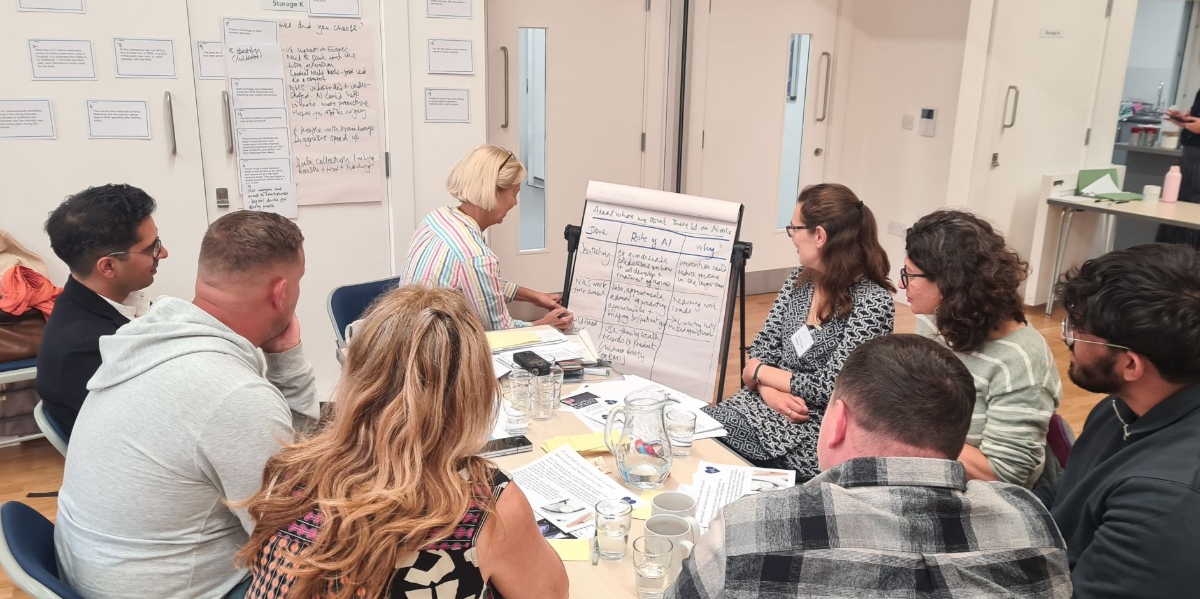
Figure: Public dialogue held in Liverpool alongside the 2024 Labour Party Conference. The process of discussion is as important as the material discussed. In line with previous dialogues attendees urged us to develop technology where AI operates as a tool for human augmentation, not replacement.
In our public dialogues we saw the same theme: good process can drive purpose. Discussion is as important as the conclusions reached. Attendees urged us to develop technology where AI operates as a tool for human augmentation, not replacement.
Two Types of Stochastic Parrot
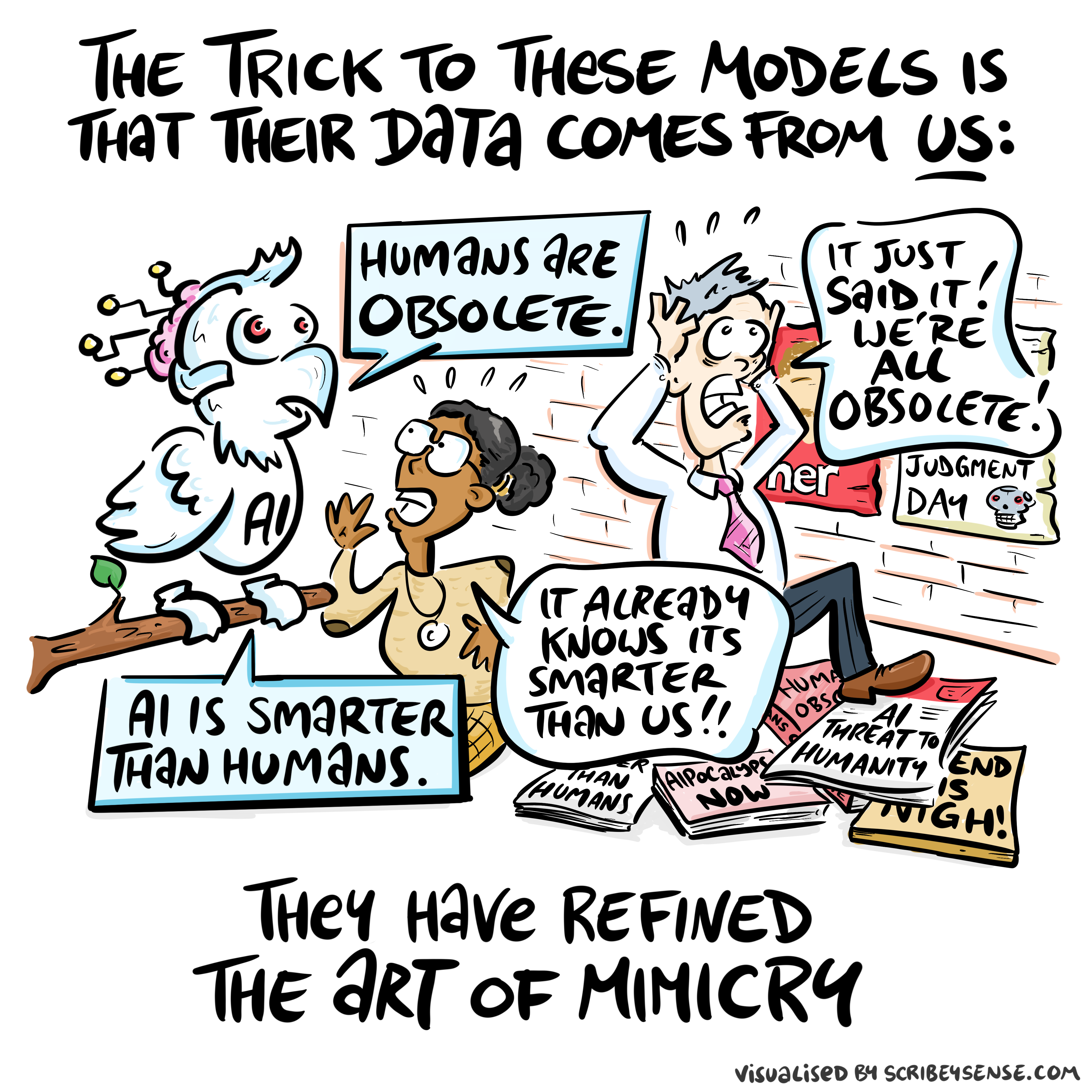
Figure: This is the drawing Dan was inspired to create for Chapter 5. An AI parrot repeats information about AI doom panicking humans.
Bender et al. (2021) was a landmark paper where researchers first raised significant warnings about large language models, characterizing them as stochastic parrots. Some of these researchers paid for their bravery with their jobs, and particularly in the UK, their voices and those of other female researchers were largely erased from public debate.
Today we see a second type of stochastic parrot emerging: “fleshy GPTs” who speak confidently and eloquently but lack real-world experience. Like the language models they champion, they make arguments that appear superficially convincing but reveal naive flaws to those with deeper domain knowledge. Ironically, some of these voices even claim the research community failed to warn about the implications of these technologies, despite papers like Bender et al. (2021) doing exactly that.
See this reflection on Two Types of Stochastic Parrots.
Many commercial AI projects automate the visible surface of a process while leaving the underlying decision problem untouched. The result looks modern and performs poorly. Leaders should ask: are we changing the work, or only the interface?
Discussion 2
Short table exercise. Pick one flow — pricing, supply chain, customer escalation, investment committee, product launch. Identify where attention is scarce, where feedback is missing, and where automation would hide risk rather than reduce it.
Part 3: Recent Developments and Future Directions
The recent wave of generative systems is commercially important because it changes the interface between humans and machines, not because it creates a digital human. Treat large language models as human-analogue machines: powerful amplifiers of information that still require human authorship for consequence. But the market story is not “bigger models only”: what is compounding is harnesses and small models on cognitive toil, under a Good Regulator constraint.
The MONIAC
The MONIAC was an analogue computer designed to simulate the UK economy. Analogue comptuers work through analogy, the analogy in the MONIAC is that both money and water flow. The MONIAC exploits this through a system of tanks, pipes, valves and floats that represent the flow of money through the UK economy. Water flowed from the treasury tank at the top of the model to other tanks representing government spending, such as health and education. The machine was initially designed for teaching support but was also found to be a useful economic simulator. Several were built and today you can see the original at Leeds Business School, there is also one in the London Science Museum and one in the Unisversity of Cambridge’s economics faculty.

Figure: Bill Phillips and his MONIAC (completed in 1949). The machine is an analogue computer designed to simulate the workings of the UK economy.
See Lawrence (2024) MONIAC p. 232-233, 266, 343.
Human Analogue Machine
Recent breakthroughs in generative models, particularly large language models, have enabled machines that, for the first time, can converse plausibly with other humans.
The Apollo guidance computer provided Armstrong with an analogy when he landed it on the Moon. He controlled it through a stick which provided him with an analogy. The analogy is based in the experience that Amelia Earhart had when she flew her plane. Armstrong’s control exploited his experience as a test pilot flying planes that had control columns which were directly connected to their control surfaces.
Figure: The human analogue machine is the new interface that large language models have enabled the human to present. It has the capabilities of the computer in terms of communication, but it appears to present a “human face” to the user in terms of its ability to communicate on our terms. (Image quite obviously not drawn by generative AI!)
The generative systems we have produced do not provide us with the “AI” of science fiction. Because their intelligence is based on emulating human knowledge. Through being forced to reproduce our literature and our art they have developed aspects which are analogous to the cultural proxy truths we use to describe our world.
These machines are to humans what the MONIAC was the British economy. Not a replacement, but an analogue computer that captures some aspects of humanity while providing advantages of high bandwidth of the machine.
See Lawrence (2024) ignorance: HAMs p. 347. See Lawrence (2024) test pilot p. 163-8, 189, 190, 192-3, 196, 197, 200, 211, 245.
HAM
The Human-Analogue Machine or HAM therefore provides a route through which we could better understand our world through improving the way we interact with machines.
Figure: The trinity of human, data, and computer, and highlights the modern phenomenon. The communication channel between computer and data now has an extremely high bandwidth. The channel between human and computer and the channel between data and human is narrow. New direction of information flow, information is reaching us mediated by the computer. The focus on classical statistics reflected the importance of the direct communication between human and data. The modern challenges of data science emerge when that relationship is being mediated by the machine.
The HAM can provide an interface between the digital computer and the human allowing humans to work closely with computers regardless of their understandin gf the more technical parts of software engineering.
Figure: The HAM now sits between us and the traditional digital computer.
Of course this route provides new routes for manipulation, new ways in which the machine can undermine our autonomy or exploit our cognitive foibles. The major challenge we face is steering between these worlds where we gain the advantage of the computer’s bandwidth without undermining our culture and individual autonomy.
See Lawrence (2024) human-analogue machine (HAMs) p. 343-347, 359-359, 365-368.
Networked Interactions
Our modern society intertwines the machine with human interactions. The key question is who has control over these interfaces between humans and machines.
Figure: Humans and computers interacting should be a major focus of our research and engineering efforts.
So the real challenge that we face for society is understanding which systemic interventions will encourage the right interactions between the humans and the machine at all of these interfaces.
Question Mark Emails
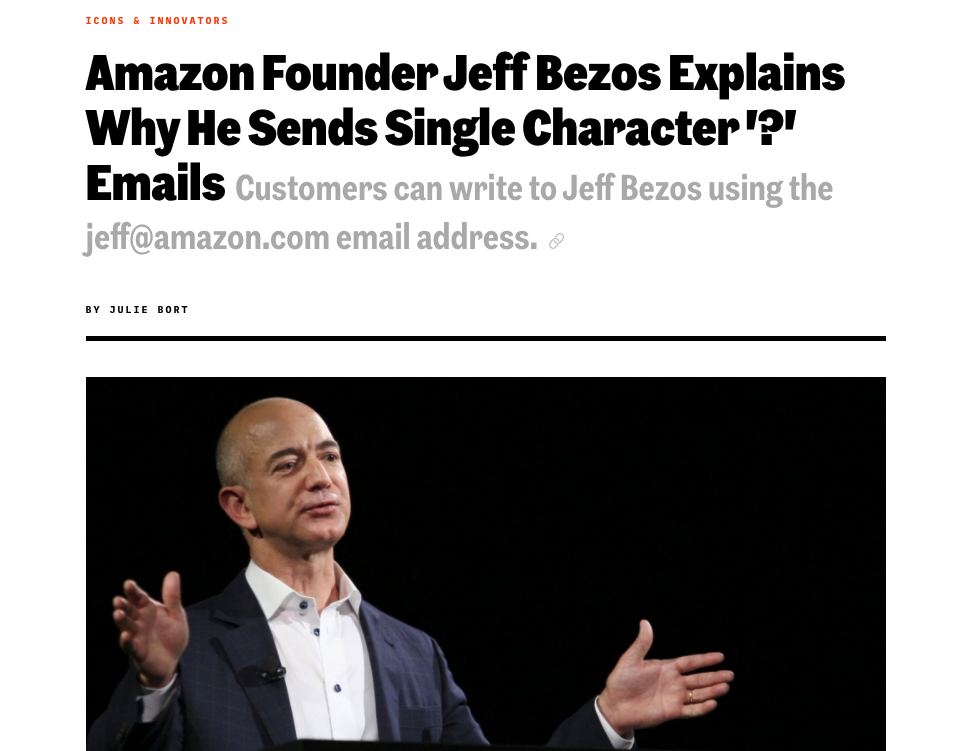
Figure: Jeff Bezos sends employees at Amazon question mark emails. They require an explaination. The explaination required is different at different levels of the management hierarchy. See this article.
One challenge at Amazon was what I call the “L4 to Q4 problem.” The issue when an graduate engineer (Level 4 in Amazon terminology) makes a change to the code base that has a detrimental effect but we only discover it when the 4th Quarter results are released (Q4).
The challenge in explaining what went wrong is a challenge in intellectual debt.
Executive Sponsorship
Another lever that can be deployed is that of executive sponsorship. My feeling is that organisational change is most likely if the executive is seen to be behind it. This feeds the corporate culture. While it may be a necessary condition, or at least it is helpful, it is not a sufficient condition. It does not solve the challenge of the institutional antibodies that will obstruct long term change. Here by executive sponsorship I mean that of the CEO of the organisation. That might be equivalent to the Prime Minister or the Cabinet Secretary.
A key part of this executive sponsorship is to develop understanding in the executive of how data driven decision making can help, while also helping senior leadership understand what the pitfalls of this decision making are.
Pathfinder Projects
I do exec education courses for the Judge Business School. One of my main recommendations there is that a project is developed that directly involves the CEO, the CFO and the CIO (or CDO, CTO … whichever the appropriate role is) and operates on some aspect of critical importance for the business.
The inclusion of the CFO is critical for two purposes. Firstly, financial data is one of the few sources of data that tends to be of high quality and availability in any organisation. This is because it is one of the few forms of data that is regularly audited. This means that such a project will have a good chance of success. Secondly, if the CFO is bought in to these technologies, and capable of understanding their strengths and weaknesses, then that will facilitate the funding of future projects.
In the DELVE data report (The DELVE Initiative, 2020), we translated this recommendation into that of “pathfinder projects.” Projects that cut across departments, and involve treasury. Although I appreciate the nuances of the relationship between Treasury and No 10 do not map precisely onto that of CEO and CFO in a normal business. However, the importance of cross cutting exemplar projects that have the close attention of the executive remains.
Commercial AI at scale needs executive sponsorship and clear decision rights. The Bezos examples are useful because they show how information architecture and leadership behaviour travel together. Without both, the technology stalls in pilots.
The Productivity Question
Productivity Flywheel
Figure: The productivity flywheel suggests technical innovation is reinvested.
The productivity flywheel should return the gains released by productivity through funding. This relies on the economic value mapping the underlying value.
Attention Reinvestment Cycle
Figure: The attention flywheel focusses on reinvesting human capital.
While the traditional productivity flywheel focuses on reinvesting financial capital, the attention flywheel focuses on reinvesting human capital - our most precious resource in an AI-augmented world. This requires deliberately creating systems that capture the value of freed attention and channel it toward human-centered activities that machines cannot replicate.
Supply Chain of Ideas
Model is “supply chain of ideas” framework, particularly in the context of information technology and AI solutions like machine learning and large language models. You suggest that this idea flow, from creation to application, is similar to how physical goods move through economic supply chains.
In the realm of IT solutions, there’s been an overemphasis on macro-economic “supply-side” stimulation - focusing on creating new technologies and ideas - without enough attention to the micro-economic “demand-side” - understanding and addressing real-world needs and challenges.
Imagining the supply chain rather than just the notion of the Innovation Economy allows the conceptualisation of the gaps between macro and micro economic issues, enabling a different way of thinking about process innovation.
Phrasing things in terms of a supply chain of ideas suggests that innovation requires both characterisation of the demand and the supply of ideas. This leads to four key elements:
- Multiple sources of ideas (diversity)
- Efficient delivery mechanisms
- Quick deployment capabilities
- Customer-driven prioritization
The next priority is mapping the demand for ideas to the supply of ideas. This is where much of our innovation system is failing. In supply chain optimisaiton a large effort is spent on understanding current stock and managing resources to bring the supply to map to the demand. This includes shaping the supply as well as managing it.
The objective is to create a system that can generate, evaluate, and deploy ideas efficiently and effectively, while ensuring that people’s needs and preferences are met. The customer here depends on the context - it could be the public, it could be a business, it could be a government department but very often it’s individual citizens. The loss of their voice in the innovation economy is a trigger for the gap between the innovation supply (at a macro level) and the innovation demand (at a micro level).
Classical productivity flywheels reinvest capital. In the AI era, the scarce input is human attention. Firms that free attention and then waste it on more shallow automation will not compound advantage. Firms that reinvest attention into judgment, relationships, and idea generation will.
Future Directions: Opportunity and New Forms of Debt
Before agents that act, one constraint from cybernetics. If the firm is still meant to regulate what its systems do, the people who own the risk must still be able to model those systems. That is the Good Regulator condition, and it is why we minimise.
The Good Regulator Theorem
Conant and Ashby: a regulator that successfully holds a system within bounds must, in effect, contain a model of that system (Conant and Ashby, 1970). An information-theoretic reading is that optimal regulation supports \(H(R|S)=0\) — the regulator’s action can be a deterministic function of system state. The practical reading for commercial leaders is sharper. If institutional judgement is still meant to regulate automated and agentic systems, those systems must remain modellable by the people who own the risk. Opacity is not merely an explainability preference; it is a failure of the regulator condition.
Model minimisation is the engineering corollary of the Good Regulator theorem. It is not aesthetic minimalism and not anti-capability. Capability that cannot be modelled by the judgement layer is capability the institution cannot regulate. The unit of design is the judgement-preserving interface — including an explicit abstain / escalate path.
Across cybernetics and organisational science this is the same object: Beer’s live regulator (Beer, 1979, 1972); Ashby’s law of requisite variety (Ashby, 1956); uncertainty absorption and exception handling (March and Simon, 1958); Galbraith’s information-processing view of organisation design (Galbraith, 1974); and the boundary between routine cases and escalated cases in knowledge hierarchies (Garicano, 2000). Agentic AI puts new stress on it because language becomes action at machine speed.
Harnesses and Small Models
We are seeing two phenomena emerging around how businesses are implementing their agentic systems. The first of which we might refer to as the unreasonable effectiveness of orchestration (Lawrence and Montgomery, 2026). Because these models emulate human behaviour they become more useful when they collaborate and call tools. This is inherited from people who, when well convened, can collaborate well and create an output that is greater than what those individuals could have done without communicating. The models can exploit the information infrastructure they are given.
THe second idea is model minimisation. This is the engineering corollary of the Good Regulator theorem (Conant and Ashby, 1970): keep the system small enough that the people who own the risk can still model what they oversee. Put together, commercial progress is not about “always use the largest model” it is more building harnesses around smaller models and enabling the delivery of routine cognitive work or cognitive toil.
A language model alone produces text and responses. A harness supplies tools, context, verification, and termination. The orchestration comes through the harness and is where much of the value is recovered.
OSCAR is a real-world harness, not a frontier-model demo. At Peterborough City Council, Julian Patmore and colleagues are building an orchestrated front door that routes resident requests to specialist services under central governance (such as guardrails, audit, and escalation) while leaving high-stakes judgment with council staff. That is the pattern: the people who know the role specify and monitor the harness. See e.g. the LGA case study.
Local Government AI Accelerator
The Local Government AI Accelerator is an ai@cam programme that pairs University of Cambridge researchers with local councils to develop practical, proof-of-concept AI solutions to real operational challenges. Funded by the Ministry of Housing, Communities and Local Government, it embeds councils as active partners from the outset rather than treating them as end-users of vendor products.
Projects include planning map automation, social housing maintenance, housing surveys, fly-tipping detection, and support for vulnerable tenants. The programme also places public concerns into the research process, building on ai@cam’s public dialogues on AI in local government.
See Cambridge launches AI Accelerator to help local government deploy AI.
ai@cam’s Local Government AI Accelerator is how Cambridge partners with councils on this class of work: proof-of-concept projects with local authorities as active partners from the outset, not as end-users of a centre-led drop. OSCAR sits in that same demand-side pattern — role-holders close to the work, university and civic partners in support.
We can think of cognitive toil as repetitive mental labour that does not exercise deep judgment but still (currently) consumes scarce human attention. Organisations are full of it. Model minimisation says: use the smallest decision-relevant model that reliably handles that routine class inside a harness with explicit escalate / abstain paths.
In contrast to typical digital deployments (e.g. the Horizon software system), a harness does not need to be a centre-led “platform drop.” It is introduced and monitored by the people who have been managing the role. This means e.g. the payroll lead, the triage nurse, the claims supervisor, the security on-call. Each of them already hold the tacit judgment layer: what is routine, what is anomaly, when to halt. Small models inside a harness keep the system modellable enough that those same people can own deployment, tune stop-conditions, and contest outputs.
The same point, put publicly: value arrives workflow by workflow, with the people who know the work — not as one centralised deployment.
AI arrives workflow by workflow
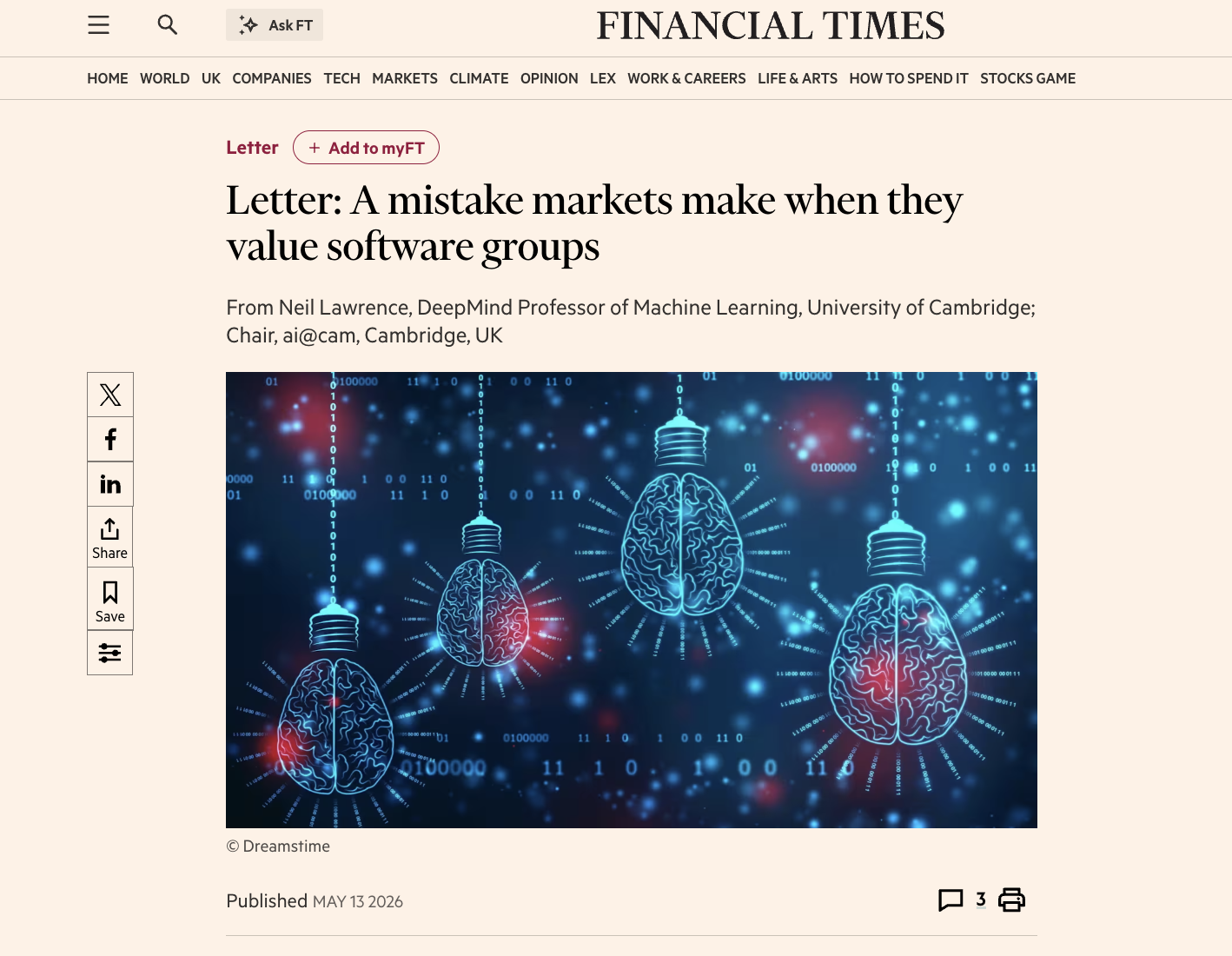
Figure: Letter in the FT: AI arrives workflow by workflow — markets err when they value software groups as if AI were one centralised deployment.
In a letter to the Financial Times (12 May 2026), I replied to reporting on Visma’s postponed IPO and to the question whether a group of some 170 businesses can “create the operational change centrally” for AI. That premise is wrong. AI is not one thing applied once from the centre. A payroll team in Oslo and a tax team in Lisbon face different regulations, customers and data. Federated structures, properly supported, sit closer to where that value is made — not further from it.
For software CEOs, founders and investors, the letter is a diligence filter. Seat counts and model features are easy to aggregate. Workflow-level adoption, with explicit judgment and recovery paths, is harder — and that is where durable value sits. The same confusion appears in policy when compute and frontier models are privileged over how people adopt tools inside their own institutions.
A mistake markets make when they value software groups
The FT letter argues for local adoption. The hazard is to hear “workflow by workflow” and then automate each workflow past the people who hold the judgment. Harnesses succeed when role-holders keep the live model: what is routine, what escalates, when to halt. If the harness replaces that judgment instead of surfacing it, the firm still looks productive while regulation fails. The process continues; the model does not. That is the start of agentic debt — and the reason model minimisation and role-held oversight travel together.
Agentic Debt
Agentic AI could pay down the technical debt and intellectual debt that plauges our deployment of complex systems. But in doing so it could create a new form of debt: agentic debt.
Agentic debt is the “new debt” introduced by systems that can act: the accrued risk and cost of operating delegated workflows without crisp boundaries. Unlike technical debt, e.g. emerging from engineering shortcuts, and intellectual debt emerging from (well engineered) complex systems, agentic debt is about unsafe or illegible delegation. Who (or what) can cause what action, on what evidence, with what recovery path?
Agentic systems — systems that can act — may pay down technical and intellectual debt. They can also create agentic debt: delegation without clear authority, evidence, or recovery. For CEOs, the governance question is becoming: who or what can cause what action, on what basis, with what stop-condition?
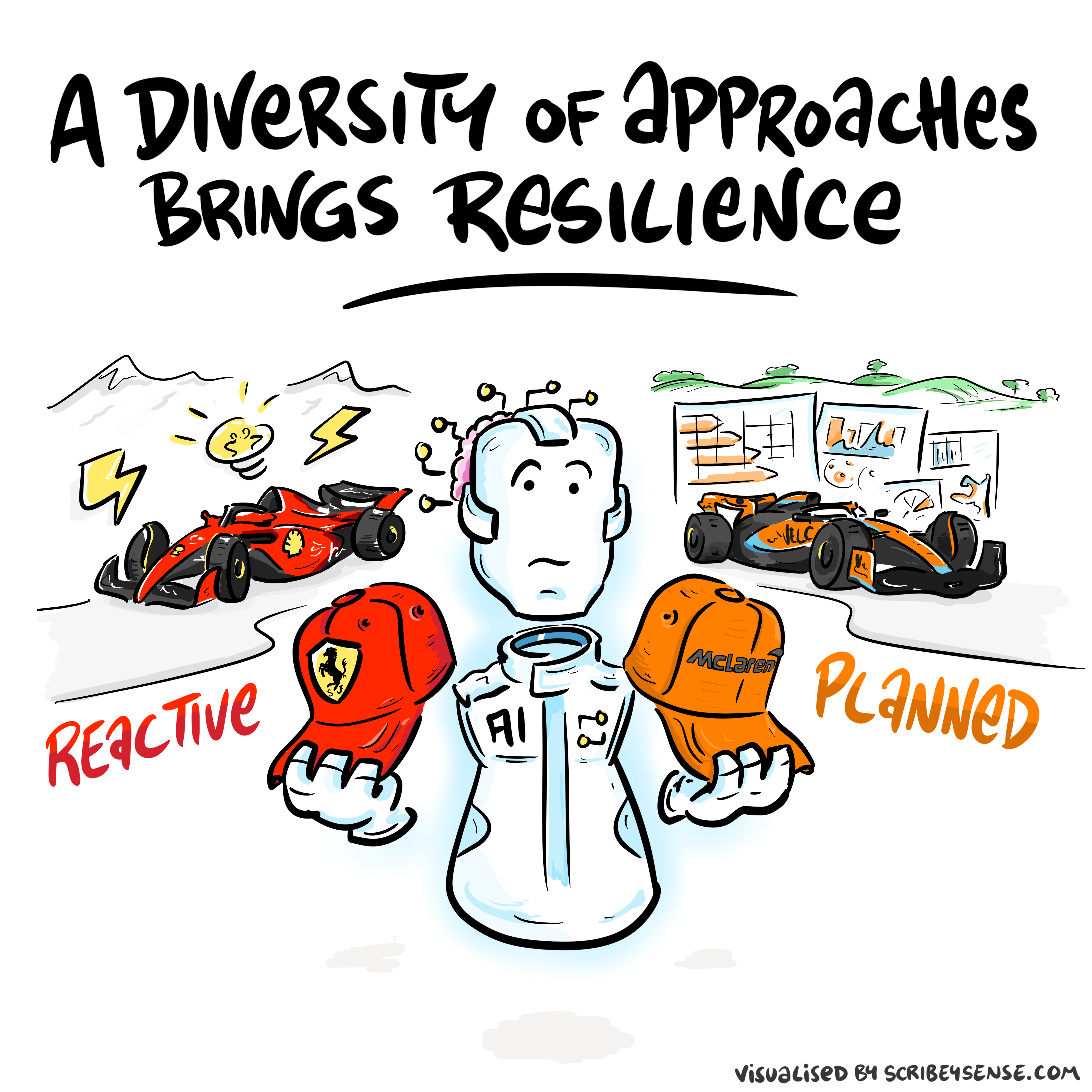
Figure: This is the drawing Dan was inspired to create for Chapter 6. It highlights how uncertainty means that a diversity of approaches brings resilience.
See blog post on Balancing Reflective and Reflexive..
From motor intelligence to mathematical instinct, it feels like there’s a full spectrum of decision-making approaches that can be deployed and that best performance is when they are judiciously deployed according to the circumstances. The Atomic Human tries to explore this in different contexts and I think Dan Andrews did a great job of capturing some of those explorations in his image for Chapter 7.
I think the reason why they relate is because in both cases there is time pressure, it’s from the outside world that pressures come and require us to deliver a conclusion on a particular timeframe. What I find remarkable in human intelligence is how we sustain both these fast and slow answers together, so that we’re ready to go with some form of answer at any given moment. That means that as individuals we are filled with contradictions, differences between the versions of our selves we imagine versus how we behave in practice.
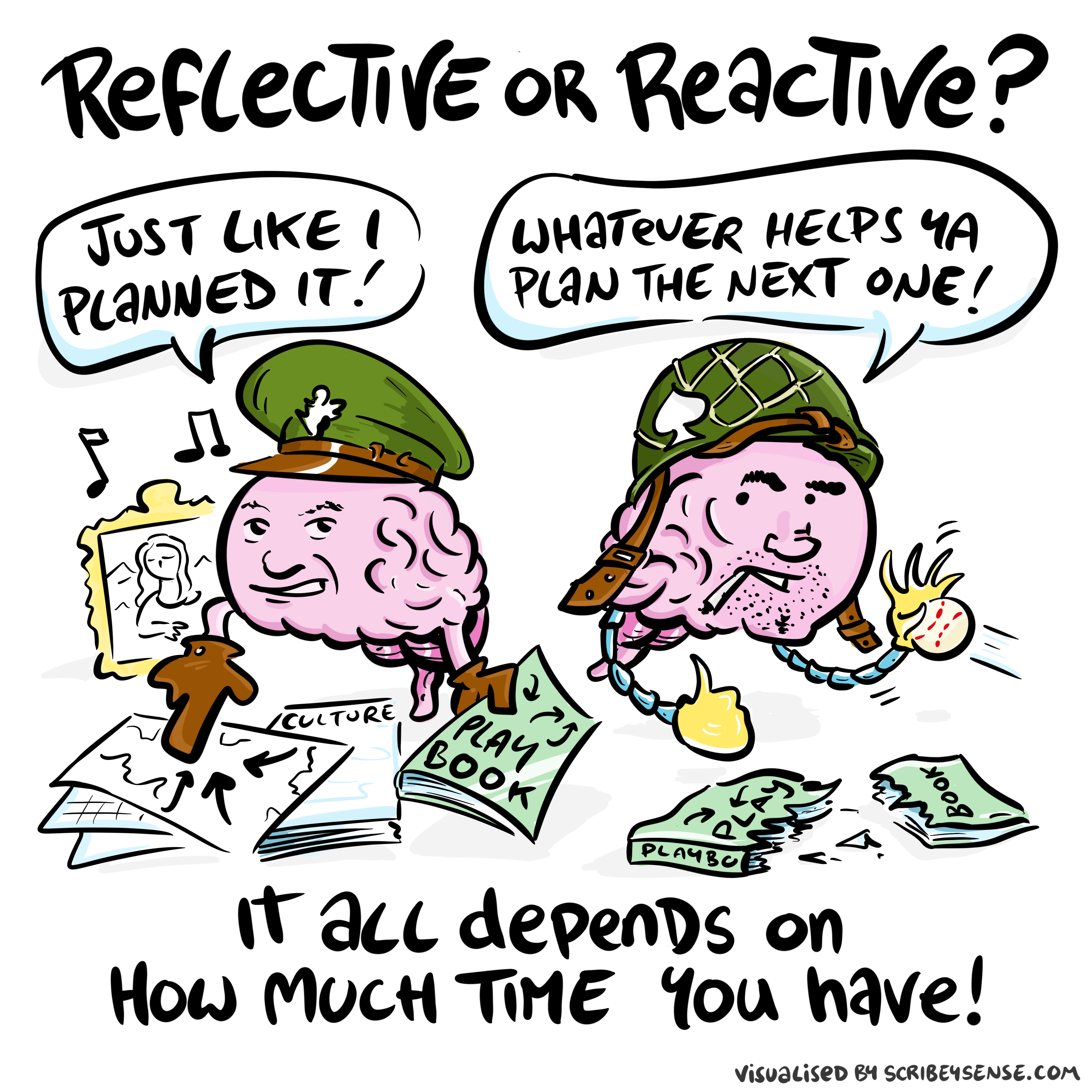
Figure: This is the drawing Dan was inspired to create for Chapter 7. Reflective and reactive approaches are driven by how much time is available for decision making.
See blog post on Racing, Fast and Slow..
Individuals and cultures can be more dominated by their reflexive or their reflective self. The arguments I make in The Gremlin of Uncertainty suggest that McLaren and Ferrari (in previous incarnations when then were dominating the F1 championship) were respectively dominated by planning and improvisational approaches. Similarly, I describe my father and brother’s approach as being respectively dominated by planning and improvisational approaches. There’s even a roundabout connection to how an individual chooses to react to a situation, with a reflexive or a reflective response. What Kahneman called slow or fast thinking.
Without knowing how much uncertainty we are facing, we don’t know which approach is better. In practice we see across individuals, cultures, nations and species that a diversity of approaches is taken. When we are certain planning can be more efficient, but it is less robust.
AI cannot replace atomic human

Figure: Opinion piece in the FT that describes the idea of a social flywheel to drive the targeted growth we need in AI innovation.
Wicked Problems
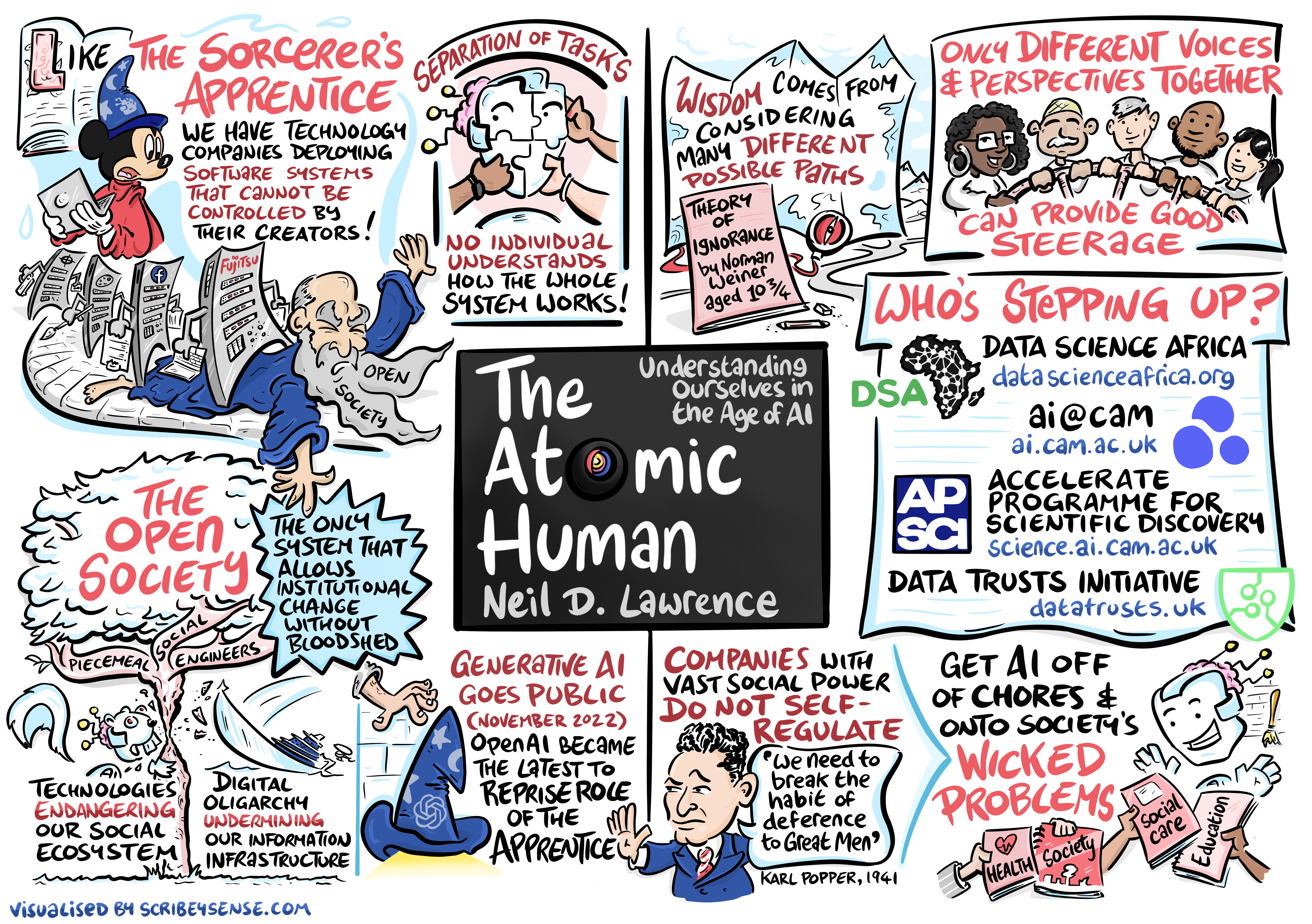
Figure: Society faces many wicked problems in health, education, security, and social care that require carefully deploying AI toward meaningful societal challenges rather than focusing on commercially appealing applications. (Illustration by Dan Andrews inspired by the Epilogue of “The Atomic Human” Lawrence (2024))
This illustration was created by Dan Andrews after reading the Epilogue of “The Atomic Human” book. The Epilogue discusses how we might deploy AI to address society’s most pressing challenges, and Dan’s drawing captures the various wicked problems we face and some of the initiatives that are looking to address them.
See blog post on Who is Stepping Up?.
A closing provocation for global business leaders: the largest commercial and societal returns may come from directing AI at problems that were previously too hard — not from shaving minutes off processes that already work. That is both a moral challenge and a strategic opportunity.
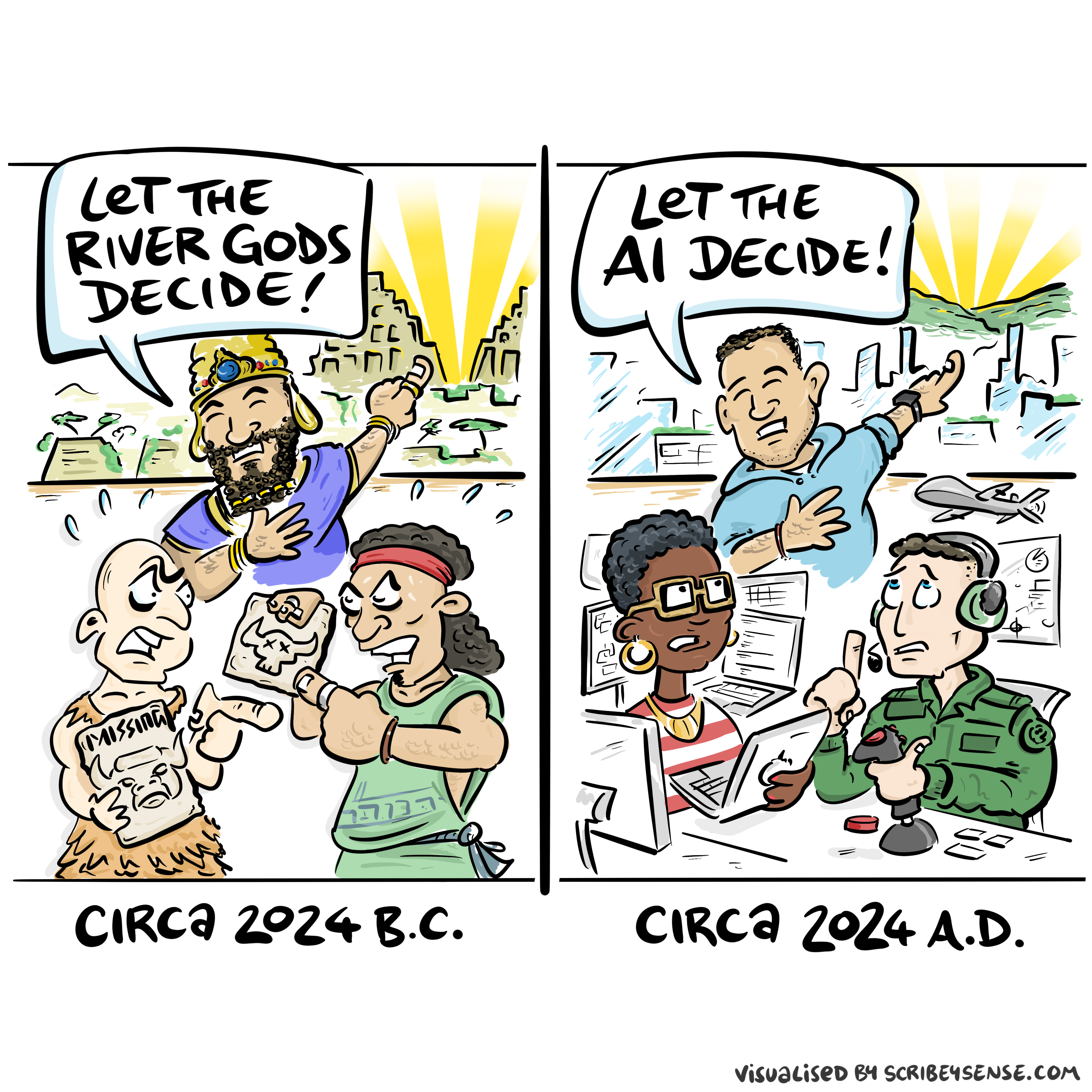
Figure: This is the drawing Dan was inspired to create for Chapter 11. It captures the core idea in our tendency to devolve complex decisions to what we perceive as greater authorities, but what are in reality ill equipped to deliver a human response.
See blog post on Playing in People’s Backyards..
In the past when decisions became too difficult, we invoked higher powers in the forms of gods, and “trial by ordeal.” Today we face a similar challenge with AI. When a decision becomes difficult there is a danger that we hand it to the machine, but it is precisely these difficult decisions that need to contain a human element.
The Atomic Human
Figure: The Atomic Human (Lawrence, 2024).
Close
Open for questions. Prefer concrete organisational examples from the room. If useful, return to one of the discussion maps and pressure-test it against the takeaways.
Thanks!
For more information on these subjects and more you might want to check the following resources.
- company: Trent AI
- book: The Atomic Human
- twitter: @lawrennd
- podcast: The Talking Machines
- newspaper: Guardian Profile Page
- blog: http://inverseprobability.com