AI Cannot Replace the Atomic Human
Abstract
Despite its transformative potential, artificial intelligence risks following a well-worn path where technological innovation fails to address society’s most pressing problems. As we transition from language models to agentic systems, the challenge isn’t just technical sophistication—it’s ensuring these advances serve real industrial and societal needs.
This talk examines this persistent gap through a lens inspired by innovation economics, with particular attention to Italy’s industrial heritage and the challenge of technology transfer. We explore why traditional market mechanisms have failed to map macro-level AI interventions to the micro-level needs of businesses and citizens, and what radical changes are needed to ensure that AI truly serves the Made in Italy ecosystem.
Artificial General Vehicle


Figure: The notion of artificial general intelligence is as absurd as the notion of an artificial general vehicle - no single vehicle is optimal for every journey. (Illustration by Dan Andrews inspired by a conversation about “The Atomic Human” Lawrence (2024))
This illustration was created by Dan Andrews inspired by a conversation about “The Atomic Human” book. The drawing emerged from discussions with Dan about the flawed concept of artificial general intelligence and how it parallels the absurd idea of a single vehicle optimal for all journeys. The vehicle itself is inspired by shared memories of Professor Pat Pending in Hanna Barbera’s Wacky Races.
I often turn up to talks with my Brompton bicycle. Embarrassingly I even took it to Google which is only a 30 second walk from King’s Cross station. That made me realise it’s become a sort of security blanket. I like having it because it’s such a flexible means of transport.
But is the Brompton an “artificial general vehicle?” A vehicle that can do everything? Unfortunately not, for example it’s not very good for flying to the USA. There is no artificial general vehicle that is optimal for every journey. Similarly there is no such thing as artificial general intelligence. The idea is artificial general nonsense.
That doesn’t mean there aren’t different principles to intelligence we can look at. Just like vehicles have principles that apply to them. When designing vehicles we need to think about air resistance, friction, power. We have developed solutions such as wheels, different types of engines and wings that are deployed across different vehicles to achieve different results.
Intelligence is similar. The notion of artificial general intelligence is fundamentally eugenic. It builds on Spearman’s term “general intelligence” which is part of a body of literature that was looking to assess intelligence in the way we assess height. The objective then being to breed greater intelligences (Lyons, 2022).
The Atomic Human
Figure: The Atomic Eye, by slicing away aspects of the human that we used to believe to be unique to us, but are now the preserve of the machine, we learn something about what it means to be human.
The development of what some are calling intelligence in machines, raises questions around what machine intelligence means for our intelligence. The idea of the atomic human is derived from Democritus’s atomism.
In the fifth century bce the Greek philosopher Democritus posed a question about our physical universe. He imagined cutting physical matter into pieces in a repeated process: cutting a piece, then taking one of the cut pieces and cutting it again so that each time it becomes smaller and smaller. Democritus believed this process had to stop somewhere, that we would be left with an indivisible piece. The Greek word for indivisible is atom, and so this theory was called atomism.
The Atomic Human considers the same question, but in a different domain, asking: As the machine slices away portions of human capabilities, are we left with a kernel of humanity, an indivisible piece that can no longer be divided into parts? Or does the human disappear altogether? If we are left with something, then that uncuttable piece, a form of atomic human, would tell us something about our human spirit.
See Lawrence (2024) atomic human, the p. 13.
Embodiment Factors: Walking vs Light Speed
Imagine human communication as moving at walking pace. The average person speaks about 160 words per minute, which is roughly 2000 bits per minute. If we compare this to walking speed, roughly 1 m/s we can think of this as the speed at which our thoughts can be shared with others.
Compare this to machines. When computers communicate, their bandwidth is 600 billion bits per minute. Three hundred million times faster than humans or the equiavalent of \(3 \times 10 ^{8}\). In twenty minutes we could be a kilometer down the road, where as the computer can go to the Sun and back again..
This difference is not just only about speed of communication, but about embodiment. Our intelligence is locked in by our biology: our brains may process information rapidly, but our ability to share those thoughts is limited to the slow pace of speech or writing. Machines, in comparison, seem able to communicate their computations almost instantaneously, anywhere.
So, the embodiment factor is the ratio between the time it takes to think a thought and the time it takes to communicate it. For us, it’s like walking; for machines, it’s like moving at light speed. This difference means that most direct comparisons between human and machine need to be carefully made. Because for humans not the size of our communication bandwidth that counts, but it’s how we overcome that limitation..
Philosopher’s Stone
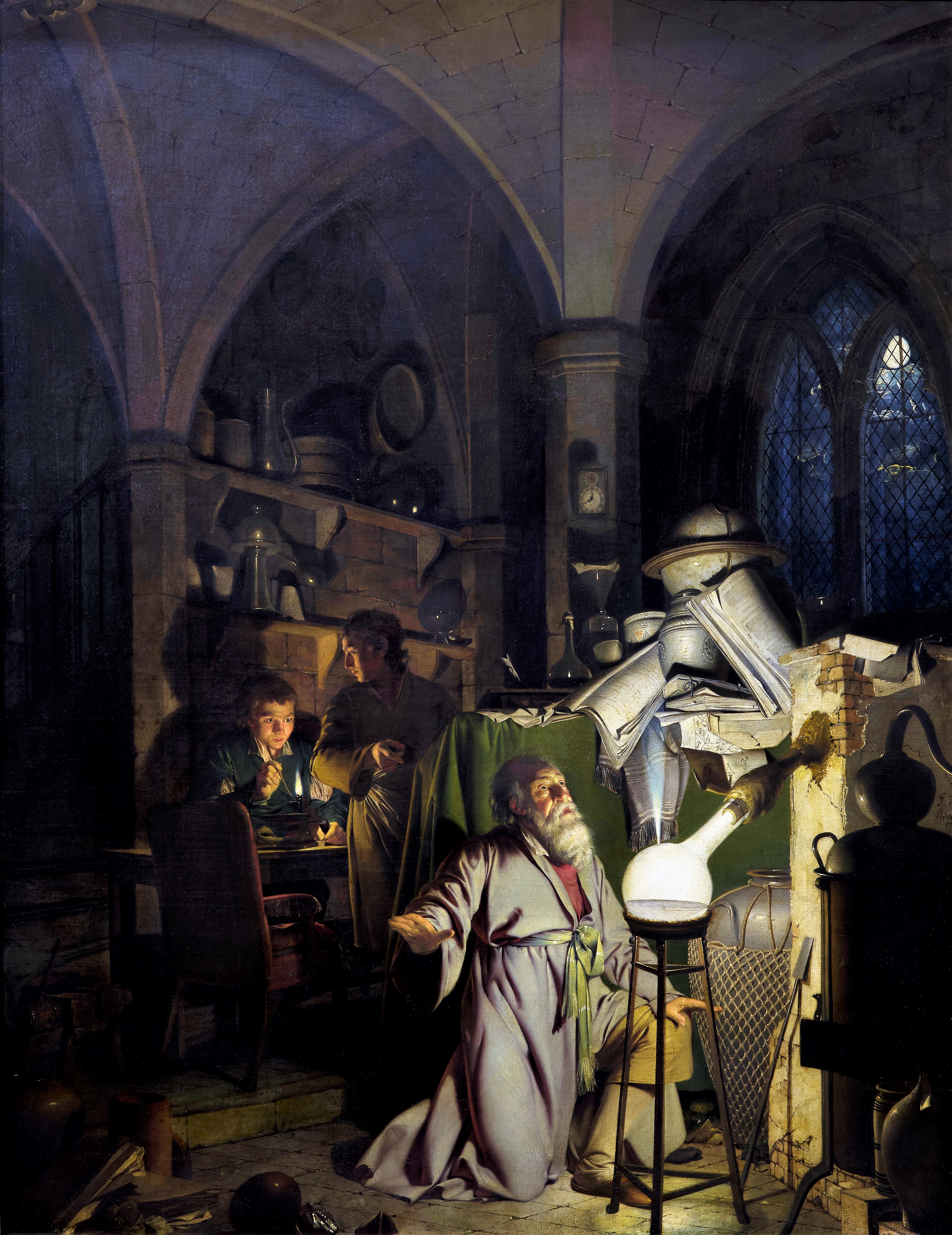
Figure: The Alchemist by Joseph Wright of Derby (1771). The picture depicts Hennig Brand discovering the element phosphorus when searching for the Philosopher’s Stone.
The philosopher’s stone is a mythical substance that can convert base metals to gold.
In our modern economy, automation has the same effect as the philosopher’s stone. During the industrial revolution, steel and steam replaced human manual labour. Today, silicon and electrons are being combined to replace human mental labour. But as Italy’s industrial districts have shown us, the real value isn’t in the machine, it’s in the human networks and knowledge that surround it.
The Attention Economy
Herbert Simon on Information
What information consumes is rather obvious: it consumes the attention of its recipients. Hence a wealth of information creates a poverty of attention …
Simon (1971)
The attention economy was a phenomenon described in 1971 by the American computer scientist Herbert Simon. He saw the coming information revolution and wrote that a wealth of information would create a poverty of attention. Too much information means that human attention becomes the scarce resource, the bottleneck. It becomes the gold in the attention economy.
The power associated with control of information dates back to the invention of writing. By pressing reeds into clay tablets Sumerian scribes stored information and controlled the flow of information.
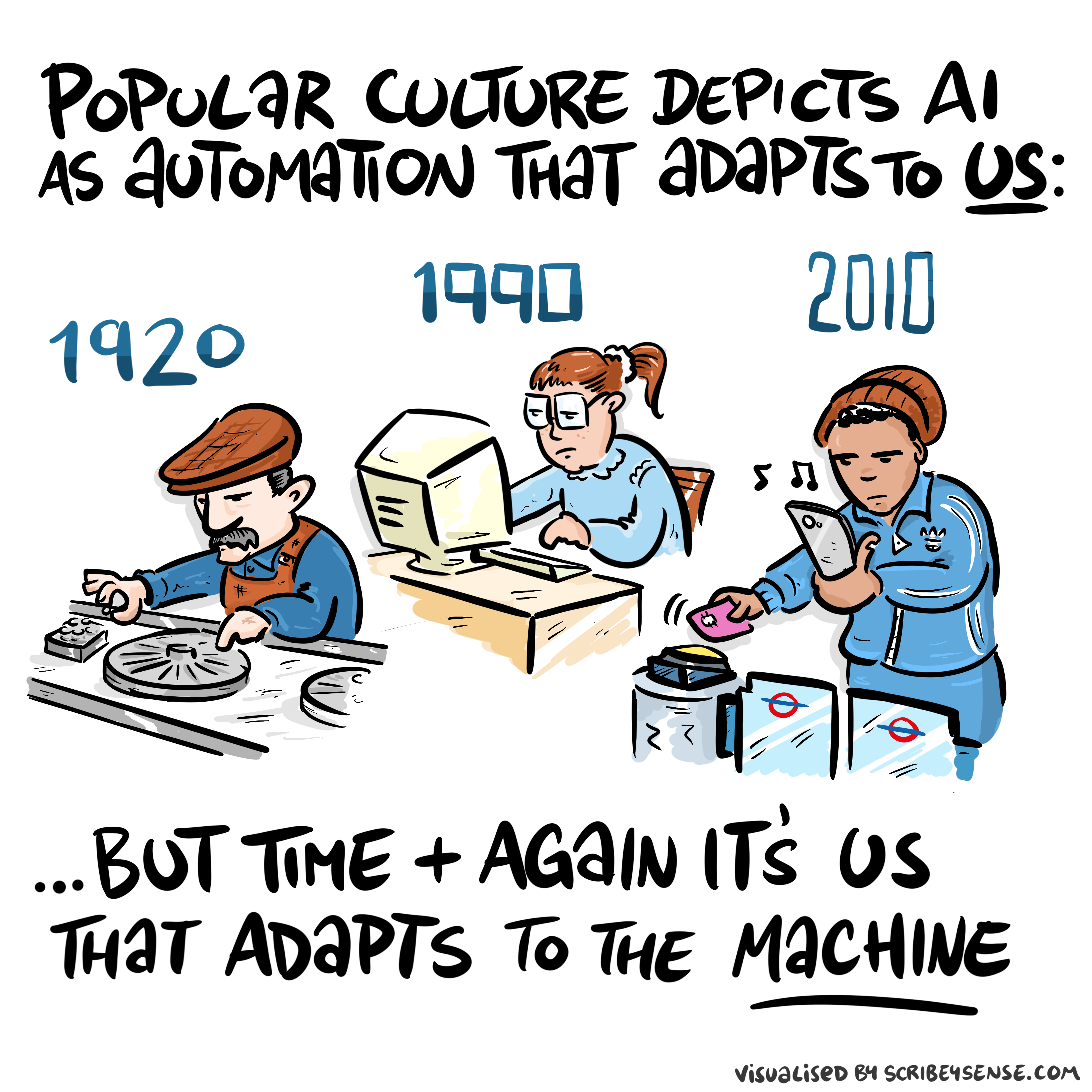
Figure: This is the drawing Dan was inspired to create for Chapter 9. It captures the core idea in the Great AI Fallacy, that over time it has been us adapting to the machine rather than the machine adapting to us.
See blog post on The Great AI Fallacy..
The Great AI Fallacy is the idea that the machine can adapt and respond to us, when in reality we find that it is us that have to adapt to the machine.
Human Capital Index
The World Bank’s human capital index is one area where many European countries are leading international economy, or at least an area where they currently outperform both the USA and China. The index is a measure of education and health of a population.
Technological progress disrupts existing systems. A new social contract is needed to smooth the transition and guard against rising inequality. Significant investments in human capital throughout a person’s lifecycle are vital to this effort.
World Bank (2019)]
In the 2020 version of the index, the UK was ranked 11th, Italy 30th, US 35th and China 45th.
For Italy there is a deficit in human capital, more exported than imported. For US and UK there is a surplus.
From Language Models to Agents
As we transition from large language models to agentic systems with reasoning capabilities, we face a critical choice. Will these AI agents serve the productivity flywheel—accelerating the conversion of attention into economic value? Or will they help us redirect that attention toward solving society’s most pressing problems?
Il Made in Italy e l’Intelligenza Artificiale
Italy’s industrial success has always been built on something that’s difficult to automate: the deep tacit knowledge embedded in industrial districts, the human judgment in design and craft, the social capital that enables innovation networks. The distretti industriali of Emilia-Romagna, the design clusters of Milan, the manufacturing networks of Piemonte, these succeed not despite their human-centeredness, but because of it.
Technology Transfer: The Real Challenge
The Competence Centers you’re building, like CIM 4.0 in Turin, understand something crucial: technology transfer isn’t about deploying models, it’s about building capability. It’s about ensuring that AI serves the micro-level needs of Italian businesses—the SMEs, the artisans, the manufacturing networks—not just the macro-level metrics of productivity.
Distretti Industriali e Reti di Innovazione
The historical industrial districts of Italy, from the silk producers of Emilia Romagna to the metallurgical clusters of Brescia, succeeded through interconnected dependencies, local communities, and talent development. A craft culture being shared across generations. Today’s AI infrastructure should support these networks, not replace them.
The Next Three Years
As we look toward the next triennium, the question isn’t whether we can build more sophisticated AI agents or more efficient small models. The question is whether we can build the institutional frameworks, i.e. the competence centers, the digital infrastructure, the innovation networks that ensure these technologies serve Italian businesses and citizens, not just global platform economics.
Micro not Macro Economic
While macro economic conditions can help (or hinder), fundamentally this is not a macro economic problem. Regulation can set guardrails, but it cannot solve the adoption problem, i.e. helping businesses understand where AI adds value and where it undermines trust. The challenge is micro economic: it involves supporting businesses, small and medium enterprises, to adopt a technology that can increase their reach and their efficiency without undermining what differentiates them, their atomic core. This is about firm-level capabilities, business model fit, and market incentives, not top-down policy alone.
Thanks!
For more information on these subjects and more you might want to check the following resources.
- company: Trent AI
- book: The Atomic Human
- twitter: @lawrennd
- podcast: The Talking Machines
- newspaper: Guardian Profile Page
- blog: http://inverseprobability.com