Educating the Atomic Human
Abstract
What we believe intelligence to be shapes what we choose to cultivate, measure and automate. Our notion of intelligence has been degraded by simplistic ideas of artificial intelligence largely driven by commercial interests.
Our fascination with artificial intelligence stems from the perceived uniqueness of human intelligence. Fears of AI concern not only how it invades our digital lives, but the implied threat of an intelligence that displaces us from our position at the centre of the world.
Atomism, proposed by Democritus, suggested it was impossible to continue dividing matter into ever smaller components: eventually we reach a point where a cut cannot be made. In the same way, by slicing away at the facets of human intelligence that can be replaced by machines, AI uncovers what is left: an indivisible core that is the essence of humanity.
This keynote contrasts our own evolved, locked-in, embodied intelligence with the capabilities of machine intelligence. It asks what current AI systems can and cannot tell us about human intelligence; and what that means for our how we educate in the age of AI. What we believe intelligence to be shapes what we choose to cultivate, measure and automate. That is the central question for education in the age of AI.
Our fascination with artificial intelligence stems from the perceived uniqueness of human intelligence. Fears of AI concern not only how it invades our digital lives, but the implied threat of an intelligence that displaces us from our position at the centre of the world.
Atomism, proposed by Democritus, suggested it was impossible to continue dividing matter into ever smaller components: eventually we reach a point where a cut cannot be made (the Greek for uncuttable is ‘atom’). In the same way, by slicing away at the facets of human intelligence that can be replaced by machines, AI uncovers what is left: an indivisible core that is the essence of humanity.
This keynote contrasts our own evolved, locked-in, embodied intelligence with the capabilities of machine intelligence. It asks what current AI systems can and cannot tell us about human intelligence; which human capabilities may be placed at risk through poorly considered automation; and how AI might be developed and used in ways that augment human knowledge, judgement and expertise.
Either AI is a tool for us, or we become a tool of AI. Understanding this will enable us to choose the future we want for education.
The target is not a technical catalogue of AI capability but the institutional reaction to AI challenges. Killer AI narratives often trigger disempowerment: they make the future feel inevitable, alien and ungovernable. The talk should bring the agency back to teachers, learners, universities, public institutions and civic society.
This Scribeysense image is Narcissus staring into his reflection (after Caravaggio’s Narcissus, housed in the Galleria Nazionale d’Arte Antica in Rome). It’s a deliberately “mythic” framing: gods and robots are how we tempt ourselves to think about AI, but we also centre the intelligence in our context. It is a distorted reflection of us that fascinates us, whether or not that’s how the technology operates. For leaders, that framing is usually a trap. The real risk is not a human-like entity that outsmarts us, but the scaling of systems that make (and automate) decisions, shaped by incentives and feedback loops. Keep the conversation anchored on decisions, information, failure modes, and accountability.
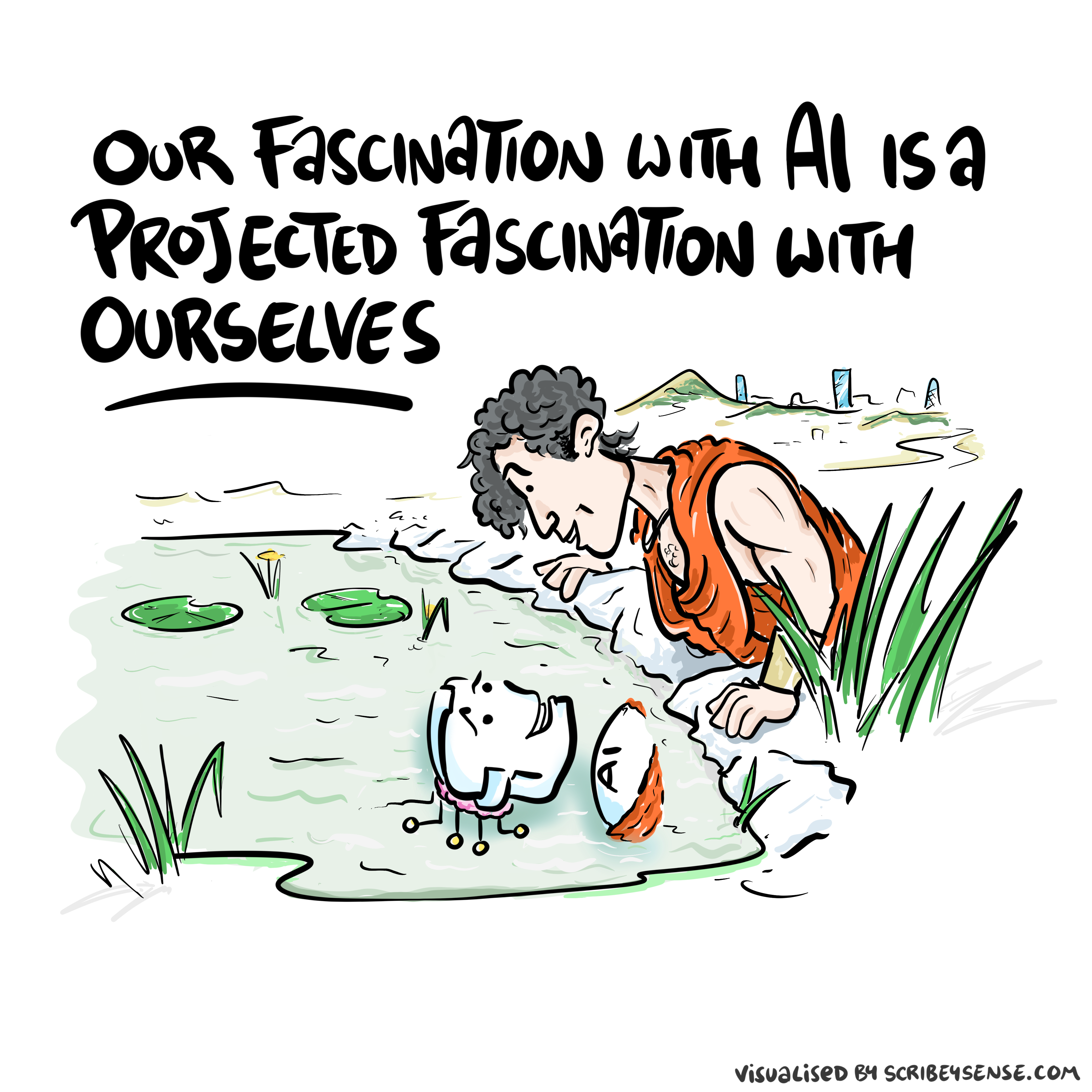
Figure: This is the drawing Dan was inspired to create for Chapter 1: Narcissus staring into his reflection (after Caravaggio’s Narcissus). It captures the fundamentally narcissistic nature of our (societal) obsession with our intelligence.
See Lawrence (2024) Terminator image embodies p. 7, 9, 12, 13, 21, 30, 31, 216, 220, 257, 333, 353. See Lawrence (2024) Terminator (movie character) p. 7, 9, 12, 13, 21, 30, 31, 216, 220, 257, 333, 353. See Lawrence (2024) anthropomorphization (‘anthrox’) p. 30-31, 90-91, 93-4, 100, 132, 148, 153, 163, 216-17, 239, 276, 326, 342.
AI in education is not a question of whether a machine is intelligent in the abstract. It is a question of what systems we build, who they serve, and what human capabilities they strengthen or weaken.
Why
Artificial General Vehicle

Figure: The notion of artificial general intelligence is as absurd as the notion of an artificial general vehicle - no single vehicle is optimal for every journey. (Illustration by Dan Andrews inspired by a conversation about “The Atomic Human” Lawrence (2024))
This illustration was created by Dan Andrews inspired by a conversation about “The Atomic Human” book. The drawing emerged from discussions with Dan about the flawed concept of artificial general intelligence and how it parallels the absurd idea of a single vehicle optimal for all journeys. The vehicle itself is inspired by shared memories of Professor Pat Pending in Hanna Barbera’s Wacky Races.
I often turn up to talks with my Brompton bicycle. Embarrassingly I even took it to Google which is only a 30 second walk from King’s Cross station. That made me realise it’s become a sort of security blanket. I like having it because it’s such a flexible means of transport.
But is the Brompton an “artificial general vehicle?” A vehicle that can do everything? Unfortunately not, for example it’s not very good for flying to the USA. There is no artificial general vehicle that is optimal for every journey. Similarly there is no such thing as artificial general intelligence. The idea is artificial general nonsense.
That doesn’t mean there aren’t different principles to intelligence we can look at. Just like vehicles have principles that apply to them. When designing vehicles we need to think about air resistance, friction, power. We have developed solutions such as wheels, different types of engines and wings that are deployed across different vehicles to achieve different results.
Intelligence is similar. The notion of artificial general intelligence is fundamentally eugenic. It builds on Spearman’s term “general intelligence” which is part of a body of literature that was looking to assess intelligence in the way we assess height. The objective then being to breed greater intelligences (Lyons, 2022).
The first response to disempowerment is conceptual. If we accept the myth of a single ladder of intelligence, then AI appears as a machine climbing past us. But human intelligence is not a single quantity. It is a collection of capabilities that operate in context: in bodies, in relationships, in institutions, in cultures.
Embodiment Factors: Walking vs Light Speed
Imagine human communication as moving at walking pace. The average person speaks about 160 words per minute, which is roughly 2000 bits per minute. If we compare this to walking speed, roughly 1 m/s we can think of this as the speed at which our thoughts can be shared with others.
Compare this to machines. When computers communicate, their bandwidth is 600 billion bits per minute. Three hundred million times faster than humans or the equiavalent of \(3 \times 10 ^{8}\). In twenty minutes we could be a kilometer down the road, where as the computer can go to the Sun and back again..
This difference is not just only about speed of communication, but about embodiment. Our intelligence is locked in by our biology: our brains may process information rapidly, but our ability to share those thoughts is limited to the slow pace of speech or writing. Machines, in comparison, seem able to communicate their computations almost instantaneously, anywhere.
So, the embodiment factor is the ratio between the time it takes to think a thought and the time it takes to communicate it. For us, it’s like walking; for machines, it’s like moving at light speed. This difference means that most direct comparisons between human and machine need to be carefully made. Because for humans not the size of our communication bandwidth that counts, but it’s how we overcome that limitation..
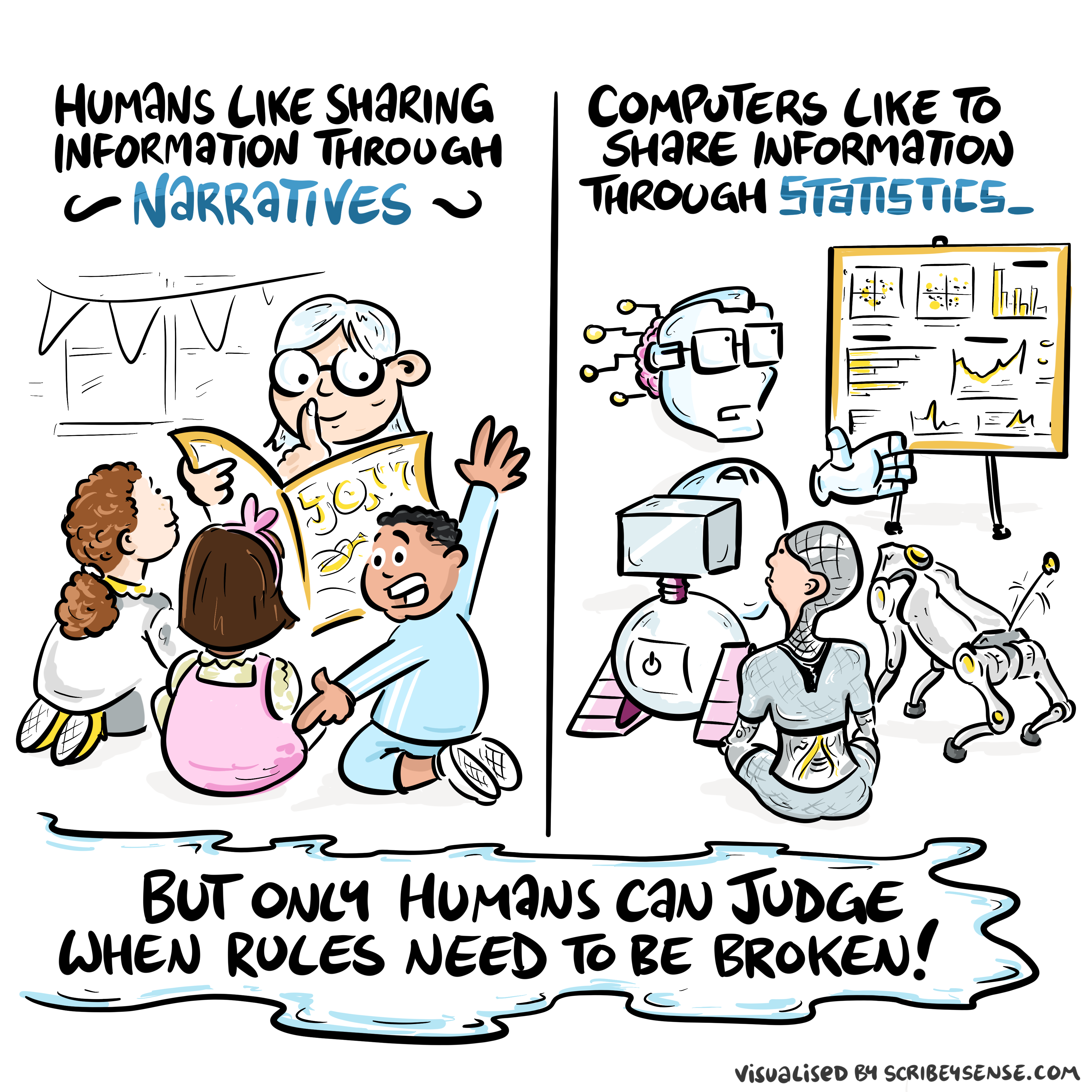
Figure: This is the drawing Dan was inspired to create for Chapter 2. It captures part of the narrative where human actors choose to follow the spirit of their instructions, and are empowered to do so because they have wider context. They can operate autonomously. Whereas machines have typically operated on data and statistics and can’t bring in context so normally operate as automatons.
See blog post on Dan Andrews image of narratives vs statistics..
What
Revolution
Arguably the information revolution we are experiencing is unprecedented in history. But changes in the way we share information have a long history. Over 5,000 years ago in the city of Uruk, on the banks of the Euphrates, communities which relied on the water to irrigate their corps developed an approach to recording transactions in clay. Eventually the system of recording system became sophisticated enough that their oral histories could be recorded in the form of the first epic: Gilgamesh.
See Lawrence (2024) cuneiform p. 337, 360, 390.

Figure: Chicago Stone, side 2, recording sale of a number of fields, probably from Isin, Early Dynastic Period, c. 2600 BC, black basalt
It was initially developed for people as a record of who owed what to whom, expanding individuals’ capacity to remember. But over a five hundred year period writing evolved to become a tool for literature as well. More pithily put, writing was invented by accountants not poets (see e.g. this piece by Tim Harford).
In some respects today’s revolution is different, because it involves also the creation of stories as well as their curation. But in some fundamental ways we can see what we have produced as another tool for us in the information revolution.

Figure: Guardian Media Network, March 2015: Beware the rise of the digital oligarchy. The worry was not runaway machines, but humans concentrating power through data and algorithms.
Guardian article on Beware the rise of the digital oligarchy
Eleven years ago I wrote in the Guardian that we should worry less about the rise of the machines than about a digital oligarchy: concentrating the power that comes with data in few hands. Panel 1 has set out what that concentration costs. The AI wave has not invented the problem. It has thickened it. Concentration still stops value spreading. That is the thread from that piece to today.
The Risk of Digital Autocracy
The digital revolution has shifted power into the hands of those who control data and algorithmic decision-making. In ancient societies, scribes preserved their power through strict controls on who could read and write, deciding what forms of writing were considered authoritative. In Europe, this institutional protection eroded with the emergence of printing in the fifteenth century, dispersing power through the modern professions Fischer (2001).
Today, control has shifted into what we might call the digital oligarchy. The modern scribe is the software engineer and their guild is the tech company, but society has not yet evolved to align the power these entities have with the social responsibilities needed to ensure wise deployment Lawrence (2024).
The attention economy leads to a challenge where automated decision-making is combined with asymmetry of information access. Some have more control of data than others, creating power imbalances. This phenomenon leads to what has been described as “algorithmic attention rents” - excess returns over what would normally be available in a competitive market O’Reilly et al. (2023).
In 1944, Karl Popper responded to the threat of fascism with “The Open Society and its Enemies,” emphasizing that change in the open society comes through trusting our institutions and their members - the piecemeal social engineers Popper (1945). The failure to engage these social engineers leads to failures like the Horizon scandal and the failur of the National Programme for IT (the Lorenzo project, Justinia (2017)). We cannot afford to make those mistakes again, as they would lead to a dysfunctional digital autocracy that would be difficult or even impossible to recover from.
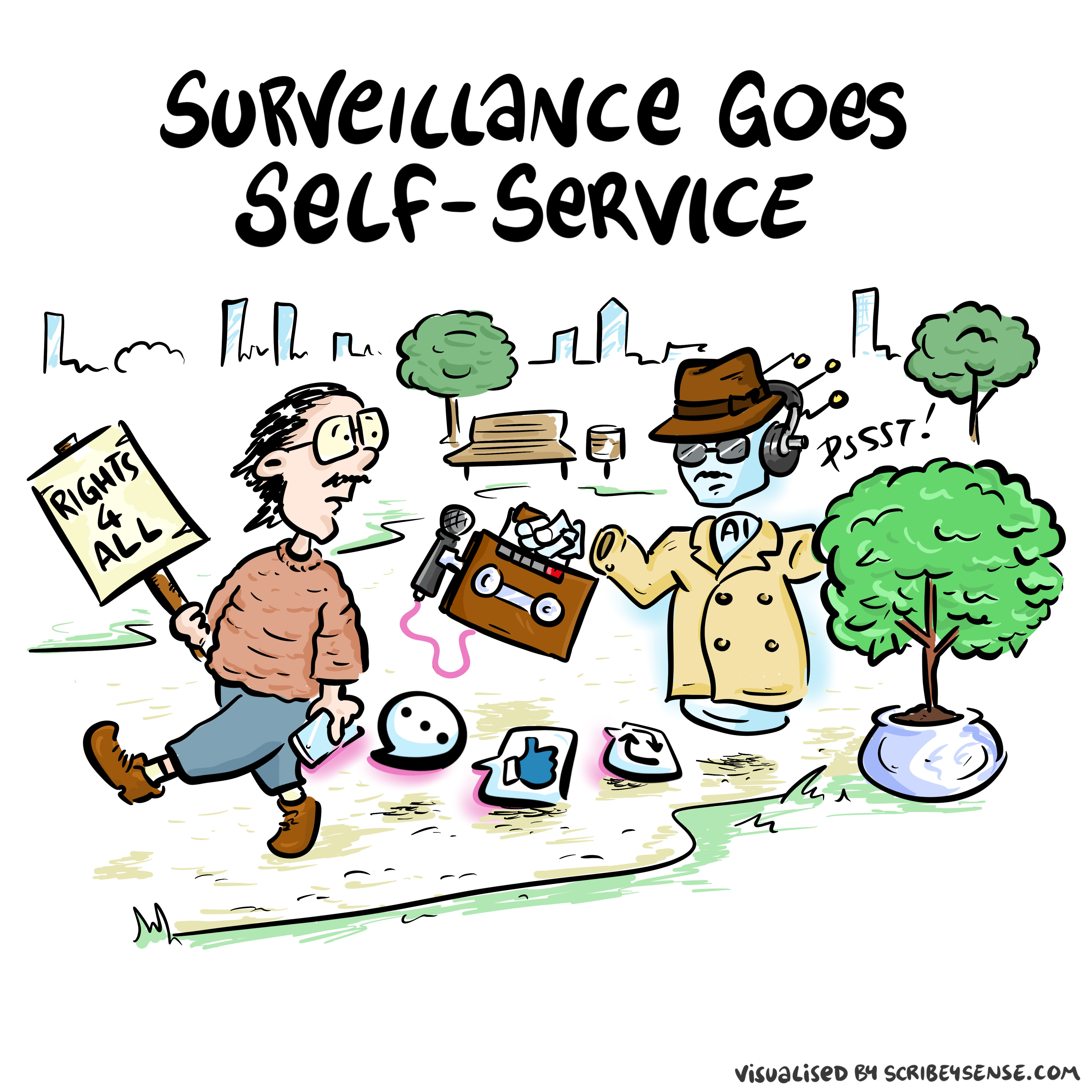
Figure: This is the drawing Dan was inspired to create for Chapter 10. The warning suggests that we should be wary of large companies that accumulate power through vast accumulation of our personal data. Today, with the advent of generative AI, we could add “our creative data” to this. It calls the power structures that result the “digital oligarchy.”
See blog post on A Retrospective on Digital Oligarchy..
Like the Sorcerer’s Apprentice
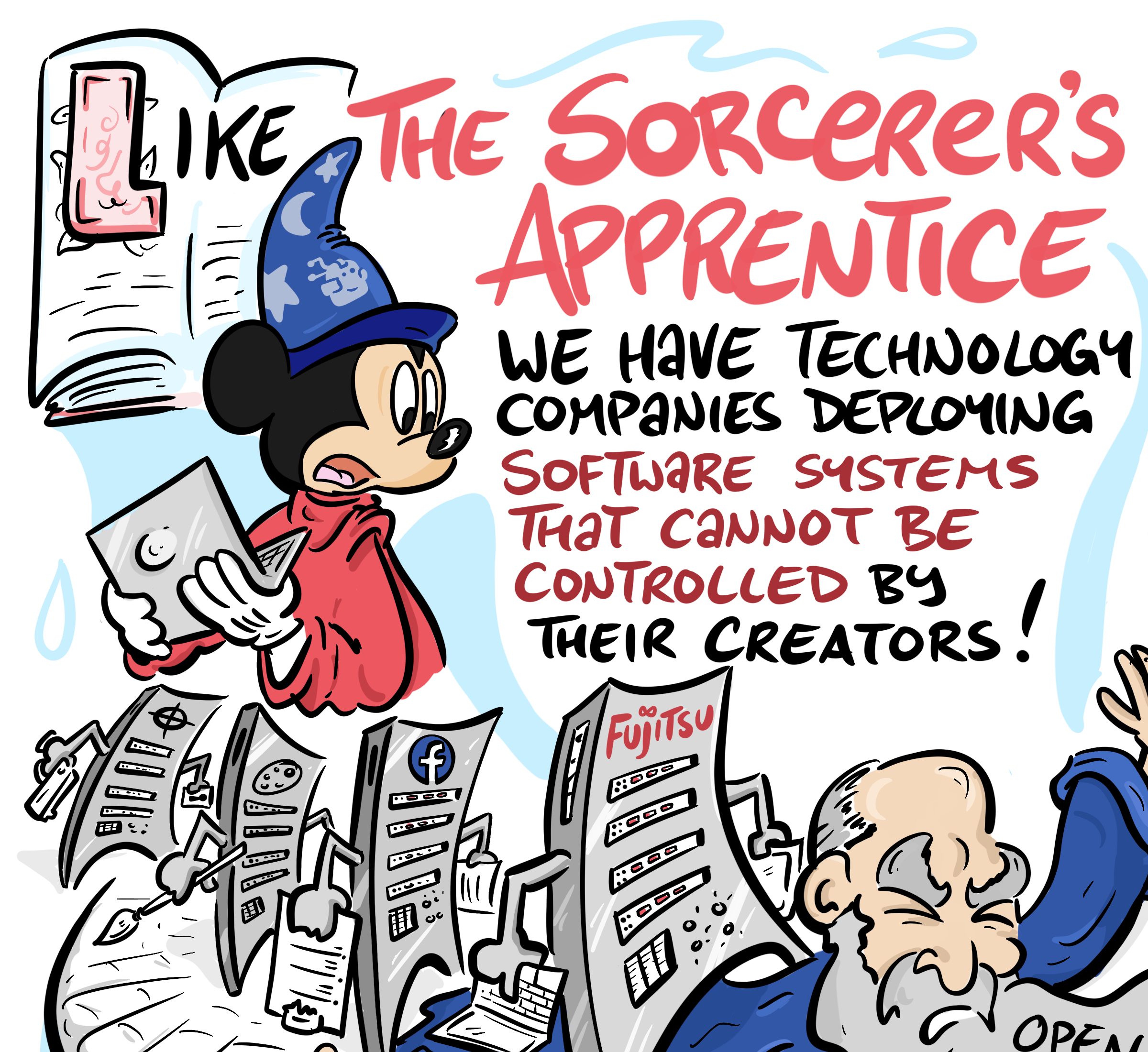
Figure: Like the sorcerer’s apprentice, we have technology companies deploying software systems that cannot be controlled by their creators. Detail from Dan Andrews’ Epilogue illustration for The Atomic Human Lawrence (2024).
This panel from Dan Andrews’ Epilogue drawing restates the sorcerer’s apprentice metaphor with contemporary logos: server-racks march as enchanted brooms while the apprentice stares at a laptop. The point is not that machines become conscious. It is that creators and institutions can lose practical control of systems they have already released.
See blog post on Who is Stepping Up?.
River Gods
Why does this happen? When decisions become too difficult, societies have always been tempted to invoke a higher power and step back. Today that temptation is to let the model decide. The point is not a rule about which cases machines may touch. It is that without enfranchisement we stop being accountable: we outsource judgement precisely where human responsibility is most needed.
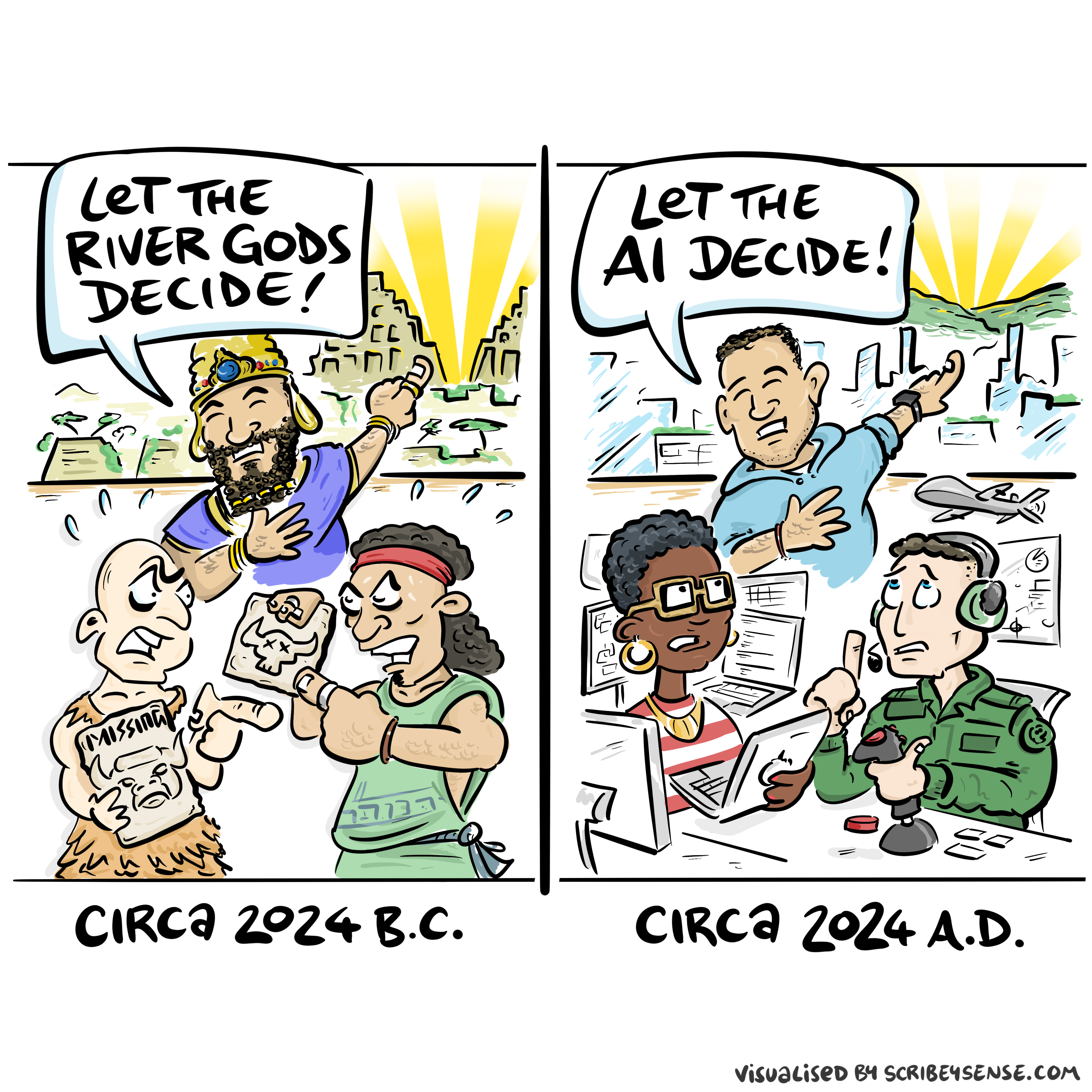
Figure: This is the drawing Dan was inspired to create for Chapter 11. It captures the core idea in our tendency to devolve complex decisions to what we perceive as greater authorities, but what are in reality ill equipped to deliver a human response.
See blog post on Playing in People’s Backyards..
In the past when decisions became too difficult, we invoked higher powers in the forms of gods, and “trial by ordeal.” Today we face a similar challenge with AI. When a decision becomes difficult there is a danger that we hand it to the machine, but it is precisely these difficult decisions that need to contain a human element.
The What is human accountability: people and institutions must remain able to see what a system did, contest it, and take responsibility for outcomes. That is enfranchisement. The Mesopotamian scribes model shows how it fails: when only a specialist class can read and rewrite the record, everyone else is locked out of power. AI recreates that pattern if capability concentrates inside a digital oligarchy.
AI in Education: Public Perspectives
In education discussions, participants strongly supported AI’s potential to reduce teacher workload but expressed significant concerns about screen time and the importance of human interaction in learning.
A clear distinction emerged between support for AI in administrative tasks versus direct teaching roles. Participants emphasized that core aspects of education require human qualities that AI cannot replicate.
Key quotes illustrate these views:
“Education isn’t just about learning, it’s about preparing children for life, and you don’t do all of that in front of a screen.”
Public Participant, Cambridge ai@cam and Hopkins Van Mil (2024) pg 18
“Kids with ADHD or autism might prefer to interact with an iPad than they would a person, it could lighten the load for them.”
Public Participant, Liverpool ai@cam and Hopkins Van Mil (2024) pg 17
The dialogue revealed particular concern about the risk of AI increasing screen time and reducing social interaction, while acknowledging potential benefits for personalized learning support.
How
Mind the Gap
With Jessica Montgomery we set this out in Mind the gap: connecting AI innovation to widespread public value Lawrence and Montgomery (2026), developed from the Bennett Institute Public Policy Annual Lecture (video). Public dialogues give a clear demand signal for AI on society’s wicked problems. The innovation system has largely advanced along another trajectory. Closing that gap is the missing half of UK AI policy: not only supply of models and infrastructure, but demand-side capacity for institutions to adapt tools to local need.
Piecemeal Social Engineers
Karl Popper introduced the concept of “piecemeal social engineers” in his seminal work “The Open Society and Its Enemies.” This approach advocates for incremental, careful changes to social institutions rather than wholesale revolutionary transformations. The piecemeal social engineer recognizes that we cannot predict all consequences of our actions and therefore must proceed carefully, learning from mistakes.
In the context of AI and technological change, we need modern piecemeal social engineers who can: 1. Bridge between different domains of expertise 2. Understand both technical and social implications 3. Make careful, reversible changes 4. Build feedback mechanisms into deployments 5. Maintain democratic accountability
This approach is relevant as we deploy AI systems that fundamentally alter social institutions. Failures of digitalsystems like Horizon and Lorenzo demonstrate what happens when we ignore the need for careful, piecemeal change and instead attempt wholesale transformation without adequate feedback mechanisms.
The Open Society
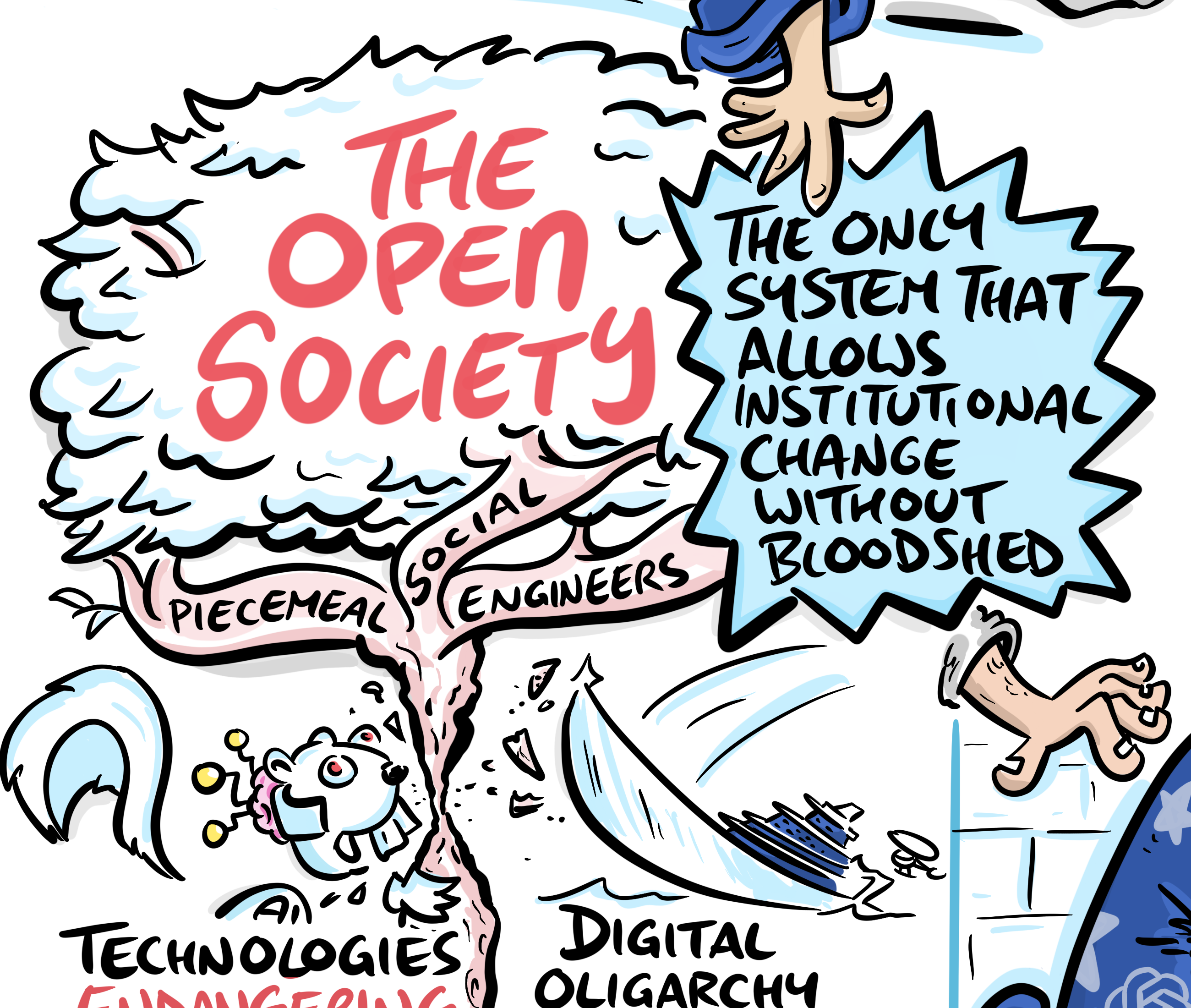
Figure: The open society and its piecemeal social engineers: the only system that allows institutional change without bloodshed. Detail from Dan Andrews’ Epilogue illustration for The Atomic Human Lawrence (2024).
Popper’s piecemeal social engineers are the people who make careful, reversible institutional change. In an AI transition they are teachers, administrators, clinicians, regulators and civic technologists — not only the vendors writing the code.
Society’s Wicked Problems
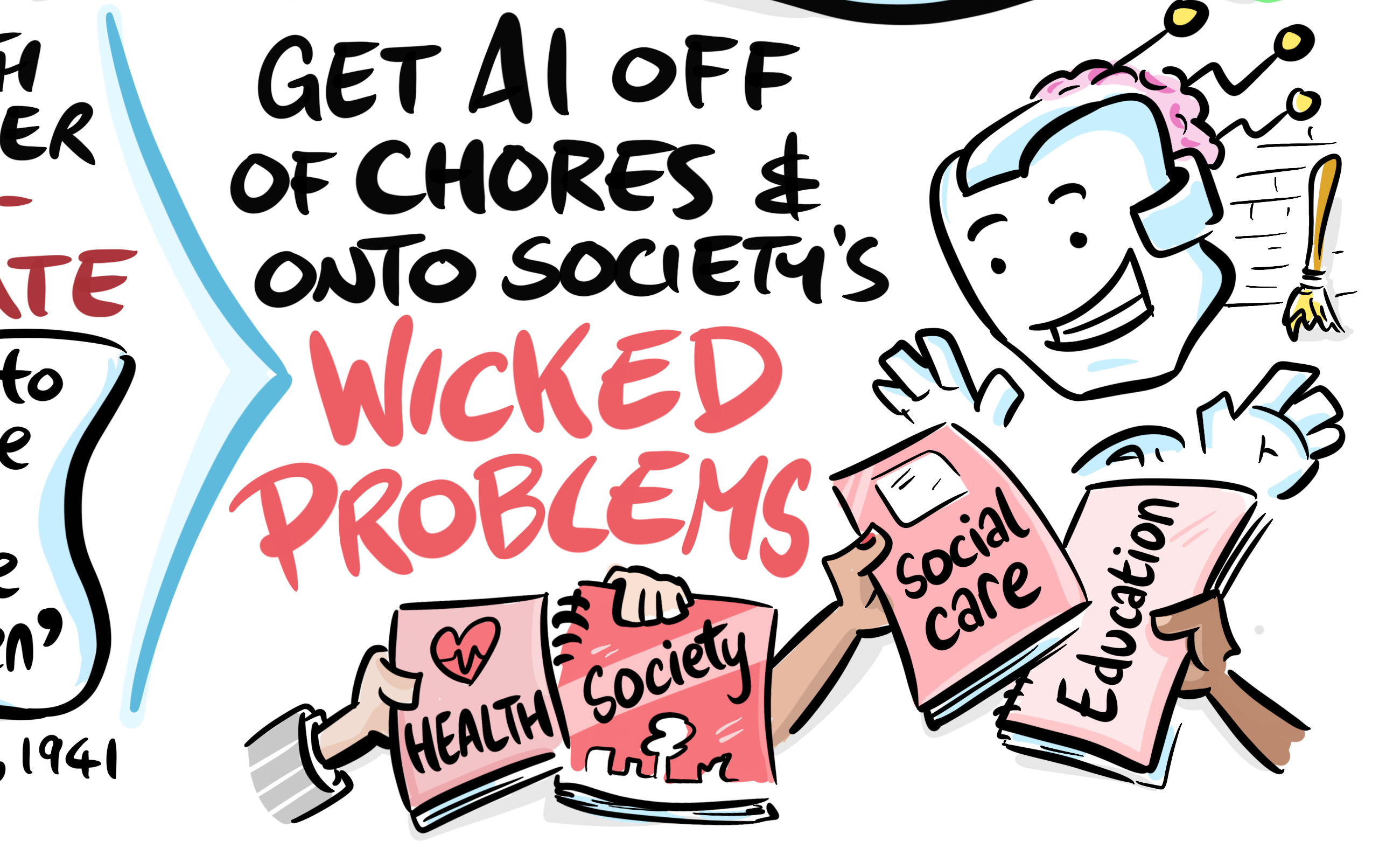
Figure: Get AI off of chores and onto society’s wicked problems: health, society, social care, education. Detail from Dan Andrews’ Epilogue illustration for The Atomic Human Lawrence (2024).
The closing ask of the Epilogue is redirection: stop treating AI mainly as a way to automate chores, and put it onto the domains where human attention is most needed and most constrained — including education.
The Attention Reinvestment Cycle
Traditional innovation models in technology assume that productivity improvements translate directly into financial returns. However, when it comes to deploying AI in sectors of public importance, this model often fails because the economic incentives don’t align with societal needs.
The attention reinvestment cycle represents an alternative approach to innovation deployment. Instead of focusing primarily on financial returns, it recognizes that efficiency gains can be measured through the liberation of human attention - our most precious resource in the digital age.
Figure: The attention reinvestment cycle represents a new approach to deploying innovation where the value created is measured in freed human attention rather than purely financial returns.
In the attention reinvestment cycle, technology deployments that free up human attention in critical domains like healthcare, education, and social services create value by allowing professionals to focus on the human aspects of their work that cannot be automated. The freed attention is reinvested through networks that share knowledge and best practices, creating a virtuous cycle that builds capacity throughout the system.
This model is particularly well-suited to sectors where human attention is both vitally important and chronically constrained. By prioritizing attention liberation over pure financial returns, it creates a pathway for innovation to address societal needs even when traditional market incentives are insufficient. This approach has been explored in the African context through initiatives like Data Science Africa Lawrence (2015).
The practical method is not automation for its own sake. It is attention reinvestment: free human attention, then put it back into learning, care and judgement. Popper’s open society supplies the institutional how. Change comes through piecemeal social engineers — people who make careful, reversible improvements inside institutions — not through deference to a few Great Men or a single general intelligence.
Do
Example: Data Science Africa
Data Science Africa is a grass roots initiative that focuses on capacity building to develop ways of solving on the ground problems in health, education, transport and conservation in way that is grounded in local needs and capabilities.
Data Science Africa
Figure: Data Science Africa https://datascienceafrica.org is a ground up initiative for capacity building around data science, machine learning and artificial intelligence on the African continent.
Figure: Data Science Africa meetings held up to October 2021.
Data Science Africa is a bottom up initiative for capacity building in data science, machine learning and artificial intelligence on the African continent.
As of June 2025 there have been thirteen workshops and schools, located in seven different countries: Nyeri, Kenya (three times); Kampala, Uganda; Arusha, Tanzania (twice); Abuja, Nigeria; Addis Ababa, Ethiopia; Accra, Ghana; Kampala, Uganda and Kimberley, South Africa (virtual), Kigali, Rwanda and Ibadan, Nigeria.
DSA Ibadan, Nigeria
Figure: Organiser’s video from Data Science Africa held in Ibadan, Nigeria from 2nd to 6th June 2025
The main notion is end-to-end data science. For example, going from data collection in the farmer’s field to decision making in the Ministry of Agriculture. Or going from malaria disease counts in health centers to medicine distribution.
The philosophy is laid out in (Lawrence, 2015). The key idea is that the modern information infrastructure presents new solutions to old problems. Modes of development change because less capital investment is required to take advantage of this infrastructure. The philosophy is that local capacity building is the right way to leverage these challenges in addressing data science problems in the African context.
Data Science Africa is now a non-govermental organization registered in Kenya. The organising board of the meeting is entirely made up of scientists and academics based on the African continent.
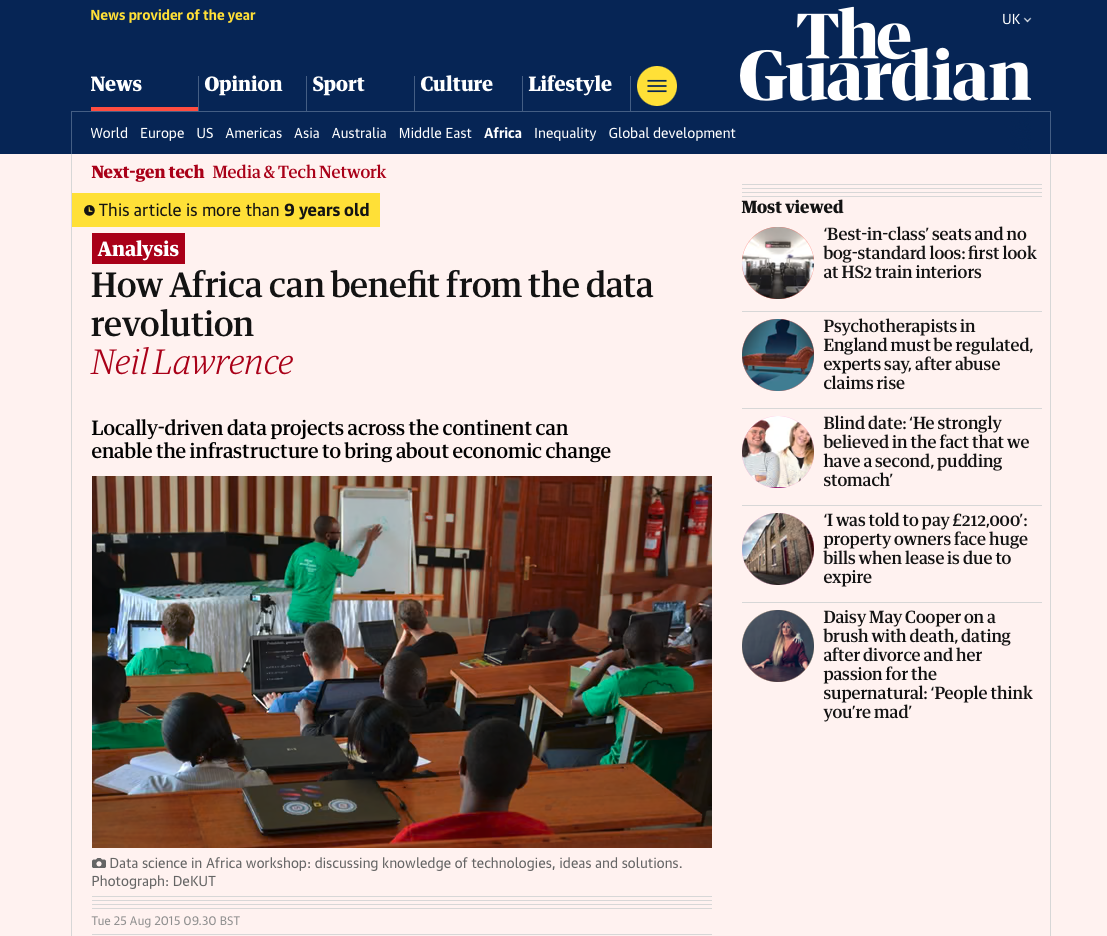
Figure: The lack of existing physical infrastructure on the African continent makes it a particularly interesting environment for deploying solutions based on the information infrastructure. The idea is explored more in this Guardian op-ed on Guardian article on How African can benefit from the data revolution.
Guardian article on Data Science Africa
Local Government AI Accelerator
The Local Government AI Accelerator is an ai@cam programme that pairs University of Cambridge researchers with local councils to develop practical, proof-of-concept AI solutions to real operational challenges. Funded by the Ministry of Housing, Communities and Local Government, it embeds councils as active partners from the outset rather than treating them as end-users of vendor products.
Projects include planning map automation, social housing maintenance, housing surveys, fly-tipping detection, and support for vulnerable tenants. The programme also places public concerns into the research process, building on ai@cam’s public dialogues on AI in local government.
See Cambridge launches AI Accelerator to help local government deploy AI.
Example: OSCAR
OSCAR (Orchestrated Service & Citizen AI Router) is a vendor-agnostic framework from Peterborough City Council for a single digital front door across local government services. Julian Patmore and colleagues are building it as a real-world harness, not a frontier-model demo. Councils have been adopting AI in silos — parking bots, fault reporting, social prescribing — which fragments the resident experience and duplicates governance. OSCAR separates orchestration from specialist capability: it routes requests to the right service agent under shared guardrails, PII redaction, permissions and audit, while leaving high-stakes judgment with council staff.
The platform is designed to run across web, WhatsApp and voice, and to sit on existing systems rather than replace them. It is still early — proof of concept, with a roadmap from librarian (FAQ / RAG) through specialist tools to a true concierge that joins up transactions — but the pattern is the one we want: role-holders close to the work specifying and monitoring the system. See the LGA case study.
Document
Good Steerage
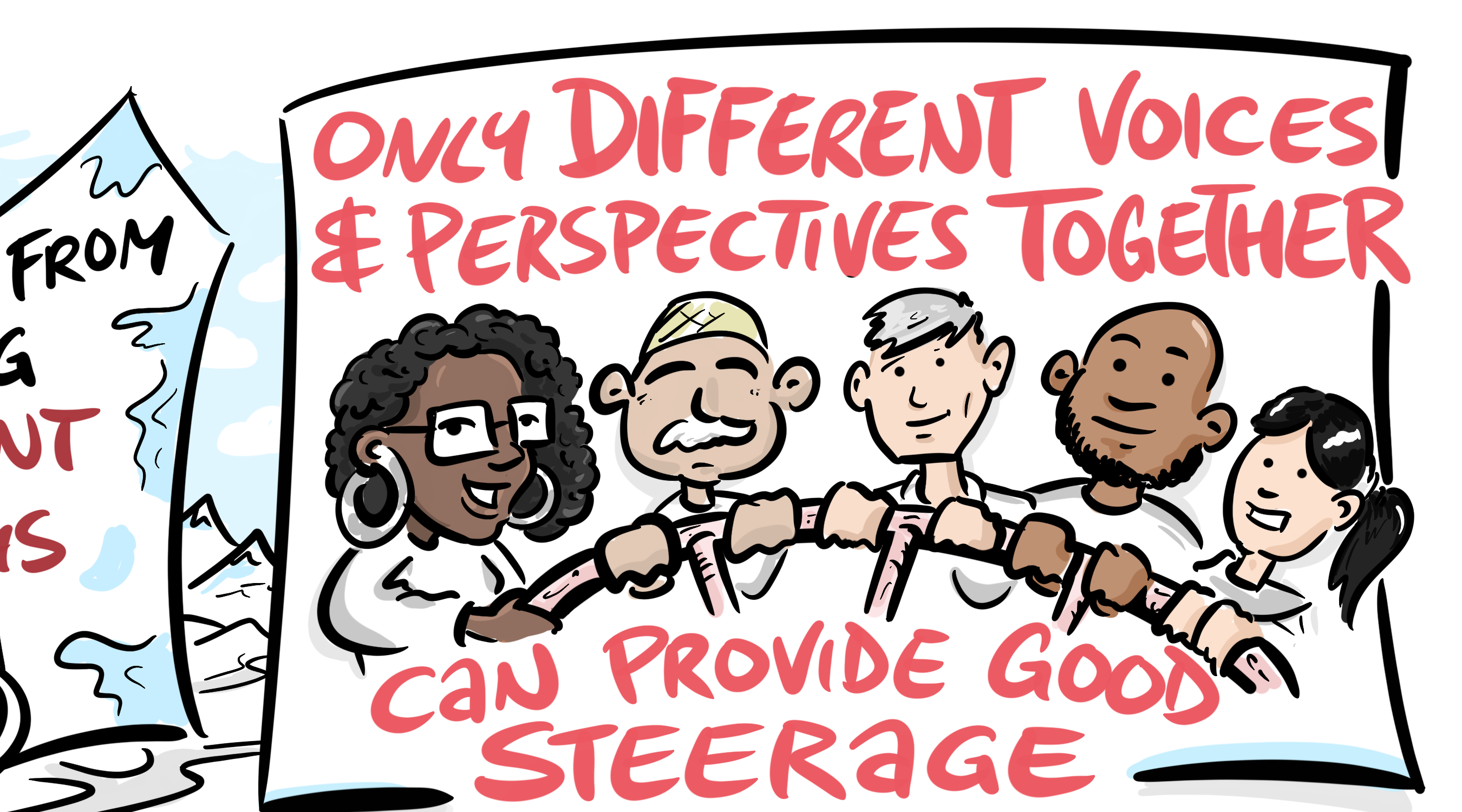
Figure: Only different voices and perspectives together can provide good steerage. Detail from Dan Andrews’ Epilogue illustration for The Atomic Human Lawrence (2024).
Steerage is a collective act. In education that means teachers, learners, parents, assessors and technologists all holding the tiller — not deferring to a single vendor or a single metric of intelligence.
Documentation is a civic act in an AI transition. If each school, department or university learns privately, power returns to vendors and consultants. If people share what they tried, what worked, what failed, and what evidence they used, then capability spreads across the system.
The antidote to disempowerment is not another grand prediction. It is a visible culture of practice: people trying things, documenting them, learning from one another and celebrating those who build shared capability.
AI in Education

Figure: AI in Education is a charity that helps schools and colleges adopt AI through an educator-led certification framework.
AI in Education is a UK charity whose AiEd Certified framework gives schools and colleges a structured way to audit AI practice, appoint champions, draft policy and share evidence. The Explorer workbook asks narrative, context-specific questions rather than chasing a perfect score. Early evaluation with participating institutions reports rising confidence and clearer strategic direction.
For this audience the point is documentation as capability-building: schools that write down what they are doing can compare practice, celebrate progress and avoid becoming passive customers of vendor narratives. Prefer the discovery-call link over an email address when pointing people onward.
Conclusion
Thanks!
For more information on these subjects and more you might want to check the following resources.
- company: Trent AI
- book: The Atomic Human
- twitter: @lawrennd
- podcast: The Talking Machines
- newspaper: Guardian Profile Page
- blog: http://inverseprobability.com