Jaynes’ World
Abstract
The relationship between physical systems and intelligence has long fascinated researchers in computer science and physics. This talk explores fundamental connections between thermodynamic systems and intelligent decision-making through the lens of free energy principles.
We examine how concepts from statistical mechanics - particularly the relationship between total energy, free energy, and entropy - might provide novel insights into the nature of intelligence and learning. By drawing parallels between physical systems and information processing, we consider how measurement and observation can be viewed as processes that modify available energy. The discussion encompasses how model approximations and uncertainties might be understood through thermodynamic analogies, and explores the implications of treating intelligence as an energy-efficient state-change process.
While these connections remain speculative, they offer a potential shared language for discussing the emergence of natural laws and societal systems through the lens of information.
Hydrodynamica
When Laplace spoke of the curve of a simple molecule of air, he may well have been thinking of Daniel Bernoulli (1700-1782). Daniel Bernoulli was one name in a prodigious family. His father and brother were both mathematicians. Daniel’s main work was known as Hydrodynamica.

Figure: Daniel Bernoulli’s Hydrodynamica published in 1738. It was one of the first works to use the idea of conservation of energy. It used Newton’s laws to predict the behaviour of gases.
Daniel Bernoulli described a kinetic theory of gases, but it wasn’t until 170 years later when these ideas were verified after Einstein had proposed a model of Brownian motion which was experimentally verified by Jean Baptiste Perrin.
Figure: Daniel Bernoulli’s chapter on the kinetic theory of gases, for a review on the context of this chapter see Mikhailov (n.d.). For 1738 this is extraordinary thinking. The notion of kinetic theory of gases wouldn’t become fully accepted in Physics until 1908 when a model of Einstein’s was verified by Jean Baptiste Perrin.
Entropy Billiards
<canvas id="multiball-canvas" width="700" height="500" style="border:1px solid black;display:block;width:100%"></canvas><div>Velocity-bin entropy: <output id="multiball-entropy"></output></div>
<div id="multiball-histogram-canvas" style="width:100%;height:250px"></div>Figure: Bernoulli’s simple kinetic models of gases assume that the molecules of air operate like billiard balls. The displayed entropy is the Shannon entropy of the observed velocity histogram (a coarse-grained proxy, not full thermodynamic entropy).
import numpy as npp = np.random.randn(10000, 1)
xlim = [-4, 4]
x = np.linspace(xlim[0], xlim[1], 200)
y = 1/np.sqrt(2*np.pi)*np.exp(-0.5*x*x)Another important figure for Cambridge was the first to derive the probability distribution that results from small balls banging together in this manner. In doing so, James Clerk Maxwell founded the field of statistical physics.
Figure: James Clerk Maxwell 1831-1879 Derived distribution of velocities of particles in an ideal gas (elastic fluid).
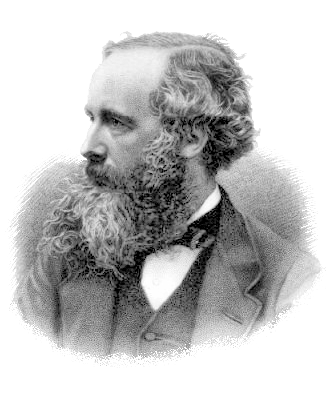
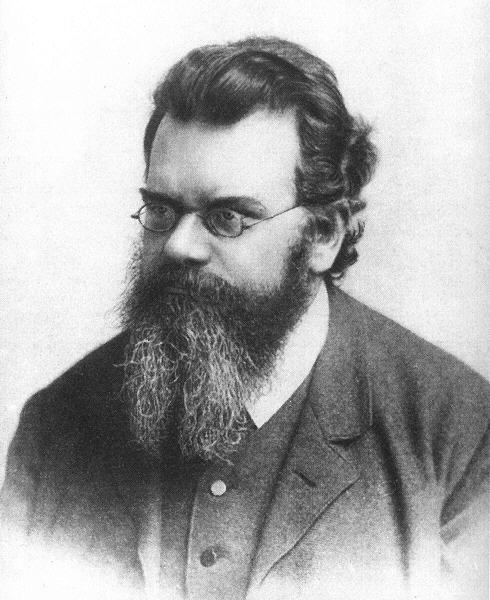
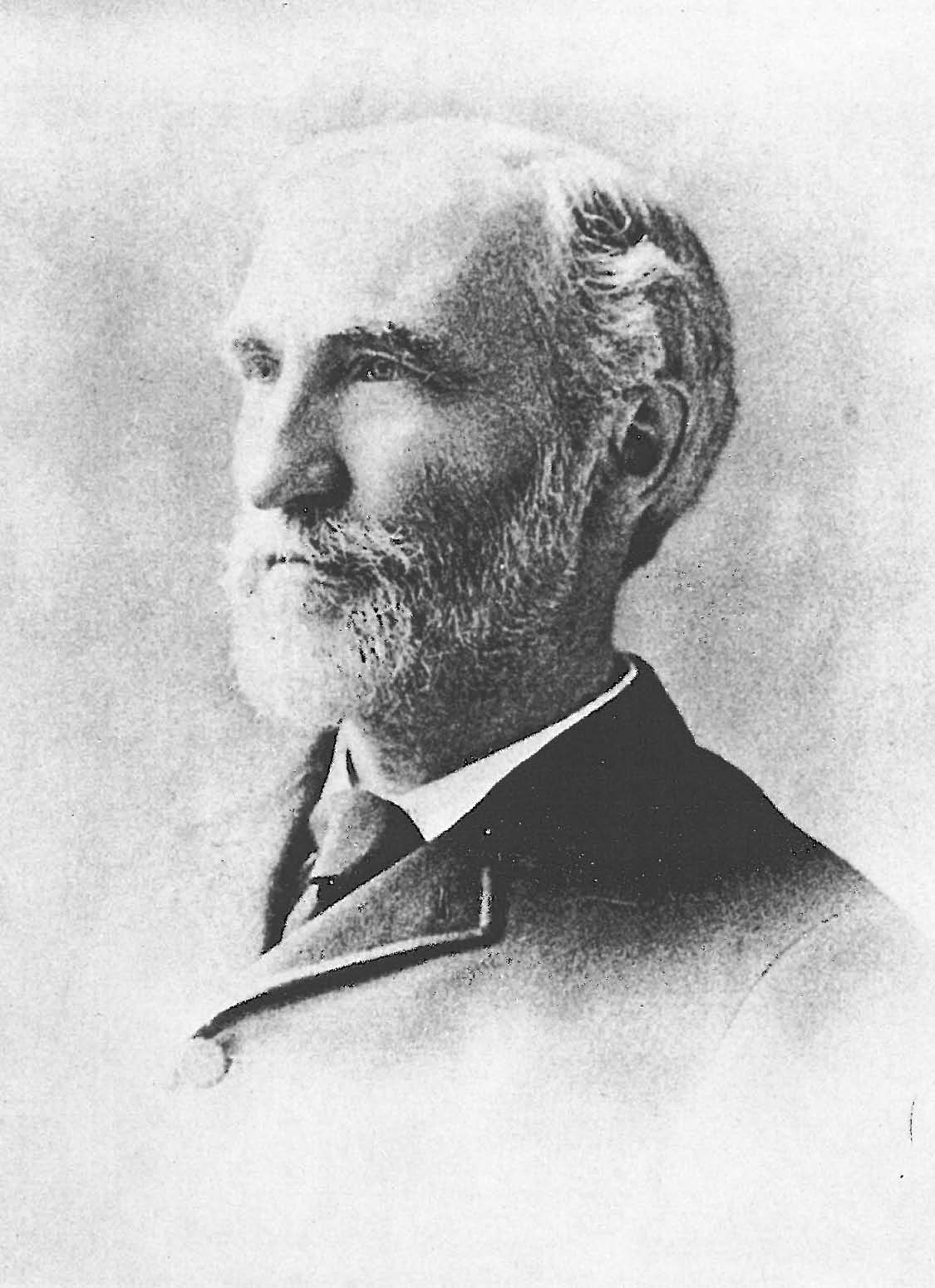
Figure: James Clerk Maxwell (1831-1879), Ludwig Boltzmann (1844-1906) Josiah Willard Gibbs (1839-1903)
Many of the ideas of early statistical physicists were rejected by a cadre of physicists who didn’t believe in the notion of a molecule. The stress of trying to have his ideas established caused Boltzmann to commit suicide in 1906, only two years before the same ideas became widely accepted.
Figure: Boltzmann’s paper Boltzmann (n.d.) which introduced the relationship between entropy and probability. A translation with notes is available in Sharp and Matschinsky (2015).
The important point about the uncertainty being represented here is that it is not genuine stochasticity, it is a lack of knowledge about the system. The techniques proposed by Maxwell, Boltzmann and Gibbs allow us to exactly represent the state of the system through a set of parameters that represent the sufficient statistics of the physical system. We know these values as the volume, temperature, and pressure. The challenge for us, when approximating the physical world with the techniques we will use is that we will have to sit somewhere between the deterministic and purely stochastic worlds that these different scientists described.
One ongoing characteristic of people who study probability and uncertainty is the confidence with which they hold opinions about it. Another leader of the Cavendish laboratory expressed his support of the second law of thermodynamics (which can be proven through the work of Gibbs/Boltzmann) with an emphatic statement at the beginning of his book.
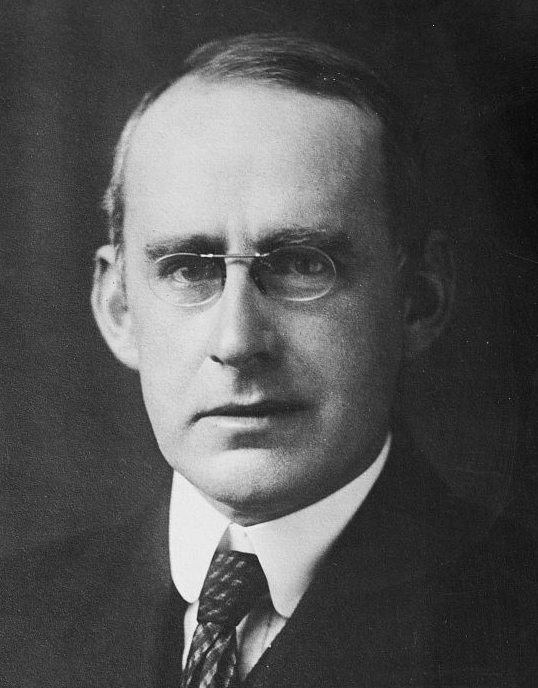
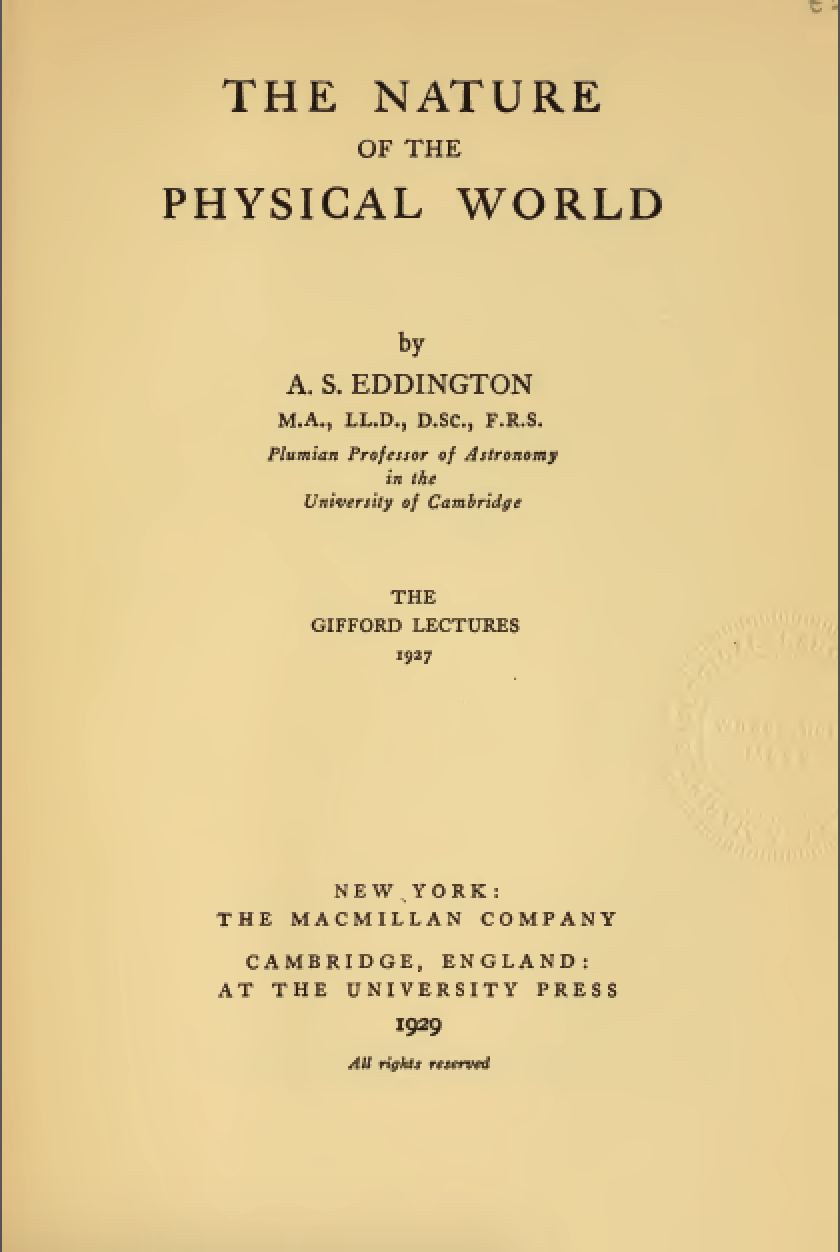
Figure: Eddington’s book on the Nature of the Physical World (Eddington, 1929)
The same Eddington is also famous for dismissing the ideas of a young Chandrasekhar who had come to Cambridge to study in the Cavendish lab. Chandrasekhar demonstrated the limit at which a star would collapse under its own weight to a singularity, but when he presented the work to Eddington, he was dismissive suggesting that there “must be some natural law that prevents this abomination from happening.”
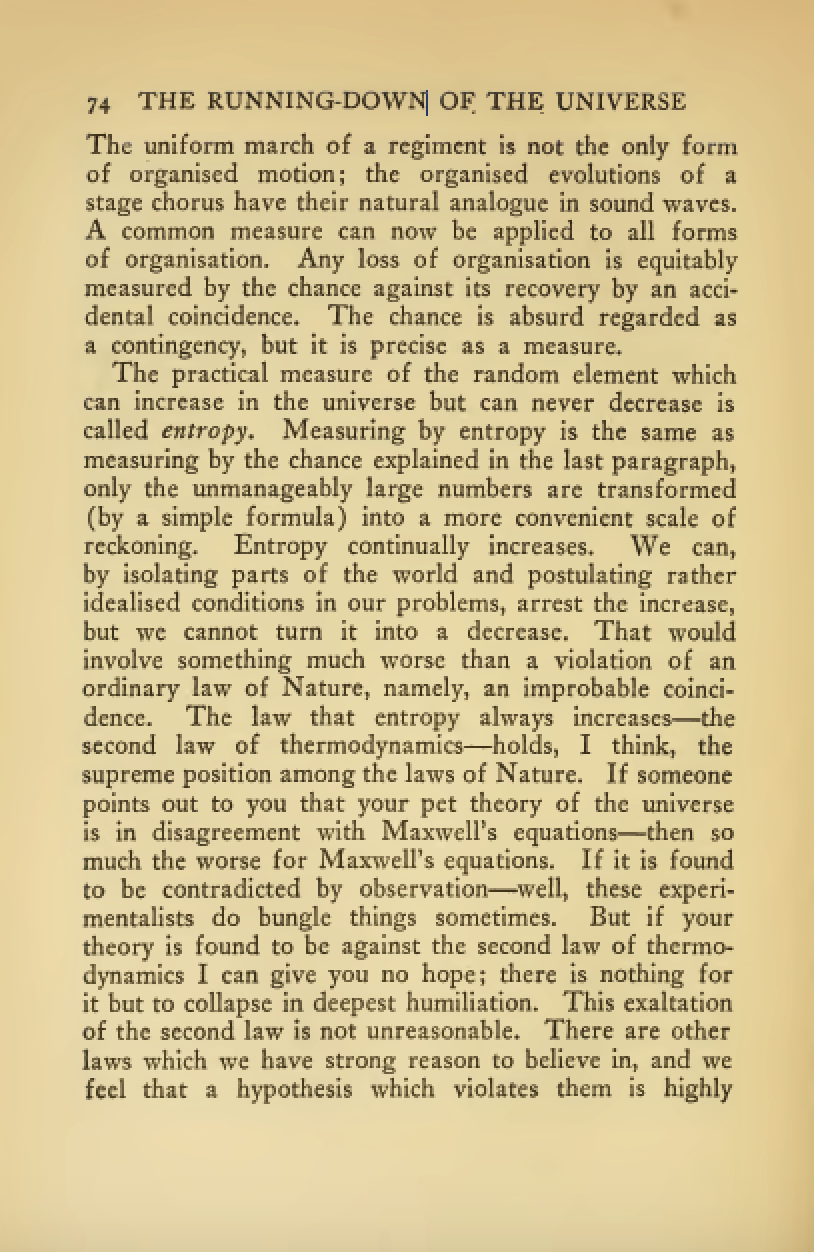
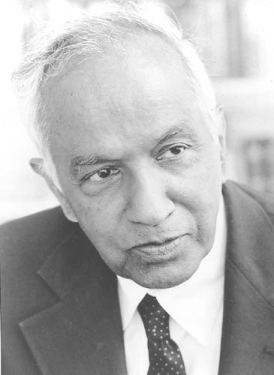
Figure: Chandrasekhar (1910-1995) derived the limit at which a star collapses in on itself. Eddington’s confidence in the 2nd law may have been what drove him to dismiss Chandrasekhar’s ideas, humiliating a young scientist who would later receive a Nobel prize for the work.
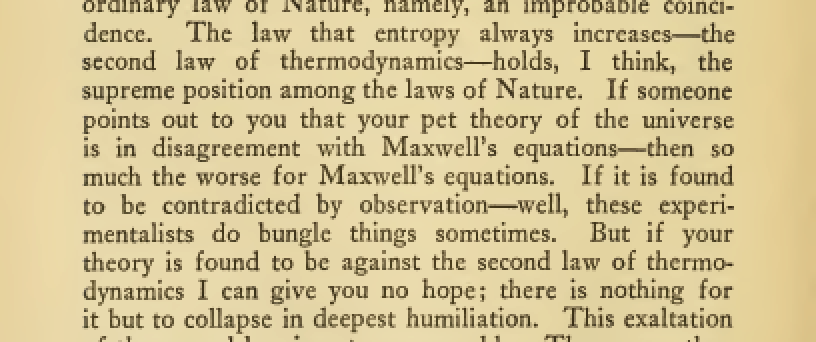
Figure: Eddington makes his feelings about the primacy of the second law clear. This primacy is perhaps because the second law can be demonstrated mathematically, building on the work of Maxwell, Gibbs and Boltzmann. Eddington (1929)
Presumably he meant that the creation of a black hole seemed to transgress the second law of thermodynamics, although later Hawking was able to show that blackholes do evaporate, but the time scales at which this evaporation occurs is many orders of magnitude slower than other processes in the universe.
Maxwell’s Demon
Maxwell’s demon is a thought experiment described by James Clerk Maxwell in his book, Theory of Heat (Maxwell, 1871) on page 308.
But if we conceive a being whose faculties are so sharpened that he can follow every molecule in its course, such a being, whose attributes are still as essentially finite as our own, would be able to do what is at present impossible to us. For we have seen that the molecules in a vessel full of air at uniform temperature are moving with velocities by no means uniform, though the mean velocity of any great number of them, arbitrarily selected, is almost exactly uniform. Now let us suppose that such a vessel is divided into two portions, A and B, by a division in which there is a small hole, and that a being, who can see the individual molecules, opens and closes this hole, so as to allow only the swifter molecules to pass from A to B, and the only the slower ones to pass from B to A. He will thus, without expenditure of work, raise the temperature of B and lower that of A, in contradiction to the second law of thermodynamics.
James Clerk Maxwell in Theory of Heat (Maxwell, 1871) page 308
He goes onto say:
This is only one of the instances in which conclusions which we have draw from our experience of bodies consisting of an immense number of molecules may be found not to be applicable to the more delicate observations and experiments which we may suppose made by one who can perceive and handle the individual molecules which we deal with only in large masses
Figure: Maxwell’s demon was designed to highlight the statistical nature of the second law of thermodynamics.
<canvas id="maxwell-canvas" width="700" height="500" style="border:1px solid black;display:block;width:100%"></canvas><div>Velocity-bin entropy: <output id="maxwell-entropy"></output></div>
<div id="maxwell-histogram-canvas" style="width:100%;height:250px"></div>Figure: Maxwell’s Demon. The demon decides balls are either cold (blue) or hot (red) according to their velocity. Balls are allowed to pass the green membrane from right to left only if they are cold, and from left to right only if they are hot. The displayed entropy is the Shannon entropy of the velocity histogram (a coarse-grained proxy, not full thermodynamic entropy).
Maxwell’s demon allows us to connect thermodynamics with information theory (see e.g. Hosoya et al. (2015);Hosoya et al. (2011);Bub (2001);Brillouin (1951);Szilard (1929)). The connection arises due to a fundamental connection between information erasure and energy consumption Landauer (1961).
Alemi and Fischer (2019)
Information Theory and Thermodynamics
Information theory provides a mathematical framework for quantifying information. Many of information theory’s core concepts parallel those found in thermodynamics. The theory was developed by Claude Shannon who spoke extensively to MIT’s Norbert Wiener at while it was in development (Conway and Siegelman, 2005). Wiener’s own ideas about information were inspired by Willard Gibbs, one of the pioneers of the mathematical understanding of free energy and entropy. Deep connections between physical systems and information processing have connected information and energy from the start.
Entropy
Shannon’s entropy measures the uncertainty or unpredictability of information content. This mathematical formulation is inspired by thermodynamic entropy, which describes the dispersal of energy in physical systems. Both concepts quantify the number of possible states and their probabilities.
Figure: Maxwell’s demon thought experiment illustrates the relationship between information and thermodynamics.
In thermodynamics, free energy represents the energy available to do work. A system naturally evolves to minimize its free energy, finding equilibrium between total energy and entropy. Free energy principles are also pervasive in variational methods in machine learning. They emerge from Bayesian approaches to learning and have been heavily promoted by e.g. Karl Friston as a model for the brain.
The relationship between entropy and Free Energy can be explored through the Legendre transform. This is most easily reviewed if we restrict ourselves to distributions in the exponential family.
Exponential Family
The exponential family has the form \[ \rho(Z) = h(Z) \exp\left(\boldsymbol{\theta}^\top T(Z) + A(\boldsymbol{\theta})\right) \] where \(h(Z)\) is the base measure, \(\boldsymbol{\theta}\) is the natural parameters, \(T(Z)\) is the sufficient statistics and \(A(\boldsymbol{\theta})\) is the log partition function. Its entropy can be computed as \[ S(Z) = A(\boldsymbol{\theta}) - \boldsymbol{\theta}^\top \nabla_\boldsymbol{\theta}A(\boldsymbol{\theta}) - E_{\rho(Z)}\left[\log h(Z)\right], \] where \(E_{\rho(Z)}[\cdot]\) is the expectation under the distribution \(\rho(Z)\).
Available Energy
Work through Measurement
In machine learning and Bayesian inference, the Markov blanket is the set of variables that are conditionally independent of the variable of interest given the other variables. To introduce this idea into our information system, we first split the system into two parts, the variables, \(X\), and the memory \(M\).
The variables are the portion of the system that is stochastically evolving over time. The memory is a low entropy partition of the system that will give us knowledge about this evolution.
We can now write the joint entropy of the system in terms of the mutual information between the variables and the memory. \[ S(Z) = S(X,M) = S(X|M) + S(M) = S(X) - I(X;M) + S(M). \] This gives us the first hint at the connection between information and energy.
If \(M\) is viewed as a measurement then the change in entropy of the system before and after measurement is given by \(S(X|M) - S(X)\) wehich is given by \(-I(X;M)\). This is implies that measurement increases the amount of available energy we obtain from the system (Parrondo et al., 2015).
The difference in available energy is given by \[ \Delta A = A(X) - A(Z|M) = I(X;M), \] where we note that the resulting system is no longer in thermodynamic equilibrium due to the low entropy of the memory.
The Animal Game
The Entropy Game is a framework for understanding efficient uncertainty reduction. To start think of finding the optimal strategy for identifying an unknown entity by asking the minimum number of yes/no questions.
The 20 Questions Paradigm
In the game of 20 Questions player one (Alice) thinks of an object, player two (Bob) must identify it by asking at most 20 yes/no questions. The optimal strategy is to divide the possibility space in half with each question. The binary search approach ensures maximum information gain with each inquiry and can access \(2^20\) or about a million different objects.
Figure: The optimal strategy in the Entropy Game resembles a binary search, dividing the search space in half with each question.
Entropy Reduction and Decisions
From an information-theoretic perspective, decisions can be taken in a way that efficiently reduces entropy - our the uncertainty about the state of the world. Each observation or action an intelligent agent takes should maximize expected information gain, optimally reducing uncertainty given available resources.
The entropy before the question is \(S(X)\). The entropy after the question is \(S(X|M)\). The information gain is the difference between the two, \(I(X;M) = S(X) - S(X|M)\). Optimal decision making systems maximize this information gain per unit cost.
Thermodynamic Parallels
The entropy game connects decision-making to thermodynamics.
This perspective suggests a profound connection: intelligence might be understood as a special case of systems that efficiently extract, process, and utilize free energy from their environments, with thermodynamic principles setting fundamental constraints on what’s possible.
Information Engines: Intelligence as an Energy-Efficiency
The entropy game shows some parallels between thermodynamics and measurement. This allows us to imagine information engines, simple systems that convert information to energy. This is our first simple model of intelligence.
Measurement as a Thermodynamic Process: Information-Modified Second Law
The second law of thermodynamics was generalised to include the effect of measurement by Sagawa and Ueda (Sagawa and Ueda, 2008). They showed that the maximum extractable work from a system can be increased by \(k_BTI(X;M)\) where \(k_B\) is Boltzmann’s constant, \(T\) is temperature and \(I(X;M)\) is the information gained by making a measurement, \(M\), \[ I(X;M) = \sum_{x,m} \rho(x,m) \log \frac{\rho(x,m)}{\rho(x)\rho(m)}, \] where \(\rho(x,m)\) is the joint probability of the system and measurement (see e.g. eq 14 in Sagawa and Ueda (2008)). This can be written as \[ W_\text{ext} \leq - \Delta\mathcal{F} + k_BTI(X;M), \] where \(W_\text{ext}\) is the extractable work and it is upper bounded by the negative change in free energy, \(\Delta \mathcal{F}\), plus the energy gained from measurement, \(k_BTI(X;M)\). This is the information-modified second law.
The measurements can be seen as a thermodynamic process. In theory measurement, like computation is reversible. But in practice the process of measurement is likely to erode the free energy somewhat, but as long as the energy gained from information, \(kTI(X;M)\) is greater than that spent in measurement the pricess can be thermodynamically efficient.
The modified second law shows that the maximum additional extractable work is proportional to the information gained. So information acquisition creates extractable work potential. Thermodynamic consistency is maintained by properly accounting for information-entropy relationships.
Efficacy of Feedback Control
Sagawa and Ueda extended this relationship to provide a generalised Jarzynski equality for feedback processes (Sagawa and Ueda, 2010). The Jarzynski equality is an imporant result from nonequilibrium thermodynamics that relates the average work done across an ensemble to the free energy difference between initial and final states (Jarzynski, 1997), \[ \left\langle \exp\left(-\frac{W}{k_B T}\right) \right\rangle = \exp\left(-\frac{\Delta\mathcal{F}}{k_BT}\right), \] where \(\langle W \rangle\) is the average work done across an ensemble of trajectories, \(\Delta\mathcal{F}\) is the change in free energy, \(k_B\) is Boltzmann’s constant, and \(\Delta S\) is the change in entropy. Sagawa and Ueda extended this equality to to include information gain from measurement (Sagawa and Ueda, 2010), \[ \left\langle \exp\left(-\frac{W}{k_B T}\right) \exp\left(\frac{\Delta\mathcal{F}}{k_BT}\right) \exp\left(-\mathcal{I}(X;M)\right)\right\rangle = 1, \] where \(\mathcal{I}(X;M) = \log \frac{\rho(X|M)}{\rho(X)}\) is the information gain from measurement, and the mutual information is recovered \(I(X;M) = \left\langle \mathcal{I}(X;M) \right\rangle\) as the average information gain.
Sagawa and Ueda introduce an efficacy term that captures the effect of feedback on the system they note in the presence of feedback, \[ \left\langle \exp\left(-\frac{W}{k_B T}\right) \exp\left(\frac{\Delta\mathcal{F}}{k_BT}\right)\right\rangle = \gamma, \] where \(\gamma\) is the efficacy.
Channel Coding Perspective on Memory
When viewing \(M\) as an information channel between past and future states, Shannon’s channel coding theorems apply (Shannon, 1948). The channel capacity \(C\) represents the maximum rate of reliable information transmission [ C = _{(M)} I(X_1;M) ] and for a memory of \(n\) bits we have [ C n, ] as the mutual information is upper bounded by the entropy of \(\rho(M)\) which is at most \(n\) bits.
This relationship seems to align with Ashby’s Law of Requisite Variety (pg 229 Ashby (1952)), which states that a control system must have at least as much ‘variety’ as the system it aims to control. In the context of memory systems, this means that to maintain temporal correlations effectively, the memory’s state space must be at least as large as the information content it needs to preserve. This provides a lower bound on the necessary memory capacity that complements the bound we get from Shannon for channel capacity.
This helps determine the required memory size for maintaining temporal correlations, optimal coding strategies, and fundamental limits on temporal correlation preservation.
Decomposition into Past and Future
Model Approximations and Thermodynamic Efficiency
Intelligent systems must balance measurement against energy efficiency and time requirements. A perfect model of the world would require infinite computational resources and speed, so approximations are necessary. This leads to uncertainties. Thermodynamics might be thought of as the physics of uncertainty: at equilibrium thermodynamic systems find thermodynamic states that minimize free energy, equivalent to maximising entropy.
Markov Blanket
To introduce some structure to the model assumption. We split \(X\) into \(X_0\) and \(X_1\). \(X_0\) is past and present of the system, \(X_1\) is future The conditional mutual information \(I(X_0;X_1|M)\) which is zero if \(X_1\) and \(X_0\) are independent conditioned on \(M\).
At What Scales Does this Apply?
The equipartition theorem tells us that at equilibrium the average energy is \(kT/2\) per degree of freedom. This means that for systems that operate at “human scale” the energy involved is many orders of magnitude larger than the amount of information we can store in memory. For a car engine producing 70 kW of power at 370 Kelvin, this implies \[ \frac{2 \times 70,000}{370 \times k_B} = \frac{2 \times 70,000}{370\times 1.380649×10^{−23}} = 2.74 × 10^{25} \] degrees of freedom per second. If we make a conservative assumption of one bit per degree of freedom, then the mutual information we would require in one second for comparative energy production would be around 3400 zettabytes, implying a memory bandwidth of around 3,400 zettabytes per second. In 2025 the estimate of all the data in the world stands at 149 zettabytes.
Small-Scale Biochemical Systems and Information Processing
While macroscopic systems operate in regimes where traditional thermodynamics dominates, microscopic biological systems operate at scales where information and thermal fluctuations become critically important. Here we examine how the framework applies to molecular machines and processes that have evolved to operate efficiently at these scales.
Molecular machines like ATP synthase, kinesin motors, and the photosynthetic apparatus can be viewed as sophisticated information engines that convert energy while processing information about their environment. These systems have evolved to exploit thermal fluctuations rather than fight against them, using information processing to extract useful work.
ATP Synthase: Nature’s Rotary Engine
ATP synthase functions as a rotary molecular motor that synthesizes ATP from ADP and inorganic phosphate using a proton gradient. The system uses the proton gradient as both an energy source and an information source about the cell’s energetic state and exploits Brownian motion through a ratchet mechanism. It converts information about proton locations into mechanical rotation and ultimately chemical energy with approximately 3-4 protons required per ATP.
Estimates suggest that one synapse firing may require \(10^4\) ATP molecules, so around \(4 \times 10^4\) protons. If we take the human brain as containing around \(10^{14}\) synapses, and if we suggest each synapse only fires about once every five seconds, we would require approximately \(10^{18}\) protons per second to power the synapses in our brain. With each proton having six degrees of freedom. Under these rough calculations the memory capacity distributed across the ATP Synthase in our brain must be of order \(6 \times 10^{18}\) bits per second or 750 petabytes of information per second. Of course this memory capacity would be devolved across the billions of neurons within hundreds or thousands of mitochondria that each can contain thousands of ATP synthase molecules. By composition of extremely small systems we can see it’s possible to improve efficiencies in ways that seem very impractical for a car engine.
Quick note to clarify, here we’re referring to the information requirements to make our brain more energy efficient in its information processing rather than the information processing capabilities of the neurons themselves!
Jaynes’s Maximum Entropy Principle
In his seminal 1957 paper (Jaynes, 1957), Ed Jaynes proposed a foundation for statistical mechanics based on information theory. Rather than relying on ergodic hypotheses or ensemble interpretations, Jaynes recast that the problem of assigning probabilities in statistical as a problem of inference with incomplete information.
A central problem in statistical mechanics is assigning initial probabilities when our knowledge is incomplete. For example, if we know only the average energy of a system, what probability distribution should we use? Jaynes argued that we should use the distribution that maximizes entropy subject to the constraints of our knowledge.
Jaynes illustrated the approachwith a simple example: Suppose a die has been tossed many times, with an average result of 4.5 rather than the expected 3.5 for a fair die. What probability assignment \(P_n\) (\(n=1,2,...,6\)) should we make for the next toss?
We need to satisfy two constraints \[\begin{align} \sum_{n=1}^6 P_n &= 1 \\ \sum_{n=1}^6 nP_n &= 4.5 \end{align}\]
Many distributions could satisfy these constraints, but which one makes the fewest unwarranted assumptions? Jaynes argued that we should choose the distribution that is maximally noncommittal with respect to missing information - the one that maximizes the entropy, \[\begin{align} S_I = -\sum_{i} p_i \log p_i \end{align}\] This principle leads to the exponential family of distributions, which in statistical mechanics gives us the canonical ensemble and other familiar distributions.
The General Maximum-Entropy Formalism
For a more general case, suppose a quantity \(x\) can take values \((x_1, x_2, \ldots, x_n)\) and we know the average values of several functions \(f_k(x)\). The problem is to find the probability assignment \(p_i = p(x_i)\) that satisfies \[\begin{align} \sum_{i=1}^n p_i &= 1 \\ \sum_{i=1}^n p_i f_k(x_i) &= \langle f_k(x) \rangle = F_k \quad k=1,2,\ldots,m \end{align}\] and maximizes the entropy \(S_I = -\sum_{i=1}^n p_i \log p_i\).
Using Lagrange multipliers, the solution is the generalized canonical distribution, \[\begin{align} p_i = \frac{1}{Z(\lambda_1,\ldots,\lambda_m)}\exp(-\lambda_1 f_1(x_i) - \ldots - \lambda_m f_m(x_i)) \end{align}\] where \(Z(\lambda_1,\ldots,\lambda_m)\) is the partition function, \[\begin{align} Z(\lambda_1,\ldots,\lambda_m) = \sum_{i=1}^n \exp(-\lambda_1 f_1(x_i) - \ldots - \lambda_m f_m(x_i)) \end{align}\] The Lagrange multipliers \(\lambda_k\) are determined by the constraints, \[\begin{align} \langle f_k \rangle = -\frac{\partial}{\partial \lambda_k}\log Z(\lambda_1,\ldots,\lambda_m) \quad k=1,2,\ldots,m. \end{align}\] The maximum attainable entropy is \[\begin{align} (S_I)_{max} = \log Z + \sum_{k=1}^m \lambda_k \langle f_k \rangle. \end{align}\]
Jaynes’ World
Jaynes’ World is a zero-player game that implements a version of the entropy game. The dynamical system is defined by a distribution, \(\rho(Z)\), over a state space \(Z\). The state space is partitioned into observable variables \(X\) and memory variables \(M\). The memory variables are considered to be in an information resevoir, a thermodynamic system that maintains information in an ordered state (see e.g. Barato and Seifert (2014)). The entropy of the whole system is bounded below by 0 and above by \(N\). So the entropy forms a compact manifold with respect to its parameters.
Unlike the animal game, where decisions are made by reducing entropy at each step, our system evovles mathematically by maximising the instantaneous entropy production. Conceptually we can think of this as ascending the gradient of the entropy, \(S(Z)\).
In the animal game the questioner starts with maximum uncertainty and targets minimal uncertainty. Jaynes’ world starts with minimal uncertainty and aims for maximum uncertainty.
We can phrase this as a thought experiment. Imagine you are in the game, at a given turn. You want to see where the game came from, so you look back across turns. The direction the game came from is now the direction of steepest descent. Regardless of where the game actually started it looks like it started at a minimal entropy configuration that we call the origin. Similarly, wherever the game is actually stopped there will nevertheless appear to be an end point we call end that will be a configuration of maximal entropy, \(N\).
This speculation allows us to impose the functional form of our proability distribution. As Jaynes has shown (Jaynes, 1957), the stationary points of a free-form optimisation (minimum or maximum) will place the distribution in the, \(\rho(Z)\) in the exponential family, \[ \rho(Z) = h(Z) \exp(\boldsymbol{\theta}^\top T(Z) - A(\boldsymbol{\theta})), \] where \(h(Z)\) is the base measure, \(T(Z)\) are sufficient statistics, \(A(\boldsymbol{\theta})\) is the log-partition function, \(\boldsymbol{\theta}\) are the natural parameters of the distribution.}
This constraint to the exponential family is highly convenient as we will rely on it heavily for the dynamics of the game. In particular, by focussing on the natural parameters we find that we are optimising within an information geometry (Amari, 2016). In exponential family distributions, the entropy gradient is given by, \[ \nabla_{\boldsymbol{\theta}}S(Z) = \mathbf{g} = \nabla^2_\boldsymbol{\theta} A(\boldsymbol{\theta}(M)) \] And the Fisher information matrix, \(G(\boldsymbol{\theta})\), is also the Hessian of the manifold, \[ G(\boldsymbol{\theta}) = \nabla^2_{\boldsymbol{\theta}} A(\boldsymbol{\theta}) = \text{Cov}[T(Z)]. \] Traditionally, when optimising on an information geometry we take natural gradient steps, equivalen to a Newton minimisation step, \[ \Delta \boldsymbol{\theta} = - G(\boldsymbol{\theta})^{-1} \mathbf{g}, \] but this is not the direction that gives the instantaneious maximisation of the entropy production, instead our gradient step is given by \[ \Delta \boldsymbol{\theta} = \eta \mathbf{g}, \] where \(\eta\) is a ‘learning rate.’
System Evolution
We are now in a position to summarise the start state and the end state of our system, as well as to speculate on the nature of the transition between the two states.
Start State
The origin configuration is a low entropy state, with value near the lower bound of 0. The information is highly structured, by definition we place all variables in \(M\), the information resevoir at this time. The uncertainty principle is present to handle the competeing needs of precision in parameters (giving us the near-singular form for \(\boldsymbol{\theta}(M)\), and capacity in the information channel that \(M\) provides (the capacity \(c(\boldsymbol{\theta})\) is upper bounded by \(S(M)\).
End State
The end configuration is a high entropy state, near the upper bound. Both the minimal entropy and maximal entropy states are revealed by Ed Jaynes’ variational minimisation approach and are in the exponential family. In many cases a version of Zeno’s paradox will arise where the system asymtotes to the final state, taking smaller steps at each time. At this point the system is at equilibrium.
Jaynes’ World
This framework explores how structure, time, causality, and locality might emerge from representation through a configuration and our uncertainty about configuration. The configuration—how variables actually relate to each other—is ontologically primary. All mathematical structures (parameters, distributions, entropy measures) emerge as consequences of tracking our uncertainty about which configuration is actual.
The system serves as: - A research framework for observer-free dynamics and entropy-based emergence - A conceptual tool for exploring information topography: landscapes where uncertainty about configuration evolves under constraints
Fundamental Structure: Configuration and Uncertainty
Configuration as Primary Reality
The configuration represents the state of structural relationships between system components. This is the reality that exists independently of our methods for observing or describing it. The mathematical representations–parameters, operators, entropy measures–are epistemic tools that emerge from our attempts to track configuration changes.
Uncertainty Distribution Over Configurations
A density matrix \(\rho\) represents our uncertainty about which configuration is actual. The density matrix is defined over the space of possible configurations, it not a description of any particular configuration. The von Neumann entropy \(S[\rho] = -\mathrm{tr}(\rho \log \rho)\) measures the amount of uncertainty in our knowledge—–equivalently, the amount of disorder in the space of possible configurations.
Emergence of Mathematical Structure
Exponential Family as Inevitable Consequence
The exponential family-style representation for the density matrix is not a choice but a consequence of seeking the minimum uncertainty about configuration subject to resolution constraints. Minimising this uncertainty (maximising entropy) while preserving certain constraint information, the method of Lagrange multipliers automatically produces the form, \[ \rho(\boldsymbol{\theta}) = \frac{1}{Z(\boldsymbol{\theta})} \exp\left( \sum_i \theta_i H_i \right), \] the natural parameters \(\boldsymbol{\theta}\) emerge as the Lagrange multipliers needed to enforce our constraints on uncertainty.
System Structure Through Uncertainty Dynamics
Let \(Z = \{Z_1, Z_2, \dots, Z_n\}\) be variables describing possible configurations. At any point in the system’s evolution, our ability to resolve uncertainty partitions these into \(X(\tau) \subseteq Z\) that are active variables where uncertainty gradients exceed resolution threshold \(\varepsilon\) and \(M(\tau) = Z \setminus X(\tau)\), latent variables forming an information reservoir where uncertainty changes remain below threshold (Barato and Seifert (2014),Parrondo et al. (2015)).
Derived Mathematical Objects
The mathematical structures follow from the uncertainty framework, the log-partition function (which is a cumulant generating function) has the form, \[ A(\boldsymbol{\theta}) = \log Z(\boldsymbol{\theta}) \] and the von Neumann entropy measures uncertainty about the configuration:, \[ S(\boldsymbol{\theta}) = A(\boldsymbol{\theta}) - \boldsymbol{\theta}^\top \nabla A(\boldsymbol{\theta}) \] with the Fisher Information Matrix capturing the uncertainty geometry, \[ G_{ij}(\boldsymbol{\theta}) = \frac{\partial^2 A}{\partial \theta_i \partial \theta_j} \] These choices arise from our uncertainty measures about configuration possibilities.
Resolution Constraints and Discrete Structure
We limit the total number of configurations by bounding the system capacity (\(N\) bits maximum). This in turn implies a minimum detectable resolution \(\varepsilon\) in the uncertainty space.
Uncertainty-Driven Dynamics
Core Principle: Uncertainty Resolution
Variable Activation Through Uncertainty Thresholds
Variables become active when uncertainty gradients about their associated configuration aspects exceed the resolution threshold, \[ X(\tau) = \left\{ i \mid \left| \frac{\text{d}\theta_i}{\text{d}\tau} \right| \geq \varepsilon \right\}, \quad M(\tau) = Z \setminus X(\tau). \] This activation represents the point where uncertainty about particular configuration aspects becomes resolvable and can drive further uncertainty resolution.
Information Geometry of Uncertainty Evolution
The Fisher Information Matrix partitions according to uncertainty resolvability, \[ G(\boldsymbol{\theta}) = \begin{bmatrix} G_{XX} & G_{XM} \\ G_{MX} & G_{MM} \end{bmatrix}, \] where \(G_{XX}\) describes the geometry of resolvable uncertainty, \(G_{MM}\) the structure of the latent uncertainty reservoir, and \(G_{XM}\) the coupling between resolved and unresolved aspects. This partitioning governs how uncertainty resolution propagates through the configuration space.
Lemma 1: Form of the Minimal Entropy Configuration
The minimal-entropy state that is compatible with the system’s resolution constraint and regularity condition is represented by a density matrix of the exponential form, \[ \rho(\boldsymbol{\theta}_o) = \frac{1}{Z(\boldsymbol{\theta}_o)} \exp\left( \sum_i \theta_{oi} H_i \right), \] where all components \(\theta_{oi}\) are sub-threshold \[ |\dot{\theta}_{oi}| < \varepsilon. \] This state minimises entropy under the constraint that it remains regular, continuous, and detectable only above a resolution scale $$. Its structure can be derived via a minimum-entropy analogue of Jaynes’ maximum entropy formalism (Jaynes, 1963), using the same density matrix geometry but inverted optimization.
Lemma 2: Symmetry Breaking
If \(\theta_k \in M(\tau)\) and \(|\dot{\theta}_k| \geq \varepsilon\), then \[ \theta_k \in X(\tau + \delta \tau). \]
Perceived Time
The system evolves in two time scales:
System time \(\tau\): the external time parameter in which the system evolves according to \[ t(\tau) := S_{X(\tau)}(\tau) \]
Perceived time \(t\): the internal time that measures the accumulated entropy of active variables, defined as \[ t(\tau) := S_{X(\tau)}(\tau) \]
The relationship between these time scales is given by \[ \frac{\text{d}t}{\text{d}\tau} = \boldsymbol{\theta}^\top G(\boldsymbol{\theta}) \boldsymbol{\theta} = -\boldsymbol{\theta}^\top \nabla_\boldsymbol{\theta} S[\rho_\boldsymbol{\theta}] \]
This reveals that perceived time flows at different rates depending on the information content of the system. In regions where parameters are strongly aligned with entropy change, perceived time flows rapidly relative to system time. In regions where parameters are weakly coupled to entropy change, perceived time flows slowly.
Lemma 3: Monotonicity of Perceived Time
\[ t(\tau_2) \geq t(\tau_1) \quad \text{for all } \tau_2 > \tau_1 \]
Corollary: Irreversibility
\(t(\tau)\) increases monotonically, preventing time-reversal globally.
In regions where parameters are weakly coupled to entropy change (low \(\boldsymbol{\theta}^\top \nabla_\boldsymbol{\theta} S[\rho_\boldsymbol{\theta}]\)), perceived time flows slowly.
At critical points where parameters become orthogonal to the entropy gradient (\(\boldsymbol{\theta}^\top \nabla_\boldsymbol{\theta} S[\rho_\boldsymbol{\theta}] \approx 0\)), the time parameterization approaches singularity indicating phase transitions in the system’s information structure. }
Conjecture: Frieden-Analogous Extremal Flow
At points where the latent-to-active flow functional is locally extremal (e.g., $ $), the system may exhibit critical slowing where information resevoir variables are slow relative to active variables. It may be possible to separate the system entropy into active variables and, \(I = S[\rho_X]\) and “intrinsic information” \(J= S[\rho_{X|M}]\) allowing us to create an information analogous to B. Roy Frieden’s extreme physical information (Frieden (1998)) which allows derivation of locally valid differential equations that depend on the information topography.
From Maximum to Minimal Entropy
Jaynes formulated his principle in terms of maximizing entropy, we can also view certain problems as minimizing entropy under appropriate constraints. The duality becomes apparent when we consider the relationship between entropy and information.
The maximum entropy principle finds the distribution that is maximally noncommittal given certain constraints. Conversely, we can seek the distribution that minimizes entropy subject to different constraints - this represents the distribution with maximum structure or information.
Consider the uncertainty principle. When we seek states that minimize the product of position and momentum uncertainties, we are seeking minimal entropy states subject to the constraint of the uncertainty principle.
The mathematical formalism remains the same, but with different constraints and optimization direction, \[\begin{align} \text{Minimize } S_I &= -\sum_{i} p_i \log p_i \\ \text{subject to } \sum_{i} p_i &= 1 \\ \text{and } g_k(p_1, p_2, \ldots, p_n) &= G_k \quad k=1,2,\ldots,r, \end{align}\] where \(g_k\) are functions representing constraints different from simple averages.
The solution still takes the form of an exponential family, \[\begin{align} p_i = \frac{1}{Z}\exp\left(-\sum_{k=1}^r \mu_k \frac{\partial g_k}{\partial p_i}\right), \end{align}\] where \(\mu_k\) are Lagrange multipliers for the constraints.
Minimal Entropy States in Quantum Systems
The pure states of quantum mechanics are those that minimize von Neumann entropy \(S = -\text{Tr}(\rho \log \rho)\) subject to the constraints of quantum mechanics.
For example, coherent states minimize the entropy subject to constraints on the expectation values of position and momentum operators. These states achieve the minimum uncertainty allowed by quantum mechanics.
Histogram Game
To illustrate the concept of the Jaynes’ world entropy game we’ll run a simple example using a four bin histogram. The entropy of a four bin histogram can be computed as, \[ S(p) = - \sum_{i=1}^4 p_i \log_2 p_i. \]
import numpy as npFirst we write some helper code to plot the histogram and compute its entropy.
We can compute the entropy of any given histogram.
# Define probabilities
p = np.zeros(4)
p[0] = 4/13
p[1] = 3/13
p[2] = 3.7/13
p[3] = 1 - p.sum()

# Safe entropy calculation
nonzero_p = p[p > 0]  # Filter out zeros
entropy = - (nonzero_p*np.log2(nonzero_p)).sum()
print(f"The entropy of the histogram is {entropy:.3f}.")
Figure: The entropy of a four bin histogram.
We can play the entropy game by starting with a histogram with all the probability mass in the first bin and then ascending the gradient of the entropy function.
Two-Bin Histogram Example
The simplest possible example of Jaynes’ World is a two-bin histogram with probabilities \(p\) and \(1-p\). This minimal system allows us to visualize the entire entropy landscape.
The natural parameter is the log odds, \(\theta = \log\frac{p}{1-p}\), and the update given by the entropy gradient is \[ \Delta \theta_{\text{steepest}} = \eta \frac{\text{d}S}{\text{d}\theta} = \eta p(1-p)(\log(1-p) - \log p). \] The Fisher information is \[ G(\theta) = p(1-p) \] This creates a dynamic where as \(p\) approaches either 0 or 1 (minimal entropy states), the Fisher information approaches zero, creating a critical slowing" effect. This critical slowing is what leads to the formation of information resevoirs. Note also that in the natural gradient the updated is given by multiplying the gradient by the inverse Fisher information, which would lead to a more efficient update of the form, \[ \Delta \theta_{\text{natural}} = \eta(\log(1-p) - \log p), \] however, it is this efficiency that we want our game to avoid, because it is the inefficient behaviour in the reagion of saddle points that leads to critical slowing and the emergence of information resevoirs.
import numpy as np# Python code for gradients
p_values = np.linspace(0.000001, 0.999999, 10000)
theta_values = np.log(p_values/(1-p_values))
entropy = -p_values * np.log(p_values) - (1-p_values) * np.log(1-p_values)
fisher_info = p_values * (1-p_values)
gradient = fisher_info * (np.log(1-p_values) - np.log(p_values))Figure: Entropy gradients of the two bin histogram agains position.
This example reveals the entropy extrema at \(p = 0\), \(p = 0.5\), and \(p = 1\). At minimal entropy (\(p \approx 0\) or \(p \approx 1\)), the gradient approaches zero, creating natural information reservoirs. The dynamics slow dramatically near these points - these are the areas of critical slowing that create information reservoirs.
Gradient Ascent in Natural Parameter Space
We can visualize the entropy maximization process by performing gradient ascent in the natural parameter space \(\theta\). Starting from a low-entropy state, we follow the gradient of entropy with respect to \(\theta\) to reach the maximum entropy state.
import numpy as np# Parameters for gradient ascent
theta_initial = -9.0 # Start with low entropy
learning_rate = 1
num_steps = 1500
# Initialize
theta_current = theta_initial
theta_history = [theta_current]
p_history = [theta_to_p(theta_current)]
entropy_history = [entropy(theta_current)]
# Perform gradient ascent in theta space
for step in range(num_steps):
# Compute gradient
grad = entropy_gradient(theta_current)
# Update theta
theta_current = theta_current + learning_rate * grad
# Store history
theta_history.append(theta_current)
p_history.append(theta_to_p(theta_current))
entropy_history.append(entropy(theta_current))
if step % 100 == 0:
print(f"Step {step+1}: θ = {theta_current:.4f}, p = {p_history[-1]:.4f}, Entropy = {entropy_history[-1]:.4f}")Figure: Evolution of the two-bin histogram during gradient ascent in natural parameter space.
Figure: Entropy evolution during gradient ascent for the two-bin histogram.
Figure: Gradient ascent trajectory in the natural parameter space for the two-bin histogram.
The gradient ascent visualization shows how the system evolves in the natural parameter space \(\theta\). Starting from a negative \(\theta\) (corresponding to a low-entropy state with \(p << 0.5\)), the system follows the gradient of entropy with respect to \(\theta\) until it reaches \(\theta = 0\) (corresponding to \(p = 0.5\)), which is the maximum entropy state.
Note that the maximum entropy occurs at \(\theta = 0\), which corresponds to \(p = 0.5\). The gradient of entropy with respect to \(\theta\) is zero at this point, making it a stable equilibrium for the gradient ascent process.
Uncertainty Principle
One challenge is how to parameterise our exponential family. We’ve mentioned that the variables \(Z\) are partitioned into observable variables \(X\) and memory variables \(M\). Given the minimal entropy initial state, the obvious initial choice is that at the origin all variables, \(Z\), should be in the information reservoir, \(M\). This implies that they are well determined and present a sensible choice for the source of our parameters.
We define a mapping, \(\boldsymbol{\theta}(M)\), that maps the information resevoir to a set of values that are equivalent to the natural parameters. If the entropy of these parameters is low, and the distribution \(\rho(\boldsymbol{\theta})\) is sharply peaked then we can move from treating the memory mapping, \(\boldsymbol{\theta}(\cdot)\), as a random processe to an assumption that it is a deterministic function. We can then follow gradients with respect to these \(\boldsymbol{\theta}\) values.
This allows us to rewrite the distribution over \(Z\) in a conditional form, \[ \rho(X|M) = h(X) \exp(\boldsymbol{\theta}(M)^\top T(X) - A(\boldsymbol{\theta}(M))). \]
Unfortunately this assumption implies that \(\boldsymbol{\theta}(\cdot)\) is a delta function, and since our representation as a compact manifold (bounded below by \(0\) and above by \(N\)) it does not admit any such singularities.
Formal Derivation of the Uncertainty Principle
We can derive the uncertainty principle formally from the information-theoretic properties of the system. Consider the mutual information between parameters \(\boldsymbol{\theta}(M)\) and capacity variables \(c(M)\): \[ I(\boldsymbol{\theta}(M); c(M)) = H(\boldsymbol{\theta}(M)) + H(c(M)) - H(\boldsymbol{\theta}(M), c(M)) \] where \(H(\cdot)\) represents differential entropy.
Since the total entropy of the system is bounded by \(N\), we know that \(h(\boldsymbol{\theta}(M), c(M)) \leq N\). Additionally, for any two random variables, the mutual information satisfies \(I(\boldsymbol{\theta}(M); c(M)) \geq 0\), with equality if and only if they are independent.
For our system to function as an effective information reservoir, \(\boldsymbol{\theta}(M)\) and \(c(M)\) cannot be independent - they must share information. This gives us, \[ h(\boldsymbol{\theta}(M)) + h(c(M)) \geq h(\boldsymbol{\theta}(M), c(M)) + I_{\min} \] where \(I_{\min} > 0\) is the minimum mutual information required for the system to function.
For variables with fixed variance, differential entropy is maximized by Gaussian distributions. For a multivariate Gaussian with covariance matrix \(\Sigma\), the differential entropy is: \[ h(\mathcal{N}(0, \Sigma)) = \frac{1}{2}\ln\left((2\pi e)^d|\Sigma|\right) \] where \(d\) is the dimensionality and \(|\Sigma|\) is the determinant of the covariance matrix.
The Cramér-Rao inequality provides a lower bound on the variance of any unbiased estimator. If \(\boldsymbol{\theta}\) is a parameter vector and \(\hat{\boldsymbol{\theta}}\) is an unbiased estimator, then: \[ \text{Cov}(\hat{\boldsymbol{\theta}}) \geq G^{-1}(\boldsymbol{\theta}) \] where \(G(\boldsymbol{\theta})\) is the Fisher information matrix.
In our context, the relationship between parameters \(\boldsymbol{\theta}(M)\) and capacity variables \(c(M)\) follows a similar bound. The Fisher information matrix for exponential family distributions has a special property: it equals the covariance of the sufficient statistics, which in our case are represented by the capacity variables \(c(M)\). This gives us \[ G(\boldsymbol{\theta}(M)) = \text{Cov}(c(M)) \]
Applying the Cramér-Rao inequality we have \[ \text{Cov}(\boldsymbol{\theta}(M)) \cdot \text{Cov}(c(M)) \geq G^{-1}(\boldsymbol{\theta}(M)) \cdot G(\boldsymbol{\theta}(M)) = \mathbf{I} \] where \(\mathbf{I}\) is the identity matrix.
For one-dimensional projections, this matrix inequality implies, \[ \text{Var}(\boldsymbol{\theta}(M)) \cdot \text{Var}(c(M)) \geq 1 \] and converting to standard deviations we have \[ \Delta\boldsymbol{\theta}(M) \cdot \Delta c(M) \geq 1. \]
When we incorporate the minimum mutual information constraint \(I_{\min}\), the bound tightens. Using the relationship between differential entropy and mutual information, we can derive \[ \Delta\boldsymbol{\theta}(M) \cdot \Delta c(M) \geq k, \] where \(k = \frac{1}{2\pi e}e^{2I_{\min}}\).
This is our uncertainty principle, directly derived from information-theoretic constraints and the Cramér-Rao bound. It represents the fundamental trade-off between precision in parameter specification and capacity for information storage.
Definition of Capacity Variables
We now provide a precise definition of the capacity variables \(c(M)\). The capacity variables quantify the potential of memory variables to store information about observable variables. Mathematically, we define \(c(M)\) as, \[ c(M) = \nabla_{\boldsymbol{\theta}} A(\boldsymbol{\theta}(M)) \] where \(A(\boldsymbol{\theta})\) is the log-partition function from our exponential family distribution. This definition has a clear interpretation: \(c(M)\) represents the expected values of the sufficient statistics under the current parameter values.
This definition also naturally yields the Fourier relationship between parameters and capacity. In exponential families, the log-partition function and its derivatives form a Legendre transform pair, which is the mathematical basis for the Fourier duality we claim. Specifically, if we define the Fourier transform operator \(\mathcal{F}\) as the mapping that takes parameters to expected sufficient statistics, then: \[ c(M) = \mathcal{F}[\boldsymbol{\theta}(M)] \]
Capacity \(\leftrightarrow\) Precision Paradox
This creates an apparent paradox, at minimal entropy states, the information reservoir must simultaneously maintain precision in the parameters \(\boldsymbol{\theta}(M)\) (for accurate system representation) but it must also provide sufficient capacity \(c(M)\) (for information storage).
The trade-off can be expressed as, \[ \Delta\boldsymbol{\theta}(M) \cdot \Delta c(M) \geq k, \] where \(k\) is a constant. This relationship can be recognised as a natural uncertainty principle that underpins the behaviour of the game. This principle is a necessary consequence of information theory. It follows from the requirement for the parameter-like states, \(M\) to have both precision and high capacity (in the Shannon sense ). The uncertainty principle ensures that when parameters are sharply defined (low \(\Delta\boldsymbol{\theta}\)), the capacity variables have high uncertainty (high \(\Delta c\)), allowing information to be encoded in their relationships rather than absolute values.
This trade-off between precision and capacity directly parallels Shannon’s insights about information transmission (Shannon, 1948), where he demonstrated that increasing the precision of a signal requires increasing bandwidth or reducing noise immunity—creating an inherent trade-off in any communication system. Our formulation extends this principle to the information reservoir’s parameter space.
In practice this means that the parameters \(\boldsymbol{\theta}(M)\) and capacity variables \(c(M)\) must form a Fourier-dual pair, \[ c(M) = \mathcal{F}[\boldsymbol{\theta}(M)], \] This duality becomes important at saddle points when direct gradient ascent stalls.
The mathematical formulation of the uncertainty principle comes from Hirschman Jr (1957) and later refined by Beckner (1975) and Białynicki-Birula and Mycielski (1975). These works demonstrated that Shannon’s information-theoretic entropy provides a natural framework for expressing the uncertainty principle, establishing a direct bridge between the mathematical formalism of quantum mechanics and information theory. Our capacity-precision trade-off follows this tradition, expressing the fundamental limits of information processing in our system.
Quantum vs Classical Information Reservoirs
The uncertainty principle means that the game can exhibit quantum-like information processing regimes during evolution. This inspires an information-theoretic perspective on the quantum-classical transition.
At minimal entropy states near the origin, the information reservoir has characteristics reminiscent of quantum systems.
Wave-like information encoding: The information reservoir near the origin necessarily encodes information in distributed, interference-capable patterns due to the uncertainty principle between parameters \(\boldsymbol{\theta}(M)\) and capacity variables \(c(M)\).
Non-local correlations: Parameters are highly correlated through the Fisher information matrix, creating structures where information is stored in relationships rather than individual variables.
Uncertainty-saturated regime: The uncertainty relationship \(\Delta\boldsymbol{\theta}(M) \cdot \Delta c(M) \geq k\) is nearly saturated (approaches equality), similar to Heisenberg’s uncertainty principle in quantum systems and the entropic uncertainty relations established by Białynicki-Birula and Mycielski (1975).
As the system evolves towards higher entropy states, a transition occurs where some variables exhibit classical behavior.
From wave-like to particle-like: Variables transitioning from \(M\) to \(X\) shift from storing information in interference patterns to storing it in definite values with statistical uncertainty.
Decoherence-like process: The uncertainty product \(\Delta\boldsymbol{\theta}(M) \cdot \Delta c(M)\) for these variables grows significantly larger than the minimum value \(k\), indicating a departure from quantum-like behavior.
Local information encoding: Information becomes increasingly encoded in local variables rather than distributed correlations.
The saddle points in our entropy landscape mark critical transitions between quantum-like and classical information processing regimes. Near these points
The critically slowed modes maintain quantum-like characteristics, functioning as coherent memory that preserves information through interference patterns.
The rapidly evolving modes exhibit classical characteristics, functioning as incoherent processors that manipulate information through statistical operations.
This natural separation creates a hybrid computational architecture where quantum-like memory interfaces with classical-like processing.
The quantum-classical transition can be quantified using the moment generating function \(M_Z(t)\). In quantum-like regimes, the MGF exhibits oscillatory behavior with complex analytic structure, whereas in classical regimes, it grows monotonically with simple analytic structure. The transition between these behaviors identifies variables moving between quantum-like and classical information processing modes.
This perspective suggests that what we recognize as “quantum” versus “classical” behavior may fundamentally reflect different regimes of information processing - one optimized for coherent information storage (quantum-like) and the other for flexible information manipulation (classical-like). The emergence of both regimes from our entropy-maximizing model indicates that nature may exploit this computational architecture to optimize information processing across multiple scales.
This formulation of the uncertainty principle in terms of information capacity and parameter precision follows the tradition established by Shannon (1948) and expanded upon by Hirschman Jr (1957) and others who connected information entropy uncertainty to Heisenberg’s uncertainty.
Quantitative Demonstration
We can demonstrate this principle quantitatively through a simple model. Consider a two-dimensional system with memory variables \(M = (m_1, m_2)\) that map to parameters \(\boldsymbol{\theta}(M) = (\theta_1(m_1), \theta_2(m_2))\). The capacity variables are \(c(M) = (c_1(m_1), c_2(m_2))\).
At minimal entropy, when the system is near the origin, the uncertainty product is exactly: \[ \Delta\theta_i(m_i) \cdot \Delta c_i(m_i) = k \] for each dimension \(i\).
As the system evolves and entropy increases, some variables transition to classical behavior with: \[ \Delta\theta_i(m_i) \cdot \Delta c_i(m_i) \gg k \]
This increased product reflects the transition from quantum-like to classical information processing. The variables that maintain the minimal uncertainty product \(k\) continue to function as coherent information reservoirs, while those with larger uncertainty products function as classical processors.
This principle provides testable predictions for any system modeled as an information reservoir. Specifically, we predict that variables functioning as effective memory must demonstrate precision-capacity trade-offs near the theoretical minimum \(k\), while processing variables will show excess uncertainty above this minimum.
Maximum Entropy and Density Matrices
In Jaynes (1957) Jaynes showed how the maximum entropy formalism is applied, in later papers such as Jaynes (1963) he showed how his maximum entropy formalism could be applied to von Neumann entropy of a density matrix.
As Jaynes noted in his 1962 Brandeis lectures: “Assignment of initial probabilities must, in order to be useful, agree with the initial information we have (i.e., the results of measurements of certain parameters). For example, we might know that at time \(t = 0\), a nuclear spin system having total (measured) magnetic moment \(M(0)\), is placed in a magnetic field \(H\), and the problem is to predict the subsequent variation \(M(t)\)… What initial density matrix for the spin system \(\rho(0)\), should we use?”
Jaynes recognized that we should choose the density matrix that maximizes the von Neumann entropy, \[\begin{align} S = -\text{Tr}(\rho \log \rho), \end{align}\] subject to constraints from our measurements, \[\begin{align} \text{Tr}(\rho M_{op}) = M(0), \end{align}\] where \(M_{op}\) is the operator corresponding to total magnetic moment.
The solution is the quantum version of the maximum entropy distribution, \[\begin{align} \rho = \frac{1}{Z}\exp(-\lambda_1 A_1 - \lambda_2 A_2 - \cdots - \lambda_m A_m), \end{align}\] where \(A_i\) are the operators corresponding to measured observables, \(\lambda_i\) are Lagrange multipliers, and \(Z = \text{Tr}[\exp(-\lambda_1 A_1 - \cdots - \lambda_m A_m)]\) is the partition function.
This unifies classical entropies and density matrix entropies under the same information-theoretic principle. It clarifies that quantum states with minimum entropy (pure states) represent maximum information, while mixed states represent incomplete information.
Jaynes further noted that “strictly speaking, all this should be restated in terms of quantum theory using the density matrix formalism. This will introduce the \(N!\) permutation factor, a natural zero for entropy, alteration of numerical values if discreteness of energy levels becomes comparable to \(k_BT\), etc.”
Quantum States and Exponential Families
The minimal entropy quantum states provides a connection between density matrices and exponential family distributions. This connection enables us to use many of the classical techniques from information geometry and apply them to the game in the case where the uncertainty principle is present.
The minimal entropy density matrix belongs to an exponential family, just like many classical distributions,
Classical Exponential Family
\[ f(x; \theta) = h(x) \cdot \exp[\eta(\theta)^\top \cdot T(x) - A(\theta)] \]
Quantum Minimal Entropy State
\[ \rho = \exp(-\mathbf{R}^\top \cdot \mathbf{G} \cdot \mathbf{R} - Z) \]
- Both have an exponential form
- Both involve sufficient statistics (in the quantum case, these are quadratic forms of operators)
- Both have natural parameters (G in the quantum case)
- Both include a normalization term
The matrix \(G\) in the minimal entropy state is directly related to the ‘quantum Fisher information matrix,’ \[ \mathbf{G} = \text{QFIM}/4 \] where QFIM is the quantum Fisher information matrix, which quantifies how sensitively the state responds to parameter changes.
This creates a link between
- Minimal entropy (maximum order)
- Uncertainty (fundamental quantum limitations)
- Information (ability to estimate parameters precisely)
The relationship implies, \[ V \cdot \text{QFIM} \geq \frac{\hbar^2}{4} \] which connects the covariance matrix (uncertainties) to the Fisher information (precision in parameter estimation).
These minimal entropy states may have physical relationships to interpretations squeezed states in quantum optics. They are the states that achieve the ultimate precision allowed by quantum mechanics.
Minimal Entropy States
In Jaynes’ World, we begin at a minimal entropy configuration - the “origin” state. Understanding the properties of these minimal entropy states is crucial for characterizing how the system evolves. These states are constrained by the uncertainty principle we previously identified: \(\Delta\boldsymbol{\theta}(M) \cdot \Delta c(M) \geq k\).
This constraint is reminiscient of the Heisenberg uncertainty principle in quantum mechanics, where \(\Delta x \cdot \Delta p \geq \hbar/2\). This isn’t a coincidence - both represent limitations on precision arising from the mathematical structure of information.
Structure of Minimal Entropy States
The minimal entropy configuration under the uncertainty constraint takes a specific mathematical form. It is a pure state (in the sense of having minimal possible entropy, \(S(Z) = 0\)) that exactly saturates the uncertainty bound. For a system with multiple degrees of freedom, the distribution takes a Gaussian form, \[ \rho(Z) = \frac{1}{\mathcal{Z}}\exp(-\mathbf{R}^\top \cdot \boldsymbol{\Lambda} \cdot \mathbf{R}), \] where \(\mathbf{R}\) represents the vector of all variables, \(\boldsymbol{\Lambda}\) is the precision matrix (inverse covariance) constrained by the uncertainty principle, and \(\mathcal{Z}\) is the partition function (normalization constant).
This form is an exponential family distribution, in line with Jaynes’ principle that entropy-optimized distributions belong to the exponential family. The precision matrix \(\boldsymbol{\Lambda}\) determines how uncertainty is distributed among different variables and their correlations. Importantly, while minimal entropy states have \(S(Z) = 0\), the total entropy of the system is constrained to be between 0 and \(N\) as it evolves, forming a compact manifold with respect to its parameters. This upper bound \(N\) ensures that as the system evolves from minimal to maximal entropy, it remains within a well-defined entropy space.
Fisher Information and Minimal Uncertainty
There’s a connection between the precision matrix \(\boldsymbol{\Lambda}\) and the Fisher information matrix \(\mathbf{G}\). For a multivariate Gaussian distribution, the Fisher information matrix is proportional to the precision matrix: \(\mathbf{G} = \boldsymbol{\Lambda}/2\). This creates the relationship, \[ \mathbf{V} \cdot \mathbf{G} \geq k^2 \] where \(\mathbf{V}\) is the covariance matrix containing all uncertainties and correlations. This inequality connects the covariance (uncertainties) to the Fisher information (precision in parameter estimation).
Connection to Information Reservoirs
Implications for System Evolution
As Jaynes’ World evolves from its minimal entropy state toward maximum entropy, we expect transitions to occur, Uncertainty desaturation: The uncertainty relationship \(\Delta\boldsymbol{\theta}(M) \cdot \Delta c(M) \geq k\) becomes less tightly saturated, with the product growing larger than the minimum value.
Physical Interpretation
Understanding these minimal entropy states provides insight into the starting point of Jaynes’ World and illuminates how the system will evolve toward maximum entropy. The uncertainty principle we’ve identified represents not just a mathematical constraint but a fundamental limitation on how information can be structured in any system.
The concept of minimal entropy states has an analog in quantum mechanics. What is the most ordered state possible that still respects the quantum uncertainty principle?
In quantum mechanics, a system’s state is described by a density matrix \(\rho\), which is analogous to a probability distribution in classical statistics. Key properties include,
- Hermitian: \(\rho = \rho^\dagger\) (like how probability distributions are real-valued)
- Positive semi-definite: \(\rho \geq 0\) (probabilities can’t be negative)
- Unit trace: \(\text{Tr}(\rho) = 1\) (total probability sums to 1)
For pure quantum states (states with complete information), \(\rho = |\psi\rangle\langle\psi|\) where \(|\psi\rangle\) is a state vector.
The density matrix analog of Shannon entropy is von Neumann entropy, \[ S(\rho) = -\text{Tr}(\rho \ln \rho) \] This measures the amount of “mixedness” or uncertainty in a quantum state. Pure states have zero entropy, representing complete certainty about the quantum state (within the constraints of quantum mechanics). Mixed states have positive entropy, indicating some level of classical uncertainty.
The uncertainty principle imposes fundamental limits on precision through the uncertainty principle. For position (\(x\)) and momentum (\(p\)), \[ \Delta x \cdot \Delta p \geq \frac{\hbar}{2} \] where \(\hbar\) (Planck’s constant divided by \(2\pi\)) sets the scale of quantum effects.
For multiple variables, this generalizes to a matrix inequality, \[ V + i\frac{\hbar}{2}\Omega \geq 0, \] where \(V\) is the covariance matrix containing all the uncertainties and correlations, and \(\Omega\) is the symplectic form representing the canonical commutation relations.
This constraint creates an irreducible minimum to the uncertainty possible in the system, it establishes the minimum “information state” of the system.
Density Matrices and Exponential Families
The minimal entropy state provides a connection between density matrices and exponential family distributions. This connection enables us to use many of the classical techniques from information geometry and apply them to the game in the case where the uncertainty principle is present.
The minimal entropy density matrix belongs to an exponential family, just like many classical distributions.
- Both have an exponential form
- Both involve sufficient statistics (in the quantum case, these are quadratic forms of operators)
- Both have natural parameters (\(G\) in the quantum case)
- Both include a normalization term
Classical Exponential Family
\[ f(x; \theta) = h(x) \cdot \exp[\eta(\theta)^\top \cdot T(x) - A(\theta)] \]
Quantum Minimal Entropy State
\[ \rho = \exp(-\mathbf{R}^\top \cdot \mathbf{G} \cdot \mathbf{R} - Z) \]
Gradient Ascent and Uncertainty Principles
In our exploration of information dynamics, we now turn to the relationship between gradient ascent on entropy and uncertainty principles. This section demonstrates how systems naturally evolve from quantum-like states (with minimal uncertainty) toward classical-like states (with excess uncertainty) through entropy maximization.
For simplicity, we’ll focus on multivariate Gaussian distributions, where the uncertainty relationships are particularly elegant. In this setting, the precision matrix \(\Lambda\) (inverse of the covariance matrix) fully characterizes the distribution. The entropy of a multivariate Gaussian is directly related to the determinant of the covariance matrix, \[ S = \frac{1}{2}\log\det(V) + \text{constant}, \] where \(V = \Lambda^{-1}\) is the covariance matrix.
For conjugate variables like position and momentum, the Heisenberg uncertainty principle imposes constraints on the minimum product of their uncertainties. In our information-theoretic framework, this appears as a constraint on the determinant of certain submatrices of the covariance matrix.
import numpy as np
from scipy.linalg import eigh
import matplotlib.pyplot as plt
from matplotlib.patches import Ellipse
The code below implements gradient ascent on the entropy of a multivariate Gaussian system while respecting uncertainty constraints. We’ll track how the system evolves from minimal uncertainty states (quantum-like) to states with excess uncertainty (classical-like).
First, we define key functions for computing entropy and its gradient.
# Constants
hbar = 1.0  # Normalized Planck's constant
min_uncertainty_product = hbar/2
The compute_entropy function calculates the entropy of a multivariate Gaussian distribution from its precision matrix. The compute_entropy_gradient function computes the gradient of entropy with respect to the precision matrix, which is essential for our gradient ascent procedure.
Next, we implement functions to handle the constraints imposed by the uncertainty principle:
The project_gradient function ensures that our gradient ascent respects the uncertainty principle by projecting the gradient to maintain minimum uncertainty products when necessary. The initialize_multidimensional_state function creates a starting state with multiple position-momentum pairs, each initialized to the minimum uncertainty allowed by the uncertainty principle, but with different “squeeze factors” that determine the shape of the uncertainty ellipse.
Now we implement the main gradient ascent procedure.
# Perform gradient ascent on entropy
def gradient_ascent_entropy(Lambda_init, n_steps=100, learning_rate=0.01):
    """
    Perform gradient ascent on entropy while respecting uncertainty constraints.

    Parameters:
    -----------
    Lambda_init: array
        Initial precision matrix
    n_steps: int
        Number of gradient steps
    learning_rate: float
        Learning rate for gradient ascent

    Returns:
    --------
    Lambda_history: list
        History of precision matrices
    entropy_history: list
        History of entropy values
    """
    Lambda = Lambda_init.copy()
    Lambda_history = [Lambda.copy()]
    entropy_history = [compute_entropy(Lambda)]

    for step in range(n_steps):
        # Compute gradient of entropy
        grad_matrix = compute_entropy_gradient(Lambda)

        # Diagonalize Lambda to work with eigenvalues
        eigenvalues, eigenvectors = eigh(Lambda)

        # Transform gradient to eigenvalue space
        grad = np.diag(eigenvectors.T @ grad_matrix @ eigenvectors)

        # Project gradient to respect constraints
        proj_grad = project_gradient(eigenvalues, grad)

        # Update eigenvalues
        eigenvalues += learning_rate * proj_grad

        # Ensure eigenvalues remain positive
        eigenvalues = np.maximum(eigenvalues, 1e-10)

        # Reconstruct Lambda from updated eigenvalues
        Lambda = eigenvectors @ np.diag(eigenvalues) @ eigenvectors.T

        # Store history
        Lambda_history.append(Lambda.copy())
        entropy_history.append(compute_entropy(Lambda))

    return Lambda_history, entropy_history
The gradient_ascent_entropy function implements the core optimization procedure. It performs gradient ascent on the entropy while respecting the uncertainty constraints. The algorithm works in the eigenvalue space of the precision matrix, which makes it easier to enforce constraints and ensure the matrix remains positive definite.
To analyze the results, we implement functions to track uncertainty metrics and detect interesting dynamics:
# Track uncertainty products and regime classification
def track_uncertainty_metrics(Lambda_history):
    """
    Track uncertainty products and classify regimes for each conjugate pair.

    Parameters:
    -----------
    Lambda_history: list
        History of precision matrices

    Returns:
    --------
    metrics: dict
        Dictionary containing uncertainty metrics over time
    """
    n_steps = len(Lambda_history)
    n_pairs = Lambda_history[0].shape[0] // 2

    # Initialize tracking arrays
    uncertainty_products = np.zeros((n_steps, n_pairs))
    regimes = np.zeros((n_steps, n_pairs), dtype=object)

    for step, Lambda in enumerate(Lambda_history):
        # Get covariance matrix
        V = np.linalg.inv(Lambda)

        # Calculate Fisher information matrix
        G = Lambda / 2

        # For each conjugate pair
        for i in range(n_pairs):
            # Extract 2x2 submatrix for this pair
            idx1, idx2 = 2*i, 2*i+1
            V_sub = V[np.ix_([idx1, idx2], [idx1, idx2])]

            # Compute uncertainty product (determinant of submatrix)
            uncertainty_product = np.sqrt(np.linalg.det(V_sub))
            uncertainty_products[step, i] = uncertainty_product

            # Classify regime
            if abs(uncertainty_product - min_uncertainty_product) < 0.1*min_uncertainty_product:
                regimes[step, i] = "Quantum-like"
            else:
                regimes[step, i] = "Classical-like"

    return {
        'uncertainty_products': uncertainty_products,
        'regimes': regimes
    }
The track_uncertainty_metrics function analyzes the evolution of uncertainty products for each position-momentum pair and classifies them as either “quantum-like” (near minimum uncertainty) or “classical-like” (with excess uncertainty). This classification helps us understand how the system transitions between these regimes during entropy maximization.
We also implement a function to detect saddle points in the gradient flow, which are critical for understanding the system’s dynamics:
# Detect saddle points in the gradient flow
def detect_saddle_points(Lambda_history):
    """
    Detect saddle-like behavior in the gradient flow.

    Parameters:
    -----------
    Lambda_history: list
        History of precision matrices

    Returns:
    --------
    saddle_metrics: dict
        Metrics related to saddle point behavior
    """
    n_steps = len(Lambda_history)
    n_pairs = Lambda_history[0].shape[0] // 2

    # Track eigenvalues and their gradients
    eigenvalues_history = np.zeros((n_steps, 2*n_pairs))
    gradient_ratios = np.zeros((n_steps, n_pairs))

    for step, Lambda in enumerate(Lambda_history):
        # Get eigenvalues
        eigenvalues, _ = eigh(Lambda)
        eigenvalues_history[step] = eigenvalues

        # For each pair, compute ratio of gradients
        if step > 0:
            for i in range(n_pairs):
                idx1, idx2 = 2*i, 2*i+1

                # Change in eigenvalues
                delta1 = abs(eigenvalues_history[step, idx1] - eigenvalues_history[step-1, idx1])
                delta2 = abs(eigenvalues_history[step, idx2] - eigenvalues_history[step-1, idx2])

                # Ratio of max to min (high ratio indicates saddle-like behavior)
                max_delta = max(delta1, delta2)
                min_delta = max(1e-10, min(delta1, delta2))  # Avoid division by zero
                gradient_ratios[step, i] = max_delta / min_delta

    # Identify candidate saddle points (where some gradients are much larger than others)
    saddle_candidates = []
    for step in range(1, n_steps):
        if np.any(gradient_ratios[step] > 10):  # Threshold for saddle-like behavior
            saddle_candidates.append(step)

    return {
        'eigenvalues_history': eigenvalues_history,
        'gradient_ratios': gradient_ratios,
        'saddle_candidates': saddle_candidates
    }
The detect_saddle_points function identifies points in the gradient flow where some eigenvalues change much faster than others, indicating saddle-like behavior. These saddle points are important because they represent critical transitions in the system’s evolution.
Finally, we implement visualization functions to help us understand the system’s behavior:
# Visualize uncertainty ellipses for multiple pairs
def plot_multidimensional_uncertainty(Lambda_history, step_indices, pairs_to_plot=None):
    """
    Plot the evolution of uncertainty ellipses for multiple position-momentum pairs.

    Parameters:
    -----------
    Lambda_history: list
        History of precision matrices
    step_indices: list
        Indices of steps to visualize
    pairs_to_plot: list, optional
        Indices of position-momentum pairs to plot
    """
    n_pairs = Lambda_history[0].shape[0] // 2

    if pairs_to_plot is None:
        pairs_to_plot = range(min(3, n_pairs))  # Plot up to 3 pairs by default

    fig, axes = plt.subplots(len(pairs_to_plot), len(step_indices),
                            figsize=(4*len(step_indices), 3*len(pairs_to_plot)))

    # Handle case of single pair or single step
    if len(pairs_to_plot) == 1:
        axes = axes.reshape(1, -1)
    if len(step_indices) == 1:
        axes = axes.reshape(-1, 1)

    for row, pair_idx in enumerate(pairs_to_plot):
        for col, step in enumerate(step_indices):
            ax = axes[row, col]
            Lambda = Lambda_history[step]
            covariance = np.linalg.inv(Lambda)

            # Extract 2x2 submatrix for this pair
            idx1, idx2 = 2*pair_idx, 2*pair_idx+1
            cov_sub = covariance[np.ix_([idx1, idx2], [idx1, idx2])]

            # Get eigenvalues and eigenvectors of submatrix
            values, vectors = eigh(cov_sub)

            # Calculate ellipse parameters
            angle = np.degrees(np.arctan2(vectors[1, 0], vectors[0, 0]))
            width, height = 2 * np.sqrt(values)

            # Create ellipse
            ellipse = Ellipse((0, 0), width=width, height=height, angle=angle,
                             edgecolor='blue', facecolor='lightblue', alpha=0.5)

            # Add to plot
            ax.add_patch(ellipse)
            ax.set_xlim(-3, 3)
            ax.set_ylim(-3, 3)
            ax.set_aspect('equal')
            ax.grid(True)

            # Add minimum uncertainty circle
            min_circle = plt.Circle((0, 0), min_uncertainty_product,
                                   fill=False, color='red', linestyle='--')
            ax.add_patch(min_circle)

            # Compute uncertainty product
            uncertainty_product = np.sqrt(np.linalg.det(cov_sub))

            # Determine regime
            if abs(uncertainty_product - min_uncertainty_product) < 0.1*min_uncertainty_product:
                regime = "Quantum-like"
                color = 'red'
            else:
                regime = "Classical-like"
                color = 'blue'

            # Add labels
            if row == 0:
                ax.set_title(f"Step {step}")
            if col == 0:
                ax.set_ylabel(f"Pair {pair_idx+1}")

            # Add uncertainty product text
            ax.text(0.05, 0.95, f"ΔxΔp = {uncertainty_product:.2f}",
                   transform=ax.transAxes, fontsize=10, verticalalignment='top')

            # Add regime text
            ax.text(0.05, 0.85, regime, transform=ax.transAxes,
                   fontsize=10, verticalalignment='top', color=color)

            ax.set_xlabel("Position")
            ax.set_ylabel("Momentum")

    plt.tight_layout()
    return fig
The plot_multidimensional_uncertainty function visualizes the uncertainty ellipses for multiple position-momentum pairs at different steps of the gradient ascent process. These visualizations help us understand how the system transitions from quantum-like to classical-like regimes.
This implementation builds on the InformationReservoir class we saw earlier, but generalizes to multiple position-momentum pairs and focuses specifically on the uncertainty relationships. The key connection is that both implementations track how systems naturally evolve from minimal entropy states (with quantum-like uncertainty relations) toward maximum entropy states (with classical-like uncertainty relations).
As the system evolves through gradient ascent, we observe transitions.
Uncertainty desaturation: The system begins with a minimal entropy state that exactly saturates the uncertainty bound (\(\Delta x \cdot \Delta p = \hbar/2\)). As entropy increases, this bound becomes less tightly saturated.
Shape transformation: The initial highly squeezed uncertainty ellipse (with small position uncertainty and large momentum uncertainty) gradually becomes more circular, representing a more balanced distribution of uncertainty.
Quantum-to-classical transition: The system transitions from a quantum-like regime (where uncertainty is at the minimum allowed by quantum mechanics) to a more classical-like regime (where statistical uncertainty dominates over quantum uncertainty).
This evolution reveals how information naturally flows from highly ordered configurations toward maximum entropy states, while still respecting the fundamental constraints imposed by the uncertainty principle.
In systems with multiple position-momentum pairs, the gradient ascent process encounters saddle points which trigger a natural slowdown. The system naturally slows down near saddle points, with some eigenvalue pairs evolving quickly while others hardly change. These saddle points represent partially equilibrated states where some degrees of freedom have reached maximum entropy while others remain ordered. At these critical points, some variables maintain quantum-like characteristics (uncertainty saturation) while others exhibit classical-like behavior (excess uncertainty).
This natural separation creates a hybrid system where quantum-like memory interfaces with classical-like processing - emerging naturally from the geometry of the entropy landscape under uncertainty constraints.
import numpy as np
from scipy.linalg import eigh
# Constants
hbar = 1.0 # Normalized Planck's constant
min_uncertainty_product = hbar/2
# Verify gradient calculation
print("Testing gradient calculation:")
test_Lambda = np.array([[2.0, 0.5], [0.5, 1.0]]) # Example precision matrix
analytical_grad, numerical_grad = check_entropy_gradient(test_Lambda)
# Verify if we're ascending or descending
entropy_before = compute_entropy(test_Lambda)
eigenvalues, eigenvectors = eigh(test_Lambda)
step_size = 0.01
eigenvalues_after = eigenvalues + step_size * analytical_grad
test_Lambda_after = eigenvectors @ np.diag(eigenvalues_after) @ eigenvectors.T
entropy_after = compute_entropy(test_Lambda_after)
print(f"Entropy before step: {entropy_before}")
print(f"Entropy after step: {entropy_after}")
print(f"Change in entropy: {entropy_after - entropy_before}")
if entropy_after > entropy_before:
print("We are ascending the entropy gradient")
else:
print("We are descending the entropy gradient")
test_grad = compute_entropy_gradient(test_Lambda)
print(f"Precision matrix:\n{test_Lambda}")
print(f"Entropy gradient:\n{test_grad}")
print(f"Entropy: {compute_entropy(test_Lambda):.4f}")
# Initialize system with 2 position-momentum pairs
n_pairs = 2
Lambda_init = initialize_multidimensional_state(n_pairs, squeeze_factors=[0.1, 0.5])
# Run gradient ascent
n_steps = 100
Lambda_history, entropy_history = gradient_ascent_entropy(Lambda_init, n_steps, learning_rate=0.01)
# Track metrics
uncertainty_metrics = track_uncertainty_metrics(Lambda_history)
saddle_metrics = detect_saddle_points(Lambda_history)
# Print results
print("\nFinal entropy:", entropy_history[-1])
print("Initial uncertainty products:", uncertainty_metrics['uncertainty_products'][0])
print("Final uncertainty products:", uncertainty_metrics['uncertainty_products'][-1])
print("Saddle point candidates at steps:", saddle_metrics['saddle_candidates'])Figure: Eigenvalue evolution during gradient ascent.
Figure: Uncertainty products evolution during gradient ascent.
Figure: Entropy evolution during gradient ascent.
Figure: .
Visualising the Parameter-Capacity Uncertainty Principle
The uncertainty principle between parameters \(\theta\) and capacity variables \(c\) is a fundamental feature of information reservoirs. We can visualize this uncertainty relation using phase space plots.
We can demonstrate how the uncertainty principle manifests in different regimes:
Quantum-like regime: Near minimal entropy, the uncertainty product \(\Delta\theta \cdot \Delta c\) approaches the lower bound \(k\), creating wave-like interference patterns in probability space.
Transitional regime: As entropy increases, uncertainty relations begin to decouple, with \(\Delta\theta \cdot \Delta c > k\).
Classical regime: At high entropy, parameter uncertainty dominates, creating diffusion-like dynamics with minimal influence from uncertainty relations.
The visualization shows probability distributions for these three regimes in both parameter space and capacity space.
import numpy as npFigure: Visualisaiton of the uncertainty trade-off between parameter precision and capacity.
This visualization helps explain why information reservoirs with quantum-like properties naturally emerge at minimal entropy. The uncertainty principle is not imposed but arises naturally from the constraints of Shannon information theory applied to physical systems operating at minimal entropy.
Scaling to Large Systems: Emergent Statistical Behavior
We now extend our analysis to much larger systems with thousands of position-momentum pairs. This allows us to observe emergent statistical behaviors and phase transitions that aren’t apparent in smaller systems.
Large-scale systems reveal how microscopic uncertainty constraints lead to macroscopic statistical patterns. By analyzing thousands of position-momentum pairs simultaneously, we can identify emergent behaviors and natural clustering of dynamical patterns.
In large-scale systems, we observe several emergent phenomena that aren’t apparent in smaller systems:
Statistical phase transitions: As the system evolves, we observe a gradual transition from predominantly quantum-like behavior to predominantly classical-like behavior. This transition resembles a phase transition in statistical physics.
Natural clustering: The thousands of position-momentum pairs naturally organize into clusters with similar dynamical behaviors. Some clusters maintain quantum-like characteristics for longer periods, while others quickly transition to classical-like behavior.
Scale-invariant patterns: The statistical properties of the system show remarkable consistency across different scales, suggesting underlying universal principles in the entropy-uncertainty relationship.
The quantum-classical boundary, which appears sharp in small systems, becomes a statistical property in large systems. At any given time, some fraction of the system exhibits quantum-like behavior while the remainder shows classical-like characteristics. This fraction evolves over time, creating a dynamic boundary between quantum and classical regimes.
The clustering analysis reveals natural groupings of position-momentum pairs based on their dynamical trajectories. These clusters represent different “modes” of behavior within the large system, with some modes maintaining quantum coherence for longer periods while others quickly decohere into classical-like states.
import numpy as np
from scipy.linalg import eigh
from sklearn.cluster import KMeans
# Constants
hbar = 1.0 # Normalized Planck's constant
min_uncertainty_product = hbar/2
# Perform gradient check on a smaller test system
print("Performing gradient check for large system implementation:")
gradient_error = check_large_system_gradient(n_pairs=10)
print(f"Gradient check completed with maximum error: {gradient_error:.8f}")
# Run large-scale simulation
n_pairs = 5000 # 5000 position-momentum pairs (10,000×10,000 matrix)
steps = 100 # Fewer steps for large system
# Run the optimized implementation
sampled_states, entropy_history, uncertainty_metrics = large_scale_gradient_ascent(
n_pairs=n_pairs, steps=steps, learning_rate=0.01, sample_interval=5)
# Analyze results
analysis = analyze_large_system(uncertainty_metrics, n_pairs, steps)Figure: Large-scale gradient ascent reveals a quantum-classical phase transition.
The large-scale simulation reveals how microscopic uncertainty constraints lead to macroscopic statistical patterns. The system naturally organizes into regions of quantum-like and classical-like behavior, with a dynamic boundary that evolves over time.
This perspective provides a new way to understand the quantum-classical transition not as a sharp boundary, but as a statistical property of large systems. The fraction of the system exhibiting quantum-like behavior gradually decreases as entropy increases, creating a smooth transition between quantum and classical regimes.
The clustering analysis identifies natural groupings of position-momentum pairs based on their dynamical trajectories. These clusters represent different “modes” of behavior within the large system, with some modes maintaining quantum coherence for longer periods while others quickly decohere into classical-like states.
This approach to large-scale quantum-classical systems provides a powerful framework for understanding how microscopic quantum constraints manifest in macroscopic statistical behaviors. It bridges quantum mechanics and statistical physics through the common language of information theory and entropy.
Four-Bin Saddle Point Example
To illustrate saddle points and information reservoirs, we need at least a 4-bin system. This creates a 3-dimensional parameter space where we can observe genuine saddle points.
Consider a 4-bin system parameterized by natural parameters \(\theta_1\), \(\theta_2\), and \(\theta_3\) (with one constraint). A saddle point occurs where the gradient \(\nabla_\theta S = 0\), but the Hessian has mixed eigenvalues - some positive, some negative.
At these points, the Fisher information matrix \(G(\theta)\) eigendecomposition reveals.
- Fast modes: large positive eigenvalues → rapid evolution
- Slow modes: small positive eigenvalues → gradual evolution
- Critical modes: near-zero eigenvalues → information reservoirs
The eigenvectors of \(G(\theta)\) at the saddle point determine which parameter combinations form information reservoirs.
import numpy as np# Test the gradient calculation
test_theta = np.array([0.5, -0.3, 0.1, -0.3])
test_theta = test_theta - np.mean(test_theta) # Ensure constraint is satisfied
print("Testing gradient calculation:")
analytical_grad, numerical_grad = check_gradient(test_theta)
# Verify if we're ascending or descending
entropy_before = exponential_family_entropy(test_theta)
step_size = 0.01
test_theta_after = test_theta + step_size * analytical_grad
entropy_after = exponential_family_entropy(test_theta_after)
print(f"Entropy before step: {entropy_before}")
print(f"Entropy after step: {entropy_after}")
print(f"Change in entropy: {entropy_after - entropy_before}")
if entropy_after > entropy_before:
print("We are ascending the entropy gradient")
else:
print("We are descending the entropy gradient")# Initialize with asymmetric distribution (away from saddle point)
theta_init = np.array([1.0, -0.5, -0.2, -0.3])
theta_init = theta_init - np.mean(theta_init) # Ensure constraint is satisfied
# Run gradient ascent
theta_history, entropy_history = gradient_ascent_four_bin(theta_init, steps=100, learning_rate=1.0)
# Create a grid for visualization
x = np.linspace(-2, 2, 100)
y = np.linspace(-2, 2, 100)
X, Y = np.meshgrid(x, y)
# Compute entropy at each grid point (with constraint on theta3 and theta4)
Z = np.zeros_like(X)
for i in range(X.shape[0]):
for j in range(X.shape[1]):
# Create full theta vector with constraint that sum is zero
theta1, theta2 = X[i,j], Y[i,j]
theta3 = -0.5 * (theta1 + theta2)
theta4 = -0.5 * (theta1 + theta2)
theta = np.array([theta1, theta2, theta3, theta4])
Z[i,j] = exponential_family_entropy(theta)
# Compute gradient field
dX = np.zeros_like(X)
dY = np.zeros_like(Y)
for i in range(X.shape[0]):
for j in range(X.shape[1]):
# Create full theta vector with constraint
theta1, theta2 = X[i,j], Y[i,j]
theta3 = -0.5 * (theta1 + theta2)
theta4 = -0.5 * (theta1 + theta2)
theta = np.array([theta1, theta2, theta3, theta4])
# Get full gradient and project
grad = entropy_gradient(theta)
proj_grad = project_gradient(theta, grad)
# Store first two components
dX[i,j] = proj_grad[0]
dY[i,j] = proj_grad[1]
# Normalize gradient vectors for better visualization
norm = np.sqrt(dX**2 + dY**2)
# Avoid division by zero
norm = np.where(norm < 1e-10, 1e-10, norm)
dX_norm = dX / norm
dY_norm = dY / norm
# A few gradient vectors for visualization
stride = 10Figure: Visualisation of a saddle point projected down to two dimensions.
Figure: Entropy evolution during gradient ascent on the four-bin system.
The animation of system evolution would show initial rapid movement along high-eigenvalue directions, progressive slowing in directions with low eigenvalues and formation of information reservoirs in the critically slowed directions. Parameter-capacity uncertainty emerges naturally at the saddle point.
Saddle Points
Saddle points represent critical transitions in the game’s evolution where the gradient \(\nabla_{\boldsymbol{\theta}}S \approx 0\) but the game is not at a maximum or minimum. At these points.
- The Fisher information matrix \(G(\boldsymbol{\theta})\) has eigenvalues with significantly different magnitudes
- Some eigenvalues approach zero, creating “critically slowed” directions in parameter space
- Other eigenvalues remain large, allowing rapid evolution in certain directions
This creates a natural separation between “memory” variables (associated with near-zero eigenvalues) and “processing” variables (associated with large eigenvalues). The game’s behavior becomes highly non-isotropic in parameter space.
At saddle points, direct gradient ascent stalls, and the game must leverage the Fourier duality between parameters and capacity variables to continue entropy production. The duality relationship \[ c(M) = \mathcal{F}[\boldsymbol{\theta}(M)] \] allows the game to progress by temporarily increasing uncertainty in capacity space, which creates gradients in previously flat directions of parameter space.
These saddle points often coincide with phase transitions between parameter-dominated and capacity-dominated regimes, where the game’s fundamental character changes in terms of information processing capabilities.
At saddle points, we see the first manifestation of the uncertainty principle that will be explored in more detail. The relationship between parameters and capacity variables becomes important as the game navigates these critical regions. The Fourier duality relationship \[ c(M) = \mathcal{F}[\boldsymbol{\theta}(M)] \] is not just a mathematical convenience but represents a constraint on information processing that parallels emerges from uncertainty principles. The duality is essential for understanding how the game maintains both precision in parameters and sufficient capacity for information storage.
The emergence of critically slowed directions at saddle points directly leads to the formation of information reservoirs that we’ll explore in depth. These reservoirs form when certain parameter combinations become effectively “frozen” due to near-zero eigenvalues in the Fisher information matrix. This natural separation of timescales creates a hierarchical memory structure that resembles biological information processing systems, where different variables operate at different temporal scales. The game’s deliberate use of steepest ascent rather than natural gradient ensures these reservoirs form organically as the system evolves.
Saddle Point Seeking Behaviour
In the game’s evolution, we follow steepest ascent in parameter space to maximize entropy. Let’s contrast with the natural gradient approach that is often used in information geometry.
The steepest ascent direction in Euclidean space is given by, \[ \Delta \boldsymbol{\theta}_{\text{steepest}} = \eta \nabla_{\boldsymbol{\theta}} S = \eta \mathbf{g} \] where \(\eta\) is a learning rate and \(\mathbf{g}\) is the entropy gradient.
In contrast, the natural gradient adjusts the update direction according to the Fisher information geometry, \[ \Delta \boldsymbol{\theta}_{\text{natural}} = \eta G(\boldsymbol{\theta})^{-1} \nabla_{\boldsymbol{\theta}} S = \eta G(\boldsymbol{\theta})^{-1} \mathbf{g} \] where \(G(\boldsymbol{\theta})\) is the Fisher information matrix. This represents a Newton step in the natural parameter space. Often the Newton step is difficult to compute, but for exponential families and their entropies the Fisher information has a form closely related to the gradients and would be easy to leverage. The game explicitly uses steepest ascent and this leads to very different behaviour, in particular near saddle points. In this regime
Steepest ascent slows dramatically in directions where the gradient is small, leading to extremely slow progress along the critically slowed modes. This actually helps the game by preserving information in these modes while allowing continued evolution in other directions.
Natural gradient would normalize the updates by the Fisher information, potentially accelerating progress in critically slowed directions. This would destroy the natural emergence of information reservoirs that we desire.
The use of steepest ascent rather than natural gradient is deliberate in our game. It allows the Fisher information matrix’s eigenvalue structure to directly influence the temporal dynamics, creating a natural separation of timescales that preserves information in critically slowed modes while allowing rapid evolution in others.
As the game approaches a saddle point
The gradient \(\nabla_{\boldsymbol{\theta}} S\) approaches zero in some directions but remains non-zero in others
The eigendecomposition of the Fisher information matrix \(G(\boldsymbol{\theta}) = V \Lambda V^T\) reveals which directions are critically slowed
Update magnitudes in different directions become proportional to their corresponding eigenvalues
This creates the hierarchical timescale separation that forms the basis of our memory structure
This behavior creates a computational architecture where different variables naturally assume different functional roles based on their update dynamics, without requiring explicit design. The information geometry of the parameter space, combined with steepest ascent dynamics, self-organizes the game into memory and processing components.
The saddle point dynamics in Jaynes’ World provide a mathematical framework for understanding how the game navigates the information landscapes. The balance between fast-evolving “processing” variables and slow-evolving “memory” variables offers insights into how complexity might emerge in environments that instantaneously maximise entropy.
Dynamical System
Consider a dynamical system governed by the resolution-constrained gradient flow, \[ \dot{\boldsymbol{\theta}}_i = \begin{cases} -[G^\varepsilon(\boldsymbol{\theta})\boldsymbol{\theta}]_i & \text{if } |\langle H_i \rangle - \langle H_i \rangle_0| \geq \varepsilon_1 \text{ or } \mathrm{var}(H_i) \geq \varepsilon_2 \\ 0 & \text{otherwise} \end{cases} \] where \(\boldsymbol{\theta} \in \mathbb{R}^n\) represents the natural parameters of an exponential family distribution \(\rho_\theta\), \(G^\varepsilon(\boldsymbol{\theta})\) is the resolution-constrained Fisher Information Matrix (rcFIM), and \(\varepsilon_1\) and \(\varepsilon_2\) are resolution thresholds for observable expectations and variances. This system describes the steepest ascent in the entropy of the distribution \(\rho_\theta\), constrained to the manifold of exponential family distributions and subject to the resolution constraint.
The rcFIM is defined as \[ G_{ij}^\varepsilon(\boldsymbol{\theta}) = \begin{cases} G_{ij}(\boldsymbol{\theta}) & \text{if } |\langle H_i \rangle - \langle H_i \rangle_0| \geq \varepsilon_1 \text{ or } \mathrm{var}(H_i) \geq \varepsilon_2 \\ 0 & \text{otherwise} \end{cases} \] where \(G_{ij}(\boldsymbol{\theta})\) is the standard Fisher Information Matrix. This formulation ensures that only observables that exceed the resolution thresholds contribute to the system’s dynamics.
Entropy Bounds and Compactness
Recall that the entropy of the system is bounded such that, \[ 0 \leq S[\rho_\theta] \leq N \] where \(S[\rho_\theta] = -\mathbb{E}_{\rho_\theta}[\log \rho_\theta]\) is the entropy functional, and \(N\) represents the maximum possible entropy value for the system. These bounds create a compact manifold in the space of distributions, which constrains the parameter evolution.
Resolution Constraints
The system exhibits resolution constraints on observable expectations and variances, \[ |\langle H_i \rangle - \langle H_i \rangle_0| \geq \varepsilon_1 \text{ or } \mathrm{var}(H_i) \geq \varepsilon_2, \] where \(\varepsilon_1\) and \(\varepsilon_2\) are thresholds that determine when an observable becomes dynamically resolvable. This constraint imposes limits on the precision with which observables can be resolved.
The resolution thresholds are related to the information capacity of the system. As shown in the resolution-constrained entropy formulation, there’s a relationship, \[ \varepsilon_1(N) \geq \frac{\ell_1}{e^{N/d}}, \quad \varepsilon_2(N) \geq \frac{\ell_2}{e^{N/d}}, \] where \(\ell_1\) and \(\ell_2\) are characteristic length scales of the system and \(d\) is the dimensionality of the parameter space.
This relationship suggests a trade-off: as the entropy bound \(N\) increases, the system can distinguish between more states, even though the resolution thresholds themselves remain constant. A higher entropy bound allows the system to encode more information, which can be used to resolve finer details in the observable space.
Relationship Between Resolution Threshold and Entropy Bound
The resolution thresholds \(\varepsilon_1\) and \(\varepsilon_2\) and the entropy bound \(N\) are connected through the information capacity of the system. As the entropy bound increases, the resolution thresholds decrease, allowing for the detection of more subtle features in the system.
This trade-off has important implications for system dynamics. A system with a high entropy bound evolves more continuously, with smaller incremental changes in observable expectations and variances. A system with a low entropy bound, however, must evolve in larger, discrete steps: it can only respond to changes in observables that exceed the resolution thresholds.
The connection between entropy and resolution provides an explanation for the emergence of discrete structure from continuous underlying dynamics. The resolution thresholds act as natural coarse-graining scales, determining the minimum size of changes in observables that the system can respond to.
Multi-Scale Dynamics and Observable Separation
Observable Partitioning
The observables \(\{H_i\}\) can be partitioned into two subsets:
- \(\{H_M\}\): Observables with expectations and variances below the resolution thresholds (latent)
- \(\{H_X\}\): Observables with resolvable expectations or variances (active)
The Fisher information matrix can also be partitioned \[ G(\boldsymbol{\theta}) = \begin{bmatrix} G_{XX} & G_{XM} \\ G_{MX} & G_{MM} \end{bmatrix} \] where elements falling below the resolution thresholds are treated as zero in the dynamics, reflecting the resolution constraint on the system’s ability to resolve fine-grained structure.
Schur Complement Analysis
The Schur complement of \(G_{MM}\) in \(G(\boldsymbol{\theta})\) is defined as \[ G^\prime_X = G_{XX} - G_{XM}G_{MM}^{-1}G_{MX} \] This matrix \(G^\prime_X\) represents the effective information geometry for the active observables after accounting for their coupling to the latent observables. It yields a dynamical equation for the active parameters, \[\dot{\boldsymbol{\theta}}_X = -G^\prime_X\boldsymbol{\theta}_X + \text{correction terms} \] The Schur complement provides a framework for analyzing how resolution constraints create a natural separation of time scales in the system’s evolution.
Sparsification Through Entropy Maximization
As the system evolves to maximize entropy, it should move toward states where observables become more statistically independent, as minimizing mutual information between variables reduces the joint entropy. Any tendency toward independence during entropy maximization would cause the Fisher information matrix \(G(\boldsymbol{\theta})\) to trend toward a more diagonal structure over time, as off-diagonal elements represent statistical correlations between observables.
Action Functional Representation
The resolution-constrained dynamics can be formulated in terms of an action functional. Within a region where the set of active observables remains constant (no activations or deactivations), we can use the standard action functional for gradient flow: \[ \mathcal{A}[\boldsymbol{\theta}(t)] = \int_{t_0}^{t_1} \text{d}t \, \left( \frac{1}{2} \dot{\boldsymbol{\theta}}^\top G(\boldsymbol{\theta}) \dot{\boldsymbol{\theta}} + \boldsymbol{\theta}^\top G(\boldsymbol{\theta}) \boldsymbol{\theta} \right). \]
For the path that minimizes this action, the first variation must vanish, \[ \left. \frac{d}{d\epsilon} \mathcal{A}[\boldsymbol{\theta} + \epsilon \eta] \right|_{\epsilon=0} = 0, \] where \(\eta(t)\) is an arbitrary function with \(\eta(t_0) = \eta(t_1) = 0\).
Through variational calculus we recover the Euler-Lagrange equation, \[ \frac{d}{dt}(G(\boldsymbol{\theta})\dot{\boldsymbol{\theta}}) = \frac{1}{2} \dot{\boldsymbol{\theta}}^\top \frac{\partial G}{\partial \boldsymbol{\theta}} \dot{\boldsymbol{\theta}} \]
To recover the original dynamical equation, we introduce the time parameterization, \[ \frac{\text{d}\tau}{\text{d}t} = \frac{1}{\boldsymbol{\theta}^\top G(\boldsymbol{\theta}) \boldsymbol{\theta}} \]
Under this parameterization, the Euler-Lagrange equation simplifies to our original dynamics \[ \frac{\text{d}\boldsymbol{\theta}}{\text{d}\tau} = -G(\boldsymbol{\theta})\boldsymbol{\theta}. \]
This establishes the connection between the action functional and the original dynamics within a region where the set of active observables remains constant.
To incorporate the resolution constraint across the entire parameter space, we can modify the action functional to include a penalty term that enforces the threshold condition, \[ \mathcal{A}_\varepsilon[\boldsymbol{\theta}(t)] = \int_{t_0}^{t_1} \text{d}t \, \left( \frac{1}{2} \dot{\boldsymbol{\theta}}^\top G(\boldsymbol{\theta}) \dot{\boldsymbol{\theta}} + \boldsymbol{\theta}^\top G(\boldsymbol{\theta}) \boldsymbol{\theta} + \sum_i \lambda_i(t) \left( |\langle H_i \rangle - \langle H_i \rangle_0| - \varepsilon_1 \right) \Theta\left( \varepsilon_1 - |\langle H_i \rangle - \langle H_i \rangle_0| \right) + \sum_i \mu_i(t) \left( \mathrm{var}(H_i) - \varepsilon_2 \right) \Theta\left( \varepsilon_2 - \mathrm{var}(H_i) \right) \right), \] where \(\lambda_i(t)\) and \(\mu_i(t)\) are Lagrange multipliers and \(\Theta(x)\) is the Heaviside step function.
This modified action functional introduces a non-smooth term that creates discontinuities in the dynamics. The Lagrange multipliers \(\lambda_i(t)\) and \(\mu_i(t)\) enforce the constraint that observables with expectations and variances below the resolution thresholds remain fixed, while the Heaviside function \(\Theta(x)\) ensures that the penalty only applies when the constraint is violated.
The resulting Euler-Lagrange equations yield the resolution-constrained gradient flow, \[ \dot{\boldsymbol{\theta}}_i = \begin{cases} -[G^\varepsilon(\boldsymbol{\theta})\boldsymbol{\theta}]_i & \text{if } |\langle H_i \rangle - \langle H_i \rangle_0| \geq \varepsilon_1 \text{ or } \mathrm{var}(H_i) \geq \varepsilon_2 \\ 0 & \text{otherwise}. \end{cases} \]
This formulation reveals that the resolution constraint alters the nature of the system’s evolution. Rather than following a continuous path of steepest ascent, the system follows a piecewise trajectory, with discrete jumps occurring when observables cross the resolution thresholds.
Computational Implications
The resolution-constrained dynamics have important implications for the computational aspects of the system. The discrete, quantized nature of the evolution suggests that the system can be efficiently simulated using event-driven algorithms, where updates occur only when observables cross the resolution thresholds.
This approach is well-suited for systems with a large number of observables, as it allows for selective updating of only the active observables, reducing computational complexity. The resolution thresholds act as natural sparsification mechanisms, focusing computational resources on the most significant aspects of the system dynamics.
Emergence of Time
The discrete, quantized nature of the resolution-constrained dynamics suggests a novel perspective on the emergence of time. In this framework, time is not a continuous parameter but emerges from the sequence of discrete events where observables cross the resolution thresholds.
Each activation event, where an observable becomes dynamically active, represents a discrete “tick” of the system’s internal clock. The flow of time is thus quantized, with the system evolving in discrete steps rather than continuously. This quantization of time is a direct consequence of the resolution constraint, which prevents the system from responding to infinitesimally small changes in observables.
Information Geometry and Resolution Constraints
The resolution constraint alters the geometry of the observable space, creating effective discontinuities in the otherwise smooth Riemannian geometry defined by the Fisher Information Matrix.
In standard information geometry, the parameter space is a smooth Riemannian manifold, with the Fisher Information Matrix \(G(\boldsymbol{\theta})\) defining the metric tensor. The geodesics of this manifold represent the paths of steepest ascent in the entropy landscape.
However, the resolution constraint introduces a “quantized” geometry, where the observable space is effectively divided into regions based on whether observables are above or below the resolution thresholds. The boundaries between these regions represent the activation thresholds, where observables become dynamically active.
This quantized geometry has important implications for the system’s evolution. Rather than following smooth geodesics, the system follows piecewise trajectories, with discrete jumps occurring at the activation thresholds. These jumps represent the emergence of new structure, as observables become dynamically active and the system’s dimensionality increases.
The relationship between the entropy bound \(N\) and the resolution thresholds \(\varepsilon_1\) and \(\varepsilon_2\) affects the geometry of the observable space. As the entropy bound increases, the resolution thresholds decrease, leading to a finer-grained quantization of the geometry. This suggests that systems with higher entropy bounds might exhibit more complex geometric structure, with more activation thresholds and thus more opportunities for the emergence of new structure.
Understanding this quantized geometry is crucial for predicting the system’s evolution and identifying the most likely paths of emergence. It also provides insights into the relationship between information geometry and physical dynamics, suggesting that the resolution constraint might be a fundamental feature of information-based physical systems.
Information-Theoretic Interpretation
Entropy Maximization
The dynamical system describes the steepest ascent path in entropy space, constrained by the structure of the density matrix representation. As parameters evolve according to \(\dot{\boldsymbol{\theta}} = -G^\varepsilon(\boldsymbol{\theta})\boldsymbol{\theta}\), we expect the system to move toward states of increasing statistical independence, which generally correspond to higher entropy configurations.
Information Flow and Topography
The equation \(\dot{\boldsymbol{\theta}} = -G^\varepsilon(\boldsymbol{\theta})\boldsymbol{\theta}\) can be interpreted as an information flow equation, where the product \(G^\varepsilon(\boldsymbol{\theta})\boldsymbol{\theta}\) represents an information current that indicates how information propagates through the observable space as the system evolves. Under this interpretation the Fisher information matrix represents the information topography.
Resolution and Uncertainty
The resolution constraints introduce uncertainty relations into the classical statistical framework. These constraints alter the convergence properties of the entropy maximization process, creating bounds on information extraction and observable precision.
Temporal Information Dynamics
The time parameterization reveals that the flow of time in the system is connected to information processing efficiency
In regions where observables are strongly aligned with entropy change (high \(\boldsymbol{\theta}^\top \nabla_\boldsymbol{\theta} S[\rho_\boldsymbol{\theta}]\)), parameterized time flows rapidly relative to system time.
In regions where observables are weakly coupled to entropy change (low \(\boldsymbol{\theta}^\top \nabla_\boldsymbol{\theta} S[\rho_\boldsymbol{\theta}]\)), parameterized time flows slowly.
At critical points where observables become orthogonal to the entropy gradient (\(\boldsymbol{\theta}^\top \nabla_\boldsymbol{\theta} S[\rho_\boldsymbol{\theta}] \approx 0\)), the time parameterization approaches singularity indicating phase transitions in the system’s information structure.
Connections to Physical Theories
Frieden’s Extreme Physical Information
Our framework connects to Frieden’s Extreme Physical Information (EPI) principle, which posits that physical systems evolve to extremize the physical information \(I = K - J\), where \(K\) represents the observed Fisher information and \(J\) represents the intrinsic or bound information.
Frieden (1998) demonstrated that fundamental laws of physics, including relativistic ones, can emerge from the EPI principle. This suggests our information-geometric framework is capable of describing a rich set of underlying “physics.”
Conclusion
Viewing the dynamical system from the gradient flow \(\dot{\boldsymbol{\theta}} = -G^\varepsilon(\boldsymbol{\theta})\boldsymbol{\theta}\) provides a framework for understanding parameter evolution. By reformulating this system in terms of an action functional and analysing its behaviour through the Schur complement, we gain insights into the multi-scale nature of information flow in complex statistical systems.
The time parameterisation that connects the action to the original dynamics reveals how the system’s evolution adjusts to information content, moving slowly through information-rich regions while rapidly traversing information-sparse areas. This establishes a connection between information flow and temporal dynamics.
Spontaneous Organization Through Entropy Maximization
For the system to ‘spontaneously organise’ we need to understand how mutual information evolves under our dynamics.
We’re maximizing entropy in the natural parameter space \(\boldsymbol{\theta}\), not directly in probability space. This distinction is crucial - while maximizing entropy in probability space would lead to independence between variables, maximizing entropy in natural parameter space can simultaneously increase both joint entropy and mutual information.
To make this notion of “organization” more concrete, we should consider:
- Spatial or network topology - how variables are connected in some underlying structure
- Locality of interactions - how information flows between neighboring components
- Emergence of recognizable patterns or structures at different scales
Joint distribution over variables \(Z = (X, M)\), where \(M\) represents memory variables in an information reservoir (at a saddle point in the dynamics) and \(X\) represents observable variables. The system evolves by maximizing entropy \(S\) in the natural parameter space \(\boldsymbol{\theta}\), \[ \frac{\text{d}\boldsymbol{\theta}}{\text{d}t} = \eta \nabla_{\boldsymbol{\theta}}S[p(z,t)]. \] To understand spontaneous organization, we need to examine how mutual information \(I(X;M)\) evolves under these dynamics. We can decompose the joint entropy, \[ S[p(z,t)] = S(X) + S(M) - I(X;M). \] Taking the derivative across turns, \[ \frac{\text{d}S}{\text{d}t} = \frac{\text{d}S(X)}{\text{d}t} + \frac{\text{d}S(M)}{\text{d}t} - \frac{\text{d}I(X;M)}{\text{d}t}. \]
We know \(\frac{\text{d}S}{\text{d}t} > 0\) (entropy is being maximized), and because \(M\) are at saddle points we know that \(\frac{\text{d}S(M)}{\text{d}t} \approx 0\). Therefore we can rearrange to find, \[ \frac{\text{d}I(X;M)}{\text{d}t} \approx \frac{\text{d}S(X)}{\text{d}t} - \frac{\text{d}S}{\text{d}t}. \] Spontaneous organization emerges when \(\frac{\text{d}I(X;M)}{\text{d}t} > 0\), which occurs when \[ \frac{\text{d}S(X)}{\text{d}t} > \frac{\text{d}S}{\text{d}t}. \]
Fisher Information and Multiple Timescales in Spontaneous Organization
We introduce the Fisher information and the effect of multiple timescales to analyze when the gradient condition \(\frac{\text{d}S(X)}{\text{d}t} > \frac{\text{d}S}{\text{d}t}\) holds.
The Fisher information matrix \(G(\boldsymbol{\theta})\) provides a natural metric on the statistical manifold of probability distributions. For our joint distribution \(p(z|\boldsymbol{\theta})\), the Fisher information is defined as \[ G_{ij}(\boldsymbol{\theta}) = \mathbb{E}\left[\frac{\partial \log p(z|\boldsymbol{\theta})}{\partial \theta_i}\frac{\partial \log p(z|\boldsymbol{\theta})}{\partial \theta_j}\right]. \]
When we partition our variables into fast variables \(X\) and slow variables \(M\) (representing the information reservoir), we are suggesting a a timescale separation in the natural parameter dynamics, \[ \frac{\text{d}\boldsymbol{\theta}_X}{\text{d}t} = \eta_X \nabla_{\boldsymbol{\theta}_X}S[p(z,t)], \] \[ \frac{\text{d}\boldsymbol{\theta}_M}{\text{d}t} = \eta_M \nabla_{\boldsymbol{\theta}_M}S[p(z,t)], \] where \(\left|\nabla_{\boldsymbol{\theta}_X}S[p(z,t)]\right| \gg \left|\nabla_{\boldsymbol{\theta}_M}S[p(z,t)]\right|\) indicates that \(X\) evolves much faster than \(M\).
This timescale separation reflects an asymmetry that would drive spontaneous organization. The entropy dynamics can be expressed in terms of the Fisher information matrix and the natural parameter velocities, \[ \frac{\text{d}S}{\text{d}t} = \nabla_{\boldsymbol{\theta}}S \cdot \frac{\text{d}\boldsymbol{\theta}}{\text{d}t} = \nabla_{\boldsymbol{\theta}_X}S \cdot \frac{\text{d}\boldsymbol{\theta}_X}{\text{d}t} + \nabla_{\boldsymbol{\theta}_M}S \cdot \frac{\text{d}\boldsymbol{\theta}_M}{\text{d}t}. \]
Substituting our gradient ascent dynamics with different learning rates: \[ \frac{\text{d}S}{\text{d}t} = \nabla_{\boldsymbol{\theta}_X}S \cdot (\eta_X \nabla_{\boldsymbol{\theta}_X}S) + \nabla_{\boldsymbol{\theta}_M}S \cdot (\eta_M \nabla_{\boldsymbol{\theta}_M}S) = \eta_X \|\nabla_{\boldsymbol{\theta}_X}S\|^2 + \eta_M \|\nabla_{\boldsymbol{\theta}_M}S\|^2. \]
Similarly, the marginal entropy of \(X\) evolves according to, \[ \frac{\text{d}S(X)}{\text{d}t} = \nabla_{\boldsymbol{\theta}_X}S(X) \cdot \frac{\text{d}\boldsymbol{\theta}_X}{\text{d}t} = \nabla_{\boldsymbol{\theta}_X}S(X) \cdot (\eta_X \nabla_{\boldsymbol{\theta}_X}S) = \eta_X \nabla_{\boldsymbol{\theta}_X}S(X) \cdot \nabla_{\boldsymbol{\theta}_X}S. \]
Note that this is not generally equal to \(\eta_X \|\nabla_{\boldsymbol{\theta}_X}S(X)\|^2\) unless \(\nabla_{\boldsymbol{\theta}_X}S = \nabla_{\boldsymbol{\theta}_X}S(X)\), which is not typically the case when variables are correlated.
The gradient condition for spontaneous organization, \(\frac{\text{d}I(X;M)}{\text{d}t} > 0\), can be rewritten using our earlier relation \[ \frac{\text{d}I(X;M)}{\text{d}t} \approx \frac{\text{d}S(X)}{\text{d}t} - \frac{\text{d}S}{\text{d}t}, \] giving \[ \eta_X \nabla_{\boldsymbol{\theta}_X}S(X) \cdot \nabla_{\boldsymbol{\theta}_X}S > \eta_X \|\nabla_{\boldsymbol{\theta}_X}S\|^2 + \eta_M \|\nabla_{\boldsymbol{\theta}_M}S\|^2. \]
Since \(\eta_M \|\nabla_{\boldsymbol{\theta}_M}S\|^2 > 0\) (except exactly at saddle points), this inequality requires: \[ \nabla_{\boldsymbol{\theta}_X}S(X) \cdot \nabla_{\boldsymbol{\theta}_X}S > \|\nabla_{\boldsymbol{\theta}_X}S\|^2. \]
This is a stronger condition than simply requiring the gradients to be aligned. By the Cauchy-Schwarz inequality, we know that \(\nabla_{\boldsymbol{\theta}_X}S(X) \cdot \nabla_{\boldsymbol{\theta}_X}S \leq \|\nabla_{\boldsymbol{\theta}_X}S(X)\| \cdot \|\nabla_{\boldsymbol{\theta}_X}S\|\). Therefore, the condition can only be satisfied when \(\|\nabla_{\boldsymbol{\theta}_X}S(X)\| > \|\nabla_{\boldsymbol{\theta}_X}S\|\) and the gradients are sufficiently aligned.
This inequality suggests that spontaneous organization occurs when the gradient of marginal entropy \(S(X)\) with respect to \(\boldsymbol{\theta}_X\) has a larger magnitude than the gradient of joint entropy \(S\) with respect to the same parameters.
This condition can be satisfied when \(X\) variables are strongly coupled to \(M\) variables in a specific way. We express the mutual information gradient \[ \nabla_{\boldsymbol{\theta}_X}I(X;M) = \nabla_{\boldsymbol{\theta}_X}S(X) + \nabla_{\boldsymbol{\theta}_X}S(M) - \nabla_{\boldsymbol{\theta}_X}S. \]
Since \(M\) evolves slowly, we can approximate \(\nabla_{\boldsymbol{\theta}_X}S(M) \approx 0\), yielding \[ \nabla_{\boldsymbol{\theta}_X}I(X;M) \approx \nabla_{\boldsymbol{\theta}_X}S(X) - \nabla_{\boldsymbol{\theta}_X}S. \]
Our condition for spontaneous organization can be rewritten as \[ \|\nabla_{\boldsymbol{\theta}_X}S(X)\|^2 > \|\nabla_{\boldsymbol{\theta}_X}S\|^2. \]
We can expand this condition using the relationship between these gradients. Since \(\nabla_{\boldsymbol{\theta}_X}I(X;M) \approx \nabla_{\boldsymbol{\theta}_X}S(X) - \nabla_{\boldsymbol{\theta}_X}S\), we can write \[ \|\nabla_{\boldsymbol{\theta}_X}S(X)\|^2 = \|\nabla_{\boldsymbol{\theta}_X}S + \nabla_{\boldsymbol{\theta}_X}I(X;M)\|^2. \]
Expanding this squared norm we have \[ \|\nabla_{\boldsymbol{\theta}_X}S(X)\|^2 = \|\nabla_{\boldsymbol{\theta}_X}S\|^2 + \|\nabla_{\boldsymbol{\theta}_X}I(X;M)\|^2 + 2\nabla_{\boldsymbol{\theta}_X}S \cdot \nabla_{\boldsymbol{\theta}_X}I(X;M). \]
For our condition \(\|\nabla_{\boldsymbol{\theta}_X}S(X)\|^2 > \|\nabla_{\boldsymbol{\theta}_X}S\|^2\) to be satisfied, we need \[ \|\nabla_{\boldsymbol{\theta}_X}I(X;M)\|^2 + 2\nabla_{\boldsymbol{\theta}_X}S \cdot \nabla_{\boldsymbol{\theta}_X}I(X;M) > 0 \]
To analyze when this condition holds, we must examine the Fisher information geometry near saddle points. At a saddle point of the entropy landscape, the Hessian matrix of the entropy has both positive and negative eigenvalues. The Fisher information matrix \(G(\boldsymbol{\theta})\) provides the natural metric on this statistical manifold.
Near a saddle point, the Fisher information matrix exhibits a characteristic eigenvalue spectrum with a separation between large and small eigenvalues. The eigenvectors corresponding to small eigenvalues define the slow manifold (associated with memory variables \(M\)), while those with large eigenvalues correspond to fast-evolving directions (associated with observable variables \(X\)).
The gradient of joint entropy can be decomposed into components along these eigendirections. Due to the timescale separation, the gradient components along fast directions quickly equilibrate, while components along slow directions persist. This creates a scenario where:
- The gradient flow predominantly occurs along fast directions, with slow directions acting as constraints
- The system explores configurations that maximize entropy subject to these constraints
Under these conditions, the dot product \(\nabla_{\boldsymbol{\theta}_X}S \cdot \nabla_{\boldsymbol{\theta}_X}I(X;M)\) can become positive when the entropy gradient aligns with directions that increase mutual information. This alignment is not random but emerges deterministically in specific regions of the parameter space, particularly near saddle points where the eigenvalue spectrum of the Fisher information matrix exhibits a clear separation between fast and slow modes. As the system evolves toward these saddle points, it naturally enters configurations where the alignment condition is satisfied due to the geometric properties of the entropy landscape.
This analysis identifies the conditions under which spontaneous organisation becomes possible within the framework of entropy maximization in natural parameter space. The key insight is that the geometry of the Fisher information near saddle points creates regions where entropy maximization and mutual information may occur simultaneously.
This timescale separation enables an adiabatic elimination process where fast variables \(X\) reach a quasi-equilibrium for each slow configuration of \(M\). This creates effective dynamics where \(M\) adapts to encode statistical regularities in the behavior of \(X\).
Mathematically, we can express this using the Hessian matrices, \[ \mathbf{H}_X = \frac{\partial^2 S}{\partial \boldsymbol{\theta}_X \partial \boldsymbol{\theta}_X}, \] \[ \mathbf{H}_{XM} = \frac{\partial^2 S}{\partial \boldsymbol{\theta}_X \partial \boldsymbol{\theta}_M}. \]
The condition for spontaneous organization becomes \[ \frac{\text{d}I(X;M)}{\text{d}t} \approx \eta_X \text{tr}(\mathbf{H}_{S(X)}) - \eta_X \text{tr}(\mathbf{H}_S) - \eta_M \text{tr}(\mathbf{H}_{XM}) = -\eta_M \text{tr}(\mathbf{H}_{XM}). \]
This approximation is valid when the system has reached a quasi-equilibrium state for the fast variables \(X\), where \(\nabla_{\boldsymbol{\theta}_X}S \approx \nabla_{\boldsymbol{\theta}_X}S(X)\). In this regime, the first two terms approximately cancel out, leaving the cross-correlation term dominant. Here, \(\mathbf{H}_{S(X)}\) is the Hessian of the marginal entropy \(S(X)\) with respect to \(\boldsymbol{\theta}_X\), \(\mathbf{H}_S\) is the Hessian of the joint entropy, and \(\mathbf{H}_{XM}\) is the cross-correlation Hessian measuring how changes in \(\boldsymbol{\theta}_X\) affect gradients with respect to \(\boldsymbol{\theta}_M\).
Thus, mutual information increases when \(\text{tr}(\mathbf{H}_{XM}) < 0\), which occurs when the cross-correlation Hessian between \(X\) and \(M\) has predominantly negative eigenvalues. This represents configurations where joint entropy increases more efficiently by strengthening correlations rather than breaking them.
This provides a precise mathematical characterization of when spontaneous organization emerges from entropy maximization in natural parameter space under multiple timescales.
Locality Through Conditional Independence
One way to formalize the notion of locality in our information-theoretic framework is through conditional independence structures.
When we have a small number of slow modes (M) that act as information reservoirs, they can induce conditional independence between subsets of fast variables (X), creating a form of locality.
This approach connects our abstract information-theoretic framework to more intuitive notions of spatial organization and modularity without requiring an explicit spatial embedding.
We partition our fast variables X into subsets \(X = \{X^1, X^2, ..., X^K\}\), where each \(X^k\) might represent variables that are “close” to each other in some abstract sense.
The joint entropy of the entire system can be decomposed as \[ \begin{align} S(X, M) &= S(M) + S(X|M)\\ &= S(M) + \sum_{k=1}^K S(X^k|M) - \sum_{k=1}^K \sum_{j<k} I(X^k; X^j|M). \end{align} \] Here, \(I(X^k; X^j|M)\) is the conditional mutual information between subsets \(X^k\) and \(X^j\) given M. This term quantifies how much dependence remains between these subsets after accounting for the information in the slow modes M.
When the slow modes \(M\) capture the global structure of the system, the conditional mutual information terms become very small, \[ I(X^k; X^j|M) \approx 0 \quad \text{for } j \neq k. \] This means that different regions of the system become conditionally independent given the state of the slow modes, \[ p(X^1, X^2, ..., X^K|M) \approx \prod_{k=1}^K p(X^k|M). \] This factorization gives us our notion of locality - each subsystem \(X^k\) can be understood in terms of its relationship to the global slow modes \(M\), with minimal direct influence from other subsystems.
For multivariate Gaussian systems, we can formalize this connection precisely. If we consider the precision matrix (inverse covariance) of the joint distribution \(\Lambda\) and partition it according to slow modes \(M\) and fast variables \(X\), \[ \Lambda = \begin{bmatrix} \Lambda_{MM} & \Lambda_{MX} \\ \Lambda_{XM} & \Lambda_{XX} \end{bmatrix}. \] The conditional precision matrix of \(X\) given \(M\) is simply \(\Lambda_{X|M} = \Lambda_{XX}\). When \(X\) is further partitioned into subsets \(\{X^1, X^2, ..., X^K\}\), conditional independence between these subsets given \(M\) requires \(\Lambda_{X|M}\) to have a block-diagonal structure, \[ \Lambda_{X|M} = \Lambda_{XX} = \begin{bmatrix} \Lambda_{X^1 X^1} & 0 & \cdots & 0 \\ 0 & \Lambda_{X^2 X^2} & \cdots & 0 \\ \vdots & \vdots & \ddots & \vdots \\ 0 & 0 & \cdots & \Lambda_{X^K X^K} \end{bmatrix} \] The eigenvalue spectrum of the Fisher information matrix determines how effectively this block structure can be achieved. When there’s a clear separation between a few very small eigenvalues (corresponding to \(M\)) and the rest (corresponding to \(X\)), the slow modes can optimally capture the global dependencies, leaving minimal residual dependencies between different regions of \(X\).
The degree to which this factorization holds can be quantified by the off-diagonal blocks in \(\Lambda_{X|M}\). The magnitude of these elements directly determines the conditional mutual information terms \(I(X^k; X^j|M)\). The eigenvalue gap between slow and fast modes determines how effectively the slow modes can absorb the dependencies, leading to smaller off-diagonal elements and thus conditional independence.
Importantly, this same principle applies to systems represented by density matrices with quadratic Hamiltonians. For a system with density matrix \(\rho\), we can decompose it as \[ \rho = \exp(-\mathcal{H})/Z \] where \(\mathcal{H}\) is a quadratic Hamiltonian of the form \[ \mathcal{H} = \frac{1}{2}z^T J z \] with \(z\) being the state vector and \(J\) the coupling matrix. The Hamiltonian \(\mathcal{H}\) must be Hermitian (self-adjoint) to ensure the density matrix is physically valid, and the structure of \(J\) directly determines the correlation structure in the system.
The eigendecomposition of \(J\) identifies the normal modes of the system: \[ J = U \Sigma U^T \] where \(\Sigma\) is a diagonal matrix of eigenvalues. The smallest eigenvalues correspond to the slow modes, and their associated eigenvectors in \(U\) define how these modes couple to the original variables.
For conditional independence in density matrix formalism, when we partition the system into subsystems and condition on the slow modes, the residual couplings between subsystems are determined by the block structure of \(J\) after “integrating out” the slow modes. This produces an effective \(J'\) for the subsystems given the slow modes, and the off-diagonal blocks of this effective \(J'\) determine the conditional mutual information between subsystems.
The eigenvalue gap again plays the crucial role: a larger separation between slow and fast eigenvalues allows the slow modes to more effectively absorb the cross-system couplings, leading to an effective \(J'\) that is more block-diagonal and thus creating stronger conditional independence.
For readers interested in the quantum Fisher information perspective, note that for systems with quadratic Hamiltonians, the quantum Fisher information matrix is directly related to the coupling matrix \(J\). Specifically, for a Gaussian quantum state with density matrix \(\rho = \exp(-\mathcal{H})/Z\), the quantum Fisher information matrix \(F_Q\) can be expressed in terms of the second derivatives of the Hamiltonian, \[ [F_Q]_{ij} \propto \frac{\partial^2 \mathcal{H}}{\partial \theta_i \partial \theta_j}, \] where \(\theta_i\) are parameters of the system. For quadratic Hamiltonians, these derivatives yield elements of the coupling matrix \(J\). The eigenvalue structure of \(F_Q\) then determines the information geometry of the system, including which parameters correspond to slow modes (small eigenvalues) versus fast modes (large eigenvalues).
The non-commutative nature of quantum operators is embedded in the structure of \(J\) and consequently in \(F_Q\), which affects how information is distributed and how conditional independence structures form in quantum systems compared to classical ones. The symmetry properties of \(F_Q\) reflect the uncertainty relations inherent in quantum mechanics, providing additional constraints on how effectively slow modes can induce conditional independence.
The connection to the eigenvalue spectrum provides a formal link between the abstract mathematics of the game and intuitive notions of spatial organization.
When the Fisher information matrix has a few eigenvalues that are much smaller than the rest (large separation in the timescales over which the system evolves), the corresponding eigenvectors define the slow modes \(M\). These slow modes act as sufficient statistics for the interactions between different regions of the system.
The conditional independence structure induced by these slow modes creates a graph structure of dependencies. Variables that remain conditionally dependent given \(M\) are “closer” to each other than those that become conditionally independent.
This is analogous to how in physics, systems with long-range interactions often have a small number of conserved quantities or order parameters (slow modes) that govern the large-scale behavior, while local fluctuations (fast modes) can be treated as approximately independent when conditioned on these global variables.
import numpy as np
import matplotlib.pyplot as plt
import networkx as nx
import scipy.stats as stats
import mlai.plot as plot
import matplotlib.gridspec as gridspec
from matplotlib.colors import LinearSegmentedColormap
# Run the demonstration
np.random.seed(42)  # For reproducibility
demo = ConditionalIndependenceDemo(n_clusters=4, n_vars_per_cluster=5, n_slow_modes=2)
Figure: Visualization of how conditioning on slow modes induces independence between clusters of fast variables.
Figure: Dependency graphs before and after conditioning on slow modes, showing the emergence of modularity.
The visualisation demonstrates how conditioning on slow modes drastically reduces the mutual information between variables in different clusters, while preserving dependencies within clusters. This creates a modular structure where each cluster becomes nearly independent given the state of the slow modes.
This modular organization emerges from the eigenvalue structure of the Fisher information matrix, without requiring any explicit spatial embedding or pre-defined notion of locality. The slow modes act as a information bottleneck that encodes the necessary global information while allowing local regions to operate semi-independently.
In a physical system, structures like this manifest as the emergence of spatial patterns or functional modules that interact primarily through a small number of global variables. In a neural network, such structures correspond to the formation of specialized modules that handle different aspects of processing while communicating through a compressed global representation.
The notions of locality in our framework are not about physical distance, but about the conditional independence structure induced by the slow modes of the system. This abstract notion of locality that can be applied to any system where information flows are important.
Information Topography
Building on the conditional independence structure, we can define an “information topography” - a conceptual landscape that characterizes how information flows through the system.
This topography emerges from the pattern of mutual information between variables and their dependency on the slow modes. We can visualize this as a landscape where.
- The “elevation” corresponds to the conditional entropy of variables given the slow modes
- The “valleys” or “channels” represent strong information pathways between variables
- The “watersheds” or “ridges” separate regions that are conditionally independent given M
Mathematically, we can define a distance metric between variables based on their conditional mutual information, \[ d_I(X^i, X^j) = \frac{1}{I(X^i; X^j|M) + \epsilon} \] where \(\epsilon\) is a small constant to avoid division by zero. Variables with higher conditional mutual information are “closer” in this information metric.
Properties of Information Topography
The information topography has several important properties.
- It is non-Euclidean - the triangle inequality may not hold
- It is dynamic - changes in the slow modes reshape the entire landscape
- It is hierarchical - we can define different topographies at different scales by considering different subsets of the slow modes
The eigenvalue spectrum of the Fisher information matrix directly shapes this topography. The larger the separation between the few smallest eigenvalues and the rest, the more pronounced the “ridges” in the topography, leading to stronger locality and modularity.
This perspective allows us to quantify notions like “information distance” and “information barriers” without requiring an explicit spatial embedding, providing a framework for understanding modularity across different types of complex systems.
Information Topography Visualization
# Create the information topography visualization
topo_demo = InformationTopographyDemo(n_clusters=4, n_vars_per_cluster=5, n_slow_modes=2)
Figure: Eigenvalue spectrum showing separation between slow and fast modes that shapes the information topography.
Figure: Information topography visualized as a 2D landscape with points positioned according to information distance.
Figure: 3D visualization of the information landscape where elevation represents coupling to slow modes.
The information topography visualizations now directly connect to the minimal entropy gradient framework. The eigenvalue spectrum shows the clear separation between slow and fast modes that shapes the entire information landscape. Variables that are strongly coupled to the same slow modes remain conditionally dependent even after accounting for slow modes, forming natural clusters in the topography.
The 2D landscape reveals how variables cluster based on their conditional information distances, with the background gradient showing the influence of the primary slow mode. The 3D visualization adds another dimension where elevation represents coupling strength to slow modes - variables with higher elevation have more global influence across the system.
This approach demonstrates how the conditional independence structure emerges naturally from the eigenvalue spectrum of the Fisher information matrix. The slow modes act as common causes that induce dependencies between otherwise independent variables, creating a rich information topography with valleys (strong dependencies) and ridges (conditional independence).
Temporal Markovian Decomposition
The conditional independence framework we’ve developed for spatial or structural organization can be extended naturally to the temporal domain. Just as slow modes induce conditional independence between different regions in space, they also mediate dependencies between different points in time.
If we divide \(X\) into past/present \(X_0\) and future \(X_1\), we can analyze how information flows across time through the slow modes \(M\). The entropy can be decomposed into a Markovian component, where \(X_0\) and \(X_1\) are conditionally independent given \(M\), and a non-Markovian component. The conditional mutual information is \[ I(X_0; X_1 | M) = \sum_{x_0,x_1,m} p(x_0,x_1,m) \log \frac{p(x_0,x_1|m)}{p(x_0|m)p(x_1|m)}, \] which measures the remaining dependency between past and future after accounting for the information stored in the slow modes. This provides a quantitative measure of how effectively \(M\) serves as a memory that captures temporal dependencies.
When \(I(X_0; X_1 | M) = 0\), the system becomes perfectly Markovian - the slow modes capture all dependencies between past and future. This is analogous to how these same slow modes create conditional independence between spatial regions. The eigenvalue structure of the Fisher information matrix that gives rise to spatial modularity also determines the temporal memory capacity of the system.
Just as there is an information topography in space, we can define a temporal information landscape where “distance” corresponds to conditional mutual information between variables at different time points given \(M\). Temporal watersheds emerge where the slow modes fail to bridge temporal dependencies, creating effective boundaries in the system’s dynamics.
This framework highlights the tension in information processing systems. The slow modes must simultaneously: 1. Maintain minimal entropy (for efficiency) 2. Induce conditional independence between spatial regions (for modularity) 3. Capture temporal dependencies between past and future (for memory)
These competing objectives create an uncertainty principle: systems cannot simultaneously optimize for all three without trade-offs. Systems with strong spatial modularity may sacrifice temporal memory, while systems with excellent memory may require more complex slow mode structure.
So far, we have analyzed conditional independence structures given a predefined eigenvalue structure. A natural question is: can such structures emerge naturally from more fundamental principles? To address this, we can leverage the gradient ascent framework we developed earlier to demonstrate how conditional independence patterns emerge as the system evolves towards maximum entropy states.
This integration completes our theoretical picture: the eigenvalue structures that lead to locality through conditional independence are not arbitrary mathematical constructions, but natural consequences of entropy maximization under uncertainty constraints.
# Run a large-scale gradient ascent simulation to generate eigenvalue structure
n_clusters = 4
n_vars_per_cluster = 5
n_slow_modes = 2
n_pairs = n_clusters * n_vars_per_cluster  # Total number of position-momentum pairs
total_dims = 2 * n_pairs + n_slow_modes    # Total system dimensionality
steps = 100

# Initialize with minimal entropy state but with cross-cluster connections
Lambda_init = initialize_multidimensional_state(n_pairs,
                                                squeeze_factors=[0.1 + 0.1*i for i in range(n_pairs)],
                                                with_cross_connections=True)

# Run gradient ascent
eigenvalues_history, entropy_history = gradient_ascent_entropy(Lambda_init, steps, learning_rate=0.01)

# At different stages of gradient ascent, compute conditional independence metrics
stage_indices = [0, steps//4, steps//2, steps-1]  # Initial, early, middle, final stages

# Create a conditional independence demo using the evolved eigenvalue structure
ci_demo = ConditionalIndependenceDemo(n_clusters=n_clusters,
                                     n_vars_per_cluster=n_vars_per_cluster,
                                     n_slow_modes=n_slow_modes)

# Track conditional mutual information at different gradient ascent stages
mi_stages = []
for stage in stage_indices:
    # Use evolved eigenvalues to construct precision matrix
    precision = ci_demo.precision.copy()

    # Update diagonal with evolved eigenvalues
    np.fill_diagonal(precision, eigenvalues_history[stage])

    # Compute mutual information matrices
    mi_unconditional = ci_demo.compute_mutual_information_matrix(conditional_on_slow=False)
    mi_conditional = ci_demo.compute_mutual_information_matrix(conditional_on_slow=True)

    mi_stages.append({
        'step': stage,
        'unconditional': mi_unconditional,
        'conditional': mi_conditional
    })
Figure: Through gradient ascent on entropy, we observe the emergence of eigenvalue structures that lead to conditional independence patterns. The top row shows eigenvalue and entropy evolution during gradient ascent. The bottom row shows the unconditional mutual information (left) and conditional mutual information given slow modes (right) at the final stage.
The experiment results reveal:
Natural eigenvalue separation: As the system evolves toward maximum entropy, we observe a natural separation of eigenvalues into “slow” and “fast” modes. The slow modes (those with small eigenvalues and thus large variances) tend to develop connections across different regions of the system.
Emergent conditional independence: The conditional mutual information matrix shows that, after conditioning on the slow modes, the dependencies between variables from different clusters are significantly reduced. This confirms that the conditional independence structure emerges naturally through entropy maximization.
Block structure in mutual information: Without conditioning, the mutual information matrix shows significant dependencies across different regions. After conditioning on the slow modes, a block structure emerges where variables within the same cluster remain dependent, but cross-cluster dependencies are minimized.
This demonstrates a profound connection: the mathematical structure required for locality through conditional independence is not an artificial construction, but emerges naturally from entropy maximization subject to uncertainty constraints. The slow modes that act as information reservoirs connecting different parts of the system arise as a consequence of the system seeking its maximum entropy configuration while respecting fundamental constraints.
This emergent locality provides a potential explanation for how complex systems can maintain both global coherence (through slow modes) and local autonomy (through conditional independence structures). It suggests that the hierarchical organization observed in many natural and artificial systems may be a natural consequence of information-theoretic principles rather than requiring explicit design.
Fundamental Tradeoffs in Information Processing Systems
The game exhibits three properties that emerge from the characteristic structure of the Fisher information matrix: information capacity, modularity, and memory.
Information Capacity: Mathematically expressed through the variances of the slow modes, where \(\sigma_i^2 \propto \frac{1}{\lambda_i}\). Smaller eigenvalues permit higher variance in corresponding directions, allowing more information to be carried. This capacity arises directly from entropy maximization under uncertainty constraints.
Modularity: Formalized through conditional independence relations \(I(X^i; X^j | M) \approx 0\) between variables in different modules given the slow modes. When this conditional mutual information approaches zero, the precision matrix develops block structures that mathematically define spatial or functional modules.
Memory: Characterized by the temporal Markov property, where \(I(X_0; X_1 | M) = 0\) indicates that slow modes completely mediate dependencies between past and future states. This mathematical condition defines the system’s capacity to preserve relevant information across time.
The interrelationship between these properties can be understood by examining their mathematical definitions. All three depend on the same underlying eigenstructure of the Fisher information matrix, creating inherent constraints. This leads to a mathematical uncertainty relation: \[\begin{align} \mathcal{C}(M) \cdot \mathcal{S}(X|M) \cdot \mathcal{T}(X_0, X_1|M) \geq k \end{align}\] where: \[\begin{align} \mathcal{C}(M) &= \sum_{i=1}^{d_M} \frac{1}{\lambda_i} = \sum_{i=1}^{d_M} \sigma_i^2 \quad \text{(Information capacity of slow modes)}\\ \mathcal{S}(X|M) &= \sum_{i \neq j} I(X^i; X^j | M) \quad \text{(Modularity - total residual dependencies)}\\ \mathcal{T}(X_0, X_1|M) &= I(X_0; X_1 | M) \quad \text{(Memory - residual temporal dependency)} \end{align}\] and \(k\) is a system-dependent constant.
Here, \(\mathcal{C}(M)\) is defined as the sum of the variances \(\sigma_i^2\) of the slow modes, which is equivalently the sum of reciprocals of the eigenvalues \(\lambda_i\) of the Fisher information matrix corresponding to these modes. This quantity mathematically represents the total information capacity of the slow modes - how much information they can effectively store or transmit. Higher capacity allows the slow modes to capture more complex dependencies across the system, but may require more physical resources to maintain.
This uncertainty relation emerges from the shared dependence on the eigenstructure. When a system increases the information capacity of slow modes to improve memory, these modes necessarily couple more variables across space, reducing modularity. Conversely, strong modularity requires specific eigenvalue patterns that may constrain the slow modes’ ability to capture temporal dependencies.
When examining the Markov property specifically, we observe that it emerges naturally when the eigenstructure allocates sufficient information capacity to slow modes to mediate temporal dependencies. The emergence or failure of Markovianity can be precisely quantified through \(I(X_0; X_1 | M)\), where non-zero values indicate direct information pathways between past and future that bypass the slow mode bottleneck.
This mathematical framework reveals why no system can simultaneously maximize information capacity, modularity, and memory - the constraints are not design limitations but fundamental properties of information geometry. The eigenstructure must balance these properties based on the underlying physics of information propagation through the system.
The Duality Between Modularity and Memory
Modularity and memory represent a duality in information processing systems. While they appear distinct - modularity concerns spatial/functional organization while memory concerns temporal dependencies - they are two manifestations of the same underlying mathematical structure.
Both properties emerge from conditional independence relationships mediated by the slow modes: - Modularity: \(I(X^i; X^j | M) \approx 0\) for variables in different spatial/functional modules - Memory: \(I(X_0; X_1 | M) \approx 0\) for variables at different time points
This reveals a symmetry: modularity can be viewed as “spatial memory” where the slow modes maintain information about the relationships between different parts of the system. Conversely, memory can be viewed as “temporal modularity” where the slow modes create effective independence between past and future states, mediated by the present state of the slow modes.
The mathematical structures that support this duality are apparent when we examine dynamical systems over time. The same slow modes that create effective boundaries between spatial modules create bridges across time.
The eigenvalue structure of the Fisher information matrix determines both: 1. How effectively the system partitions into modules (spatial organization) 2. How effectively the system retains relevant information over time (temporal organization)
In hierarchical systems the slow modes at each level of the hierarchy simultaneously.
- Define the boundaries between modules at that level (modularity)
- Determine what information persists from past to future at that timescale (memory)
This perspective provides a unified framework for understanding how information is organized across both space and time in complex systems.
Is Landauer’s Limit Related to Shannon’s Gaussian Channel Capacity?
Digital memory can be viewed as a communication channel through time - storing a bit is equivalent to transmitting information to a future moment. This perspective immediately suggests that we look for a connection between Landauer’s erasure principle and Shannon’s channel capacity. The connection might arise because both these systems are about maintaining reliable information against thermal noise.
The Landauer limit (Landauer, 1961) is the minimum amount of heat energy that is dissapated when a bit of information is erased. Conceptually it’s the potential energy associated with holding a bit to an identifiable single value that is differentiable from the background thermal noise (representated by temperature).
The Gaussian channel capacity (Shannon, 1948) represents how identifiable a signal \(S\), is relative to the background noise, \(N\). Here we trigger a small exploration of potential relationship between these two values.
When we store a bit in memory, we maintain a signal that can be reliably distinguished from thermal noise, just as in a communication channel. This suggests that Landauer’s limit for erasure of one bit of information, \(E_{min} = k_BT\), and Shannon’s Gaussian channel capacity, \[ C = \frac{1}{2}\log_2\left(1 + \frac{S}{N}\right), \] might be different views of the same limit.
Landauer’s limit states that erasing one bit of information requires a minimum energy of \(E_{\text{min}} = k_BT\). For a communication channel operating over time \(1/B\), the signal power \(S = EB\) and noise power \(N = k_BTB\). This gives us: \[ C = \frac{1}{2}\log_2\left(1 + \frac{S}{N}\right) = \frac{1}{2}\log_2\left(1 + \frac{E}{k_BT}\right) \] where the bandwidth B cancels out in the ratio.
When we operate at Landauer’s limit, setting \(E = k_BT\), we get a signal-to-noise ratio of exactly 1: \[ \frac{S}{N} = \frac{E}{k_BT} = 1 \] This yields a channel capacity of exactly half a bit per second, \[ C = \frac{1}{2}\log_2(2) = \frac{1}{2} \text{ bit/s} \]
The factor of 1/2 appears in Shannon’s formula because of Nyquist’s theorem - we need two samples per cycle at bandwidth B to represent a signal. The bandwidth \(B\) appears in both signal and noise power but cancels in their ratio, showing how Landauer’s energy-per-bit limit connects to Shannon’s bits-per-second capacity.
This connection suggests that Landauer’s limit may correspond to the energy needed to establish a signal-to-noise ratio sufficient to transmit one bit of information per second. The temperature \(T\) may set both the minimum energy scale for information erasure and the noise floor for information transmission.
Implications for Information Engines
This connection suggests that the fundamental limits on information processing may arise from the need to maintain signals above the thermal noise floor. Whether we’re erasing information (Landauer) or transmitting it (Shannon), we need to overcome the same fundamental noise threshold set by temperature.
This perspective suggests that both memory operations (erasure) and communication operations (transmission) are limited by the same physical principles. The temperature \(T\) emerges as a fundamental parameter that sets the scale for both energy requirements and information capacity.
The connection between Landauer’s limit and Shannon’s channel capacity is intriguing but still remains speculative. For Landauer’s original work see Landauer (1961), Bennett’s review and developments see Bennet (1982), and for a more recent overview and connection to developments in non-equilibrium thermodynamics Parrondo et al. (2015).
Detecting Transitions with Moment Generating Functions
How can we detect transitions between quantum-like and classical behaviour? The moment generating function (MGF) of the entropy provides a potential route for analyzing variable transitions and detecting transitions between \(X\) and \(M\).
For each variable in our system, we can compute its moment generating function (MGF), \[ M_{Z_i}(t) = \mathbb{E}[e^{tZ_i}] = \exp(A(\theta + te_i) - A(\theta)) \] where \(e_i\) is the standard basis vector for the \(i\)-th coordinate.
The behavior of this MGF reveals what regimes variables are operating in.
- Quantum-like variables show oscillatory MGF behavior, with complex analytic structure
- Classical variables show monotonic MGF growth, with simple analytic structure
This provides a diagnostic tool to identify which variables are functioning as quantum-like information reservoirs versus classical processing components.
import numpy as np
# Create a range of t values
t = np.linspace(-3, 3, 1000)

# Compute MGFs
qm_mgf = quantum_like_mgf(t)
cl_mgf = classical_mgf(t)
The oscillation in the derivative of the log-MGF provides a clear signature of quantum-like behavior. This “oscillation index” can be used to quantify how much a variable displays quantum versus classical characteristics.
This analysis offers a practical method to detect the quantum-classical transition in our information reservoirs without needing to directly observe the system’s internal state. It connects directly to information-theoretic channel properties and provides a bridge between our abstract model and experimentally observable quantities.
Information Reservoirs
The uncertainty principle means that the game can exhibit quantum-like information processing regimes during evolution.
At minimal entropy states near the origin, the information reservoir has characteristics reminiscent of quantum systems.
Wave-like information encoding: The information reservoir near the origin necessarily encodes information in distributed, interference-capable patterns due to the uncertainty principle between parameters \(\boldsymbol{\theta}(M)\) and capacity variables \(c(M)\).
Non-local correlations: Parameters are highly correlated through the Fisher information matrix, creating structures where information is stored in relationships rather than individual variables.
Uncertainty-saturated regime: The uncertainty relationship \(\Delta\boldsymbol{\theta}(M) \cdot \Delta c(M) \geq k\) is nearly saturated (approaches equality), similar to Heisenberg’s uncertainty principle in quantum systems.
As the system evolves towards higher entropy states, a transition occurs where some variables exhibit classical behavior.
From wave-like to particle-like: Variables transitioning from \(M\) to \(X\) shift from storing information in interference patterns to storing it in definite values with statistical uncertainty.
Decoherence-like process: The uncertainty product \(\Delta\boldsymbol{\theta}(M) \cdot \Delta c(M)\) for these variables grows significantly larger than the minimum value \(k\), indicating a departure from quantum-like behavior.
Local information encoding: Information becomes increasingly encoded in local variables rather than distributed correlations.
The saddle points in our entropy landscape mark critical transitions between quantum-like and classical information processing regimes. Near these points
The critically slowed modes maintain quantum-like characteristics, functioning as coherent memory that preserves information through interference patterns.
The rapidly evolving modes exhibit classical characteristics, functioning as incoherent processors that manipulate information through statistical operations.
This natural separation creates a hybrid computational architecture where quantum-like memory interfaces with classical-like processing.
Classical Hierarchical Memory Structure
As the system evolves further toward higher entropy, a purely classical hierarchical memory structure can emerge. Unlike quantum-like reservoirs that rely on interference patterns and non-local correlations, classical information reservoirs in our system organize hierarchically:
Timescale Hierarchy: Variables separate into distinct timescale bands based on eigenvalues of the Fisher information matrix. Slower-changing variables (smaller eigenvalues) act as context for faster-changing variables (larger eigenvalues), creating a natural temporal hierarchy.
Markov Blanket Formation: Groups of variables form statistical “shields” or Markov blankets that conditionally separate one part of the system from another. This creates modular information processing units with relative statistical independence.
Mean-Field Dynamics: Fast variables respond to the average or “mean field” of slow variables, while slow variables integrate the statistics of fast variables. This two-way coupling creates stable hierarchical processing without requiring quantum coherence.
Scale-Free Organization: The hierarchical structure often exhibits scale-free properties, with similar statistical relationships appearing across different scales of organization. This enables efficient information compression and retrieval.
This classical hierarchical structure might be evident in systems with many variables and complex parameter spaces. It would emerge alongside the formation of conditional independence structures, \[ p(X|M) \approx \prod_i p(X_i|M_{\text{pa}(i)}) \] Here \(M_{\text{pa}(i)}\) represents the “parent” memory variables in the hierarchy that directly influence \(X_i\). This factorization of the joint distribution reflects the emergence of causal hierarchies that enable efficient classical information processing.
Such a hierarchical memory structure would maintains high information capacity through multiplexing across timescales rather than through quantum-like uncertainty relations. Variables at different levels of the hierarchy would simultaneously encode different aspects of information.
- Slow variables: Encode stable, context-like information (akin to semantic memory)
- Intermediate variables: Encode relationships and transformations (akin to episodic memory)
- Fast variables: Encode immediate state information (akin to working memory)
This classical hierarchical structure provides a powerful information processing architecture that emerges naturally from entropy maximization, without requiring quantum effects. Complex, efficient memory systems can develop purely through classical statistical mechanics when operating far from the minimal entropy regime.
The moment generating function \(M_Z(t)\) still provides the diagnostic: classical hierarchical systems show distinct factorization patterns in the MGF that reflect the conditional independence structure, with each level of the hierarchy contributing characteristic timescales to the overall dynamics.
Variable Transitions
How do the \(z_i\) variables transition between \(X\) and \(M\)? We need an approach to identifying when the character of variables has changed.
The moment generating function (MGF) can help identify transition candidates, \[ M_Z(t) = E[e^{t \cdot Z}] = \exp(A(\boldsymbol{\theta}+t) - A(\boldsymbol{\theta})). \] Taking the logarithm gives us the cumulant generating function: \[ K_Z(t) = \log M_Z(t) = A(\boldsymbol{\theta}+t) - A(\boldsymbol{\theta}). \] Variables transition when their contribution to cumulants changes significantly. Specifically, we can track the second derivative of the cumulant generating function (which gives the variance) for each variable, \[ \frac{d^2}{dt_i^2}K_Z(t)|_{t=0} = \frac{\partial^2 A(\boldsymbol{\theta})}{\partial \theta_i^2}. \] When a variable’s variance begins to grow rapidly as we move along the entropy gradient, it indicates that this variable is transitioning from memory (\(M\)) to observable (\(X\)). Conversely, when a variable’s contribution to higher-order cumulants decreases, it may be transitioning from \(X\) to \(M\).
This transition can also be understood as a change in the Shannon channel characteristics of the variable - from a low-noise, precision-optimized channel (in \(M\)) to a high-bandwidth, high-entropy channel (in \(X\)).
Hierarchical Memory Organization Example
As the game evolves to classical regimes, a hierarchical memory structure can emerge. We illustrate the idea with a simple dynamical system example.
Consider a system with 8 variables that undergo steepest ascent entropy maximization. As the system evolves, assume the eigenvalue spectrum of the Fisher information matrix has a separation into timescales as follows.
- Very slow variables (eigenvalues ≈ 0.01) - Deep memory, context variables
- Slow variables (eigenvalues ≈ 0.1) - Long-term memory
- Medium variables (eigenvalues ≈ 1.0) - Intermediate processing/memory
- Fast variables (eigenvalues ≈ 10.0) - Rapid processing, minimal memory
This implies a natural hierarchy where slow variables can provide context for faster variables, and faster variables can be guidedl guided by slower variables.
Figure:
A hierarchical memory structure emerges naturally during entropy maximization. The timescale separation creates a computational architecture where different levels operate at different characteristic timescales.
The hierarchy is important in understanding how it is possible for information information reservoirs to achieve high capacity (entropy) without underlying quantum-like interference effects. Different variables are characterised based on their eigenvalue in the Fisher information matrix.
Conceptual Framework
The Jaynes’ world game illustrates fundamental principles of information dynamics.
Information Conservation: Total information remains constant but redistributes between structure and randomness. This follows from the fundamental uncertainty principle between parameters and capacity. As parameters become less precisely specified, capacity increases.
Uncertainty Principle: Precision in parameters trades off with entropy capacity. This is not merely a mathematical constraint but a necessary feature of any physical information reservoir that must maintain both stability and sufficient capacity.
Self-Organization: The system autonomously navigates toward maximum entropy while maintaining necessary structure through critically slowed modes. These modes function as information reservoirs that preserve essential constraints while allowing maximum entropy production elsewhere.
Information-Energy Duality: The framework connects to thermodynamic concepts through the relationship between entropy production and available work. As shown by Sagawa and Ueda, information gain can be translated into extractable work, suggesting that our entropy game has a direct thermodynamic interpretation.
The information-modified second law indicates that the maximum extractable work is increased by \(k_BT\cdot I(X;M)\), where \(I(X;M)\) is the mutual information between observable variables and memory. This creates a direct connection between our information reservoir model and physical thermodynamic systems.
The zero-player game provides a mathematical model for studying how complex systems evolve when they instantaneously maximize entropy production.
Conclusion
The zero-player game Jaynes’ world provides a mathematical model for studying how complex systems evolve when they instantaneously maximize entropy production.
Our analysis suggests the game could illustrate the fundamental principles of information dynamics, including information conservation, an uncertainty principle, self-organization, and information-energy duality.
The game’s architecture should naturally organize into memory and processing components, without requiring explicit design.
The game’s temporal dynamics are based on steepest ascent in parameter space, this allows for analysis through the Fisher information matrix’s eigenvalue structure to create a natural separation of timescales and the natural emergence of information reservoirs.
Unifying Perspectives on Intelligence
There are multiple perspectives we can take to understanding optimal decision making: entropy games, thermodynamic information engines, least action principles (and optimal control), and Schrödinger’s bridge - provide different views. Through introducing Jaynes’ world we look to explore the relationship between these different views of decision making to provide a more complete perspective of the limitations and possibilities for making optimal decisions.
A Unified View of Intelligence Through Information
The multiple perspectives we’ve explored - entropy games, information engines, least action principles, and Schrödinger’s bridge - provide complementary views of intelligence as optimal information processing. Each framework highlights different aspects of this fundamental process:
The Entropy Game shows us that intelligence can be measured by how efficiently a system reduces uncertainty through strategic questioning or observation.
Information Engines reveal how intelligence converts information into useful work, subject to thermodynamic constraints.
Least Action Principles demonstrate that intelligence follows optimal paths through information space, minimizing cumulative uncertainty.
Schrödinger’s Bridge illuminates how intelligence can be viewed as optimal transport of probability distributions, finding the most likely paths between states of knowledge.
These perspectives converge on a unified view: intelligence is fundamentally about optimal information processing. Whether we’re discussing human cognition, artificial intelligence, or biological systems, the capacity to efficiently acquire, process, and utilize information lies at the core of intelligent behavior.
This unified perspective offers promising directions for both theoretical research and practical applications. By understanding intelligence through the lens of information theory and thermodynamics, we may develop more principled approaches to artificial intelligence, gain deeper insights into cognitive processes, and discover fundamental limits on what intelligence can achieve.
Thanks!
For more information on these subjects and more you might want to check the following resources.
- company: Trent AI
- book: The Atomic Human
- twitter: @lawrennd
- podcast: The Talking Machines
- newspaper: Guardian Profile Page
- blog: http://inverseprobability.com